My Best Friend Put My Ex-Husband’s Wife In The Room Next To Mine—Then We Realized We’d Been Told Opposite Stories

PART 8
Sunday morning, I woke to the sound of a cabinet closing downstairs.
For a moment I did not remember where I was. Then I saw the brass room key on the nightstand and heard Kara moving in the next room.
The adjoining bedrooms no longer felt like a trap. They felt almost embarrassingly ordinary.
Downstairs, Joyce sat at the island with coffee. Lydia was not there.
“Can I ask you something?” Joyce said.
“You can ask. I may not know.”
She smiled faintly. “Did Lydia ever tell you I thought you were judgmental about my divorce?”
I stared at her.
“No.”
“Good.”
“Why?”
“She told me once that you had trouble with how quickly I started dating.”
I nearly choked on my coffee.
“Joyce, I went on three terrible dates within six months of my divorce and called one man from a restaurant bathroom because he spent dinner explaining cryptocurrency to me. I was in no position to judge your timeline.”
She laughed, then looked down.
“I pulled back from you for almost a year.”
“I thought you were busy with your mother.”
“I was. But I also thought you disapproved of me.”
I sat across from her.
“Did Lydia say I said something specific?”
“No. She said you were ‘worried I was moving too fast.’”
I recognized the phrasing. Worried. Concerned. Not ready. Needed space. Lydia rarely attributed a harsh sentence to anyone. She built her bridges out of soft words, which made them harder to notice.
I could have asked Joyce for dates, context, exact wording. Instead I asked, “Do you want to talk to Lydia about it?”
“I don’t know.”
“Then don’t because of me.”
She looked relieved.
That was when I understood the practical part of changing this. We did not all have to confront Lydia. Directness was not compulsory disclosure. It also meant allowing each person to decide which relationship needed repair and which did not.
Renee came in next, already dressed for the drive home.
“Six a.m. plan defeated by birthday wine?” I asked.
“Temporarily.”
She poured coffee, then glanced between Joyce and me.
“I talked to Lydia last night.”
Joyce looked up.
“How’d it go?”
“Badly. Then less badly.”
Renee shrugged. “I told her I don’t need her to tell Joyce what I mean anymore. She said I was being dramatic. I said maybe. Then I went to bed.”
I smiled.
There was something almost revolutionary about a disagreement that did not require consensus.
At nine, everyone gathered for breakfast. Lydia came down last, showered and composed, wearing a blue sweater and no makeup.
She kissed Anita on the cheek, thanked Renee for making eggs, and sat beside me.
No one announced a reckoning.
Conversation was awkward but functional.
Then Lydia asked Kara, “Are you riding back with Anita?”
Kara said, “I think so.”
Lydia turned to me. “Mel, that means you could take Joyce if—”
She stopped herself.
The silence lasted one second.
Then Lydia looked at Joyce directly.
“Sorry. Joyce, do you need a ride?”
Joyce said, “No, I’m good.”
Lydia nodded.
It was the smallest possible correction.
I saw how hard it was for her.
I also saw how easy it was for everyone else.
After breakfast, Kara found me on the porch rolling up a phone charger.
“Can I ask you one thing about Greg?” she said.
I stiffened automatically.
She noticed.
“Not personal. I mean, it is personal. But you can say no.”
“What?”
“Did he ever tell you I was the reason he stopped coming to Evan’s birthday dinners at your place?”
“No. He said it was easier after Evan turned twenty-five if we celebrated separately.”
Kara looked tired.
“I asked him why we never went. He said you preferred family-only dinners.”
I laughed once, without humor.
“So Lydia isn’t the only one who likes a translator.”
“Apparently not.”
That realization complicated everything in a useful way.
Lydia had not invented the human tendency to avoid uncomfortable directness. She had simply become very good at servicing it.
Greg had done his own version. Maybe I had too.
“I’m not going to call him and reconstruct every birthday,” I said.
“Good. Neither am I.”
Kara leaned on the porch railing.
“What do we do now?”
“About us?”
“Yes.”
I thought about it.
“We stop assuming.”
“That’s all?”
“That seems like enough work.”
She smiled.
“I can live with that.”
Inside, Lydia called that she wanted one group picture before anyone left.
Everyone groaned, then gathered on the deck.
Lydia handed her phone to the rental-house neighbor who had come over to return a casserole dish. We arranged ourselves without instructions.
I ended up beside Kara because there was an open space.
Lydia stood two people away.
For once, nobody moved her to the center.
After the picture, the women scattered into departure rituals: locating chargers, assigning leftovers, checking under beds for earrings, deciding who wanted the unopened bag of ice.
I was folding a blanket when Lydia came up behind me.
“Joyce is upset about the dating thing,” she said quietly.
I turned.
“Did Joyce ask you to tell me?”
Lydia blinked.
“No, but—”
“Then I’m not going to discuss Joyce with you.”
Her lips pressed together.
“She told me herself this morning,” I added. “What she wants to do next is hers.”
“You see? Now everybody is going to have separate conversations and nobody will know the whole picture.”
I tucked the blanket into the basket.
“Maybe nobody is supposed to know the whole picture.”
Lydia looked genuinely alarmed by that.
She had spent years making group knowledge feel like safety. If one woman was annoyed, Lydia knew why. If another was absent, Lydia could explain. She had turned uncertainty into a service.
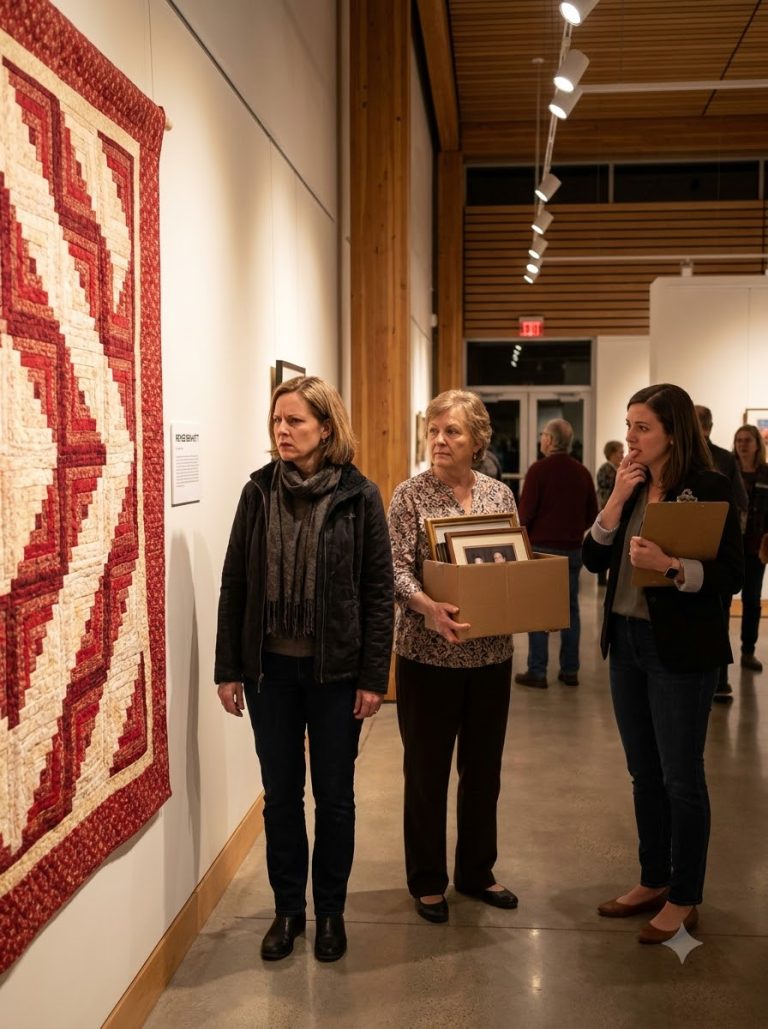
I thought of my job. At the museum, members sometimes asked questions our curators could not answer: Who owned this chair before 1912? Why was this portrait cut down? Was the crack in this vase accidental or deliberate? A bad guide invented certainty. A good one said what was known and left the blank visible.
People were not collections, but I understood the temptation.
“You hate not knowing,” I said.
“Everybody hates not knowing.”
“Not enough to make knowing your job.”
She stared at me.
“Is this your new personality now?”
“No. My new personality still loses sunglasses on top of her head.”
She almost smiled.
Then Renee came through carrying two grocery bags of leftovers.
“Anyone want the hummus?” she asked.
Lydia started to answer for Anita, caught herself, and looked toward the deck.
“Ask Anita.”
Renee said, “I will.”
Again, it was tiny.
The tiny pause told me she was trying.
I watched Lydia watch her walk away.
“What am I supposed to do with myself?” she asked, so softly I almost pretended not to hear.
I looked at her.
“Be here.”
“That’s not very useful.”
“No.”
For a woman who had built her worth around usefulness, it may have been the hardest answer I could have given.