At My Mother’s Quilt Exhibit, I Found My Own Work Credited to My Sister—Then the Library Showed Me What She Had Submitted

The first quilt I found under my sister’s name still had my pencil marks on the back.
I knew that before I turned it over.
The quilt hung from a temporary display rail in the Riverside Public Library’s second-floor gallery, twelve feet of red and cream cotton stretched under warm track lights. I had made it in 2008 from blocks my mother found in a cedar chest after my grandmother died. I remembered every argument inside it: the red that bled in the wash, the corner I unpicked twice, the narrow border Mom thought looked cheap until the final binding went on.
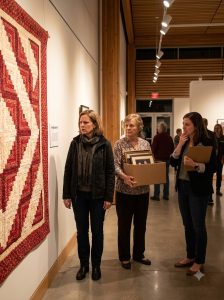
I also remembered the small graphite C I had placed inside the upper-left seam allowance because I used to mark my starting corner before machine quilting.
The wall label read:
LAKE ROAD LOG CABIN, 2008
Cotton, machine pieced and quilted
Joan Bennett with Renee Bennett Cole
From the Bennett Family Textile Collection
I read it once.
Then I read it again because apparently I believed libraries corrected themselves if given sufficient eye contact.
“Carla?”
I turned.
Leah Dawson, the library’s arts coordinator, stood near the doorway holding a clipboard and a roll of blue painter’s tape. She was about forty, with silver hoops in both ears and the practical shoes of a woman who had spent the morning climbing a ladder no one had officially authorized her to climb.
“You made it,” she said. “Renee said you might not get here until six.”
“It is five-twenty.”
“I know. We are still labeling.”
“I can see that.”
Something in my voice made her look toward the quilt.
Then at me.
“What?” she asked.
I pointed to the label.
“Why is my sister’s name on that?”
Leah’s expression changed from welcome to caution.
“I thought—”
She stopped.
“Thought what?”
“That the family attribution had been approved.”
“By whom?”
“Renee is the exhibit liaison.”
Of course she was.
The exhibition was called THREADS OF HOME: JOAN BENNETT AND THE FAMILY QUILTS. It was supposed to honor my mother’s sixty years of sewing, mending, piecing, teaching, and keeping scraps that any reasonable household would have thrown away. Mom was seventy-eight and had never sold a quilt in her life. She had made wedding quilts, baby quilts, church raffle quilts, bed quilts, wall hangings, and one spectacularly ugly Christmas tree skirt that all three of us privately hated and publicly treated as sacred.
When Riverside Library asked to mount a three-month community exhibit, Renee took charge.
Renee always took charge when the task involved forms, phone calls, refreshments, name tags, or telling other people what time to arrive.
I had not minded.
I lived ninety minutes away. I ran a small upholstery shop. September and October were my busiest months because apparently every household in the region discovered dining chairs just before Thanksgiving. Renee lived six streets from Mom and knew the library staff from the friends group.
So when she said, I’ll handle the exhibit paperwork, you just send me photos of anything Mom gave you, I had said fine.
Fine was not the same as anonymous.
“Leah,” I said, “I made that quilt.”
Her eyes flicked back to the label.
“Your mother contributed the blocks, right?”
“My mother found the blocks. My grandmother pieced most of them in the nineteen-seventies. I repaired them, designed the layout, added four replacement blocks, set the top, quilted it, and bound it.”
Leah lowered the clipboard.
“What did Renee do?”
“She drove it to Mom’s house after I finished it.”
Leah closed her eyes briefly.
“That is not what the inventory says.”
“What does the inventory say?”
Before she could answer, Renee came through the far gallery door carrying a box of framed photographs.
My sister was fifty-seven, four years older than me, with our mother’s strong shoulders and the same habit of walking into a room as if she had been sent to fix its temperature.
“There you are,” she said. “I thought you were coming later.”
I looked at the wall label.
“So did everyone else, apparently.”
Renee stopped.
Leah said, “We have an attribution question.”
“No, we have an attribution answer,” I said. “The label is wrong.”
Renee set the box on a bench.
“Carla, can we not start like this?”
“Like what?”
“You walked in four minutes ago.”
“And found my work under your name in three.”
“It is not under my name.”
I pointed.
She looked at the label as though she had never seen written language before.
“It says Mom with me.”
“Yes.”
“It is a family quilt.”
“That is not the same as you making it.”
Renee exhaled through her nose.
Leah shifted her clipboard against her hip.
“I am going to give you both a minute.”
“No,” I said.
She paused.
“I need you here because I want to know what the library was told.”
Renee’s mouth tightened.
“Carla.”
“Did you tell them you made this quilt with Mom?”
“I told them these pieces came out of family work.”
“That is not my question.”
Leah looked uncomfortable, which was fair. Nobody took an arts-coordinator job because they dreamed of mediating sisters beside a log-cabin quilt.
She opened her clipboard.
“The submitted inventory lists Joan Bennett as primary maker and Renee Cole as family collaborator and co-maker on this piece.”
I looked at Renee.
“Why?”
“Because I helped Mom with the collection.”
“You helped with the collection. You did not help make this.”
“I did not fill out every line myself.”
“Who did?”
“I do not remember.”
“Renee.”
She gave me the look she had perfected at twelve, the one that suggested my insistence on facts was an embarrassing hobby.
“Can we wait until Mom gets here?” she asked.
“No.”
“Why?”
“Because this has nothing to do with making Mom choose between us.”
Her face changed.
“That is exactly what you are doing.”
I felt the old trap open under the conversation.
If I corrected a family story, I was making Mom choose.
If Renee told the family story incorrectly, she was keeping everyone together.
I had been gone too long, lived too far away, worked too much, missed enough Wednesday lunches and random Tuesday errands that correcting the record could always be reframed as arriving late and demanding control.
I walked to the quilt.
“Leah, can it come down for a minute?”
“Yes.”
Renee frowned. “Why?”
“Because I want to show you something.”
Leah brought over a short rolling ladder. I steadied it while she unclipped the quilt from the display rail and lowered it onto the large worktable.
I folded back the upper-left corner.
Inside the binding, just visible where the backing rolled around the edge, was a graphite C.
It had faded to gray.
I touched it with one finger.
“I marked every quilt I machine-quilted this way until about 2012,” I said. “It told me where I started so I could manage thread tension when I came back around.”
Leah leaned closer.
Renee did not.
“That proves you quilted it,” she said.
“Yes.”
“It does not mean Mom did nothing.”
“I never said Mom did nothing.”
“You always do this.”
“Do what?”
“Turn family things into individual ownership.”
I stared at her.
“We are standing beside a museum-style label with your individual name on it.”
“It is a library, not a museum.”
Leah said, very quietly, “Attribution standards still apply.”
Renee looked at her.
Leah’s cheeks flushed, but she continued.
“If the label identifies makers, we should identify makers accurately. We can use ‘Bennett family tradition’ in contextual text, but co-maker has a specific meaning.”
“Fine,” Renee said. “Add Carla.”
I laughed once.
“Add me?”
“Yes.”
“Take you off.”
Her face hardened.
“There it is.”
“What?”
“You do not want credit. You want me to lose it.”
I felt my pulse in my throat.
“I want the label to describe who made the quilt.”
“You think making means only sitting at a machine.”
“No. I think making includes design, cutting, piecing, quilting, binding, repair, pattern decisions, color decisions, finishing. Which of those did you do on this quilt?”
Renee folded her arms.
“I was there when Mom sorted the blocks.”
“So was I.”
“I helped her decide what to keep.”
“Did you work on the quilt?”
“Not physically.”
“Then why does it say co-maker?”
She did not answer.
Leah looked down at the clipboard.
“There is another issue.”
Renee said quickly, “Leah.”
I turned.
“What issue?”
Leah hesitated.
Then she looked at Renee.
“I need to tell her.”
Renee’s jaw tightened.
Leah pulled one sheet from the back of the clipboard.
“The exhibit application says Carla Bennett requested that her contributions be included under general family attribution rather than individual credit.”
The room seemed to contract around that sentence.
I looked at Renee.
“I requested what?”
“It was shorthand.”
“For what?”
“You told me you did not care about being centered.”
“I told you the exhibit should be about Mom.”
“Exactly.”
“No. Not exactly.”
Renee spread one hand.
“This is what I mean. You said, ‘Do not turn it into a thing about who did what. Mom will hate that.’”
I remembered the conversation.
It had happened in June while I was stapling new webbing to a sofa frame with the phone pinned between my shoulder and ear.
Renee had been arguing about whether the exhibit should identify each family member who had worked on inherited pieces.
I had said, Do not make Mom stand in the middle while everybody claims a corner. Credit the actual makers when you know them and call the rest family pieces.
That was not a request to erase me.
“You changed my sentence,” I said.
“I interpreted it.”
“You improved it into something I never said.”
“Oh, please.”
Leah said, “We can correct the application record.”
Renee turned on her. “There is no reason to create an official correction over family wording.”
“There is if the wording affected attribution.”
I looked at Leah.
“How many pieces list Renee as co-maker?”
She checked the inventory.
“Seven.”
Renee said, “Some of those I did work on.”
“I am sure some are accurate.”
“You sound very sure.”
“I am willing to check.”
That shut her up for half a second.
I was not there to replace one lazy family story with another.
Renee had sewn. She was good at hand binding. She had helped Mom finish charity quilts for years. She had embroidered labels. She had repaired old tops. If her hands were in a quilt, I was not going to pretend otherwise because I was angry.
Accuracy had to cut both ways or it was just revenge with office supplies.
“When does the exhibit open?” I asked Leah.
“Saturday at ten.”
Three days.
“And tonight?”
“Private family preview. Six-thirty.”
I looked at the clock.
Five-forty-one.
Mom would arrive in less than an hour.
Renee saw me calculate.
“Can we please not ruin this for her?” she asked.
There was the second trap.
Correcting the label was ruining the exhibit.
The wrong label was apparently weather.
I folded the corner of the quilt back into place.
“I am not going to confront Mom in the gallery,” I said.
Renee’s shoulders lowered slightly.
“I am going to check every disputed attribution.”
They rose again.
“Tonight?”
“I can start tonight.”
“Carla, you do not even live here.”
“I live ninety minutes away, not on another continent.”
“You know what I mean.”
I did.
I had left Bellweather County at twenty-five. First for a job in a furniture workroom, then for marriage, then for my own shop after the marriage ended. Renee stayed. She raised two children ten minutes from Mom. She drove Mom to cataract surgery. She knew which grocery store carried Mom’s tea. She handled the cemetery flowers every Memorial Day even though nobody had assigned her the job.
Those things were real.
They were also not stitches in a quilt she had not made.
“I know exactly what you mean,” I said.
That was when our mother walked into the gallery wearing a blue cardigan and carrying a foil pan of lemon bars.
She saw the quilt on the table.
Then my face.
Then Renee’s.
“Oh, for heaven’s sake,” she said. “What happened already?”
* * *
Mom put the lemon bars down before anyone answered.
“What happened?” she repeated.
Renee spoke first.
“Carla has a problem with some of the labels.”
“I have a problem with one label I have seen and seven I have questions about.”
Mom closed her eyes.
There was no surprise in the gesture.
That bothered me.
“Mom,” I said, “did you see the Lake Road label?”
“Yes.”
“Did you think it was accurate?”
She picked at the edge of the foil pan.
“It was close enough for a library display.”
I felt something inside me go very still.
“Close enough how?”
“Your grandmother made the blocks. I kept them. You did the sewing. Renee helped with all this.”
“With the exhibit.”
“Yes.”
“Not the quilt.”
Mom looked at Renee.
Renee looked at the floor.
Leah moved toward the doorway.
“I can give you some privacy.”
“No,” Mom said.
Leah stopped.
My mother sighed.
“No. If we are going to have the family argument in the library, we may as well have one witness who can fix the labels afterward.”
That was so exactly Mom that I almost laughed.
I did not.
“Did you know the application said I asked not to be credited?” I asked.
“No.”
Renee said, “That is not what it says exactly.”
Leah read the sentence again.
Mom’s head turned slowly toward Renee.
“You wrote that?”
“It was an interpretation.”
“Of what?”
“Carla said she wanted the attention on you.”
Mom looked at me.
“Did you?”
“Yes. I also said credit actual makers.”
Mom pressed her lips together.
Renee said, “This is why I did not want to get into every hand that touched every piece.”
I pointed at the label.
“You got into it enough to put your hand there.”
“That is cheap.”
“No. It is visible.”
Mom sat on the bench.
At seventy-eight, she moved more slowly than she used to, but she was not fragile. That distinction mattered in our family because Renee sometimes treated inconvenience as if it were emergency and I sometimes treated endurance as if it meant Mom needed nothing.
We were both wrong in different directions.
Mom looked at the quilt.
“Take Renee’s name off that one,” she said.
Renee stared at her.
“Mom.”
“You did not make it.”
“I helped preserve the collection.”
“Then put that in the exhibit introduction. You did not make this quilt.”
The clean correction should have satisfied me.
Instead I watched Renee’s face close.
There was something hurt beneath the anger.
I recognized it because I had seen versions of it at Christmas, when relatives asked me about my upholstery business and asked Renee whether she was still helping with Mom.
Renee had a life. She worked part-time at a dental office. She had raised two capable sons. She chaired the church pantry committee. She could organize an event for two hundred people with a yellow legal pad and one extension cord.
But family conversations had compressed her into the daughter who stayed.
That did not give her my quilt.
It did make the motive less childish than wanting her name on a wall.
Leah said, “I can print a temporary correction tonight and replace the permanent label tomorrow.”
Mom nodded.
“Do that.”
Renee said nothing.
I asked Leah, “Can I see the other seven entries?”
She handed me the inventory.
The first was a blue star quilt from 1996.
Mom had pieced the top. Renee and I had both tied it at the church hall with six other women. Calling Renee co-maker was not insane, but calling only Renee co-maker was incomplete.
The second was a wedding quilt Mom made for my cousin Celeste. Renee had bound it by hand after Mom sprained her wrist. That credit belonged.
The third was mine.
The fourth was Mom’s, entirely.
The fifth was a scrap quilt all three of us had worked on one Thanksgiving because an ice storm trapped us in the house for two days.
By the seventh entry, my anger had become more precise.
Three labels were clearly wrong.
Two needed broader shared credit.
Two were defensible as written.
I told Leah exactly that.
Renee looked at me as if fairness were another form of aggression.
“You could have just said all seven were wrong,” she said.
“I could have. It would not be true.”
Mom’s mouth twitched.
Renee saw it.
“Do not,” she said.
Mom tried not to smile.
“Do not what?”
“Enjoy this.”
“I am not enjoying anything.”
“You are absolutely enjoying Carla sounding like Dad at tax time.”
That did make Mom laugh.
So I did too, unwillingly.
For fifteen seconds, the gallery felt like us again.
Then Leah flipped to the exhibit-application page.
“I need signatures on the corrected attribution list before Saturday.”
Renee said, “Fine.”
I said, “I will sign only for pieces I can identify.”
Renee threw up her hands.
“Of course.”
Mom looked at me.
“Carla.”
“What?”
“Do not turn this into work.”
“It already is work.”
“No. I mean your work face.”
I knew what she meant.
The face that had gotten me through twenty-seven years of matching fabric repeats, rebuilding chair decks, dealing with clients who insisted their dog had not caused the damage currently shaped like a dog.
Competence was useful when emotion became slippery.
Sometimes I used it to avoid admitting I was hurt.
“I am hurt,” I said.
The words surprised all three of us.
Mom’s expression softened.
Renee looked away.
I continued.
“I am not upset because I need a plaque. I am upset because somebody decided I would be easier to erase than to ask.”
Nobody answered.
Leah looked down at her clipboard.
Mom reached for my hand.
I let her take it.
Renee did not apologize.
Not then.
Instead she said, “You left all of this with us for years and now you are acting like the record belongs to you.”
My hand tightened in Mom’s.
“There it is,” I said.
“What?”
“The actual argument.”
Renee’s eyes flashed.
“You got to leave. You built a business. You had a whole life somewhere else. I stayed here and handled everything nobody photographs.”
Mom said, “Renee.”
“No. She wants honesty.”
I did.
I just did not enjoy the first delivery.
Renee continued.
“I found the quilts in closets. I aired them. I drove them here. I scanned photographs. I sat with Mom for six weekends while she tried to remember dates. I called cousins who do not answer their phones. I made this exhibit happen.”
“All of that deserves credit.”
“You say that now.”
“I have always said you handled the exhibit.”
“You say it like administrative work.”
“Because it is administrative work.”
Her face reddened.
I heard myself and stopped.
That had been unfair.
Organizing memory was not lesser work because it did not involve a sewing machine.
“I am sorry,” I said.
Renee blinked.
I repeated it.
“That was unfair. Curating this is real work. Researching dates is real work. Preserving Mom’s collection is real work.”
She watched me cautiously.
“But it is not the same work as making the quilts.”
Her mouth tightened again.
“No,” she said. “Apparently not.”
The distinction stood between us.
Not solved.
At least visible.
The family preview went on.
That was the strange part.
My aunt Darlene arrived at six-thirty with a camera and immediately cried over a green-and-gold quilt Mom had made when my cousin went to college. Renee’s older son brought his girlfriend. Two members of the library board came downstairs carrying paper cups of sparkling cider. Mom stood beside the opening panel while Leah explained how the exhibit moved from hand piecing to machine quilting across three generations.
Nobody knew that forty minutes earlier we had been arguing over who belonged on the wall.
Renee performed normal better than I did.
She introduced people, adjusted a crooked photo frame, and told my cousin where to find the quilt made from Grandpa’s work shirts.
I stayed near the edge of the room and took notes.
Not secret notes.
Work notes.
Piece title. Current attribution. Likely maker. Evidence available. Question.
By eight, I had a list of eleven items that needed checking, not seven.
Some because the labels were wrong.
Some because the labels were too vague.
One because the date was off by five years.
That last one was Mom’s fault.
“I did not make that in 1984,” she said when I asked.
“You wrote 1984 on the inventory.”
“I was thinking of the blue one.”
“You see what happens when we use records?”
Mom gave me a look.
“Do not become unbearable just because you are useful.”
Renee, standing six feet away, laughed despite herself.
It was the first time she had looked at me without armor all evening.
Then she remembered she was angry.
At nine, after the last guest left, Leah locked the gallery and handed us a printout of the revised inventory.
“I can have corrected labels ready tomorrow afternoon,” she said. “But I need agreement on the attributions.”
Renee said, “Carla has appointed herself attribution police, so I assume she will provide the indictment.”
Mom rubbed her forehead.
“Renee.”
“I am tired.”
“So am I.”
“So maybe we do not do this tonight.”
I agreed.
That surprised her.
“I have records at home and at the shop,” I said. “I would rather check than argue from memory.”
Renee picked up her purse.
“Fine.”
Mom said, “Carla, are you staying with me?”
“I can.”
Renee stopped halfway to the door.
“I thought you had work tomorrow.”
“I can open the shop late.”
“Must be nice.”
There it was again.
Not the quilt.
The old accounting of proximity.
I put my notebook into my bag.
“I own the shop. It is one of the few advantages of also owning every problem in it.”
Renee looked ready to answer.
Mom said, “Go home.”
Renee turned.
“Excuse me?”
“I mean both of you. I am going home. Carla can sleep at my house. Renee, you can go to yours. Tomorrow we will all be less ridiculous.”
“Speak for yourself,” I said.
Mom pointed at me.
“Especially you.”
* * *
Mom’s house smelled like lemon furniture polish and the lavender sachets she put in drawers because my grandmother had done the same.
I slept in my old bedroom, though almost nothing in it was mine anymore.
The posters were gone. The twin bed had become a full. Renee’s younger son had used the room during college summers, and there was still a faded university pennant on one wall.
At six-thirty the next morning, I found Mom at the kitchen table with coffee and the exhibit inventory.
“You could sleep later,” I said.
“So could you.”
I poured coffee.
For a while we sat without speaking.
Then I asked, “Why weren’t you surprised by the label?”
Mom’s fingers stopped around the mug.
She did not ask which label.
That answered part of it.
“Mom.”
“I saw a draft.”
“When?”
“A couple of weeks ago.”
“Whose?”
“Renee brought the labels over because she wanted me to check dates.”
“And you saw her name on Lake Road?”
“Yes.”
“Did you tell her it was wrong?”
“I said you did most of the work.”
“Most?”
“She said she was using family collaboration language.”
I stared at her.
“You knew I was being called a person who declined credit?”
“No. I told you I did not know that part.”
“But you knew some of the maker labels were wrong.”
Mom looked into her coffee.
“Yes.”
“Why didn’t you tell me?”
Her answer took too long.
I felt something in my chest begin to ache before she spoke.
“Because I wanted one nice thing,” she said.
I looked at her.
“One exhibit where the two of you did not turn every old piece of cloth into evidence from childhood.”
“That is not what I am doing.”
“I know.”
“Do you?”
She winced.
I hated that I had caused it.
I also did not take the question back.
Mom folded the inventory page in half, then unfolded it.
“Renee has been working on this for months.”
“I know.”
“She has been here every week.”
“I know.”
“She is proud of it.”
“I know.”
“And you…”
She stopped.
“And I what?”
Mom’s eyes met mine.
“You handle being overlooked better than Renee handles being corrected.”
The sentence was quiet.
It still landed like a slammed door.
I sat back.
Mom reached toward me.
I moved my hand before she could touch it.
Not dramatically.
Just enough.
Her face changed.
“Carla.”
“No. Let me understand.”
“That came out wrong.”
“I think it came out accurately.”
“I did not mean you should be overlooked.”
“You meant it was cheaper.”
“No.”
“Yes.”
I could hear my own voice getting sharper.
I lowered it.
“You thought if something was unfair to both daughters, choose the daughter who could carry it more quietly.”
Mom’s eyes filled.
“I was trying to keep peace.”
“Whose?”
She did not answer.
The kitchen clock ticked behind us.
I thought about every holiday when Mom had asked me to let something go because Renee was stressed. Every time Renee had been told not to push me because I was busy. We had both been assigned tolerances.
Renee was the one who stayed and shouldered things.
I was the one who left and could absorb things.
Those family identities had become excuses to ask each of us for the same performance forever.
“I do not want the exhibit ruined,” I said.
Mom wiped one eye.
“Neither do I.”
“I do not want Renee humiliated.”
“I know.”
“I also will not agree to false credit because I am supposedly good at surviving it.”
Mom nodded.
“I know.”
“No. You know now.”
She looked hurt.
The words were harsh.
They were also true.
I took a breath.
“I am not leaving.”
“I did not think you were.”
“I mean this conversation.”
Mom looked at me.
“I am angry. I am going to work. I will come back tonight. We are still going to the opening Saturday if there is an opening to go to.”
Her mouth trembled.
“Okay.”
I stood.
Then I leaned down and kissed her forehead.
The gesture did not forgive anything.
That was why it mattered.
* * *
My shop sat in a converted service garage behind a row of small brick storefronts. The front room held fabric books, two client chairs waiting for pickup, and a long cutting table permanently scarred by thirty years of blades and staples.
I unlocked at nine-fifteen.
My assistant, Dani, looked at the clock theatrically.
“Should I call someone?”
“I was gone one morning.”
“You are forty-five minutes late.”
“I own the building.”
“You rent the building.”
“Then I own nothing and would like compassion.”
She handed me a coffee.
“Best I can do.”
Dani was thirty-one and had worked with me for four years. She knew enough about my family to understand that when I said library exhibit in a particular tone, furniture was not the problem.
I pulled two plastic storage boxes from the office closet.
Inside were my old work notebooks.
I started keeping them when I was twenty-eight because custom upholstery clients had a supernatural ability to forget what fabric they had chosen while holding the swatch they had chosen it from.
The notebooks grew into everything.
Chair measurements.
Fabric yardage.
Foam densities.
Quilt layouts.
Machine settings.
Odd little diagrams.
Names and dates.
Not because I expected anyone to need proof.
Because I liked knowing where a thing came from.
I found 2008 in the third box.
Lake Road Log Cabin occupied four pages.
Mom’s blocks: 31 usable.
Carla replacement blocks: 4.
Red wash test failed—prewash all new solid.
Layout 5 x 7, narrow cream border.
Quilted on Bernina, walking foot, diagonal grid.
Bound Sept 14.
Delivered Mom Sept 20.
On the next page I had taped a tiny red fabric triangle beside the note NEVER BUY THIS DYE LOT AGAIN.
I laughed.
Dani leaned over the cutting table.
“That looks incriminating.”
“The fabric committed crimes.”
I photographed the relevant pages.
Then I opened an old hard drive with project photos.
There I was in 2008, thirty-five years old, hair pulled through the back of a baseball cap, standing beside the half-quilted Lake Road top on the machine.
There was Mom beside the finished quilt on her porch.
There was no Renee because Renee had not been part of making it.
For the other disputed pieces, the records were less clean.
That was fine.
I did not need clean.
I needed honest.
One photo showed Renee sitting on Mom’s sofa sewing binding onto Celeste’s wedding quilt.
I added it to the attribution packet in Renee’s favor.
Another showed all three of us around the Thanksgiving scrap quilt.
I wrote: shared construction, details uncertain; credit all three or use Bennett family collaborative piece.
A 2014 wall hanging had no useful notebook entry at all.
I called Mom.
“Who made the appliqué birds?”
“Which birds?”
“The orange ones on the brown wall quilt.”
“Oh. Your aunt Darlene.”
“Aunt Darlene?”
“I think.”
“That is not confidence.”
“She cut them. I sewed them.”
“Did Renee work on it?”
“She picked the brown fabric.”
I wrote: Joan Bennett; appliqué shapes cut by Darlene Pierce; fabric selection assisted by Renee Cole if contextual credit desired.
Mom said, “You are enjoying this now.”
“A little.”
“Your father would be terrified.”
“He kept receipts in shoeboxes.”
“He believed a shoebox was a filing system.”
“It was. Just a bad one.”
For three minutes, we were ordinary again.
Then Mom said, “I am sorry about this morning.”
I stopped typing.
“I know.”
“I meant what I said, though.”
“That is not usually the second half of an apology.”
“I mean you do handle things better.”
“Mom.”
“No. Let me finish. I have used that as permission to ask more of you emotionally because I ask more of Renee practically.”
I sat down.
“That is complicated.”
“I am seventy-eight. I have had time to become complicated.”
I smiled despite myself.
She continued.
“I should have corrected the labels when I saw them.”
“Yes.”
“I should not have decided your hurt was safer than her anger.”
My throat tightened.
“Thank you.”
“I still want my opening.”
There she was.
I laughed.
“We will try.”
* * *
By Thursday afternoon, Leah had corrected eight labels, rewritten two, and removed one piece from the exhibit because none of us could establish who had finished it after my grandmother’s death.
She did not seem annoyed by the work.
She seemed energized by it.
“This is better,” she said, standing beside the revised opening panel.
Renee, who had arrived ten minutes earlier and had spoken to me only when necessary, said, “It is longer.”
“Longer can be better.”
“Not on wall text.”
Leah smiled. “That is why I cut your second paragraph.”
Renee almost smiled back.
The revised exhibit introduction did something I had not expected.
It gave Renee more credit.
Not as maker of quilts she did not make.
As curator.
The panel read:
This exhibition was developed from Joan Bennett’s family textile collection through oral-history interviews and archival research coordinated by Renee Bennett Cole, with object histories and maker attributions contributed by Joan Bennett, Carla Bennett, extended family members, and the Riverside community.
Renee read it twice.
“That sounds like a real job,” she said.
“It is a real job,” Leah answered.
I looked at my sister.
She looked away.
For one second I thought that might be enough.
Not to fix us.
To give the exhibit a truthful structure that did not require one kind of work to impersonate another.
We went through the disputed pieces together.
Lake Road: Grandmother’s blocks, repaired/designed/finished by me, with history from Mom.
Celeste’s wedding quilt: Mom primary maker, hand binding by Renee.
Thanksgiving scrap quilt: Joan, Renee, Carla collaborative.
A blue baby quilt: Mom pieced, I machine quilted, Renee embroidered the name panel.
Two entirely Mom pieces.
One Renee had repaired and rebound in 2019, credited clearly as conservation work rather than original making.
The more precise the labels became, the less petty the argument looked.
Accuracy expanded everybody instead of shrinking them.
At five, Leah printed the final set.
Renee stood beside the printer while labels emerged one by one.
“I still think most people do not care,” she said.
“Probably not,” I replied.
Her expression sharpened.
“Then why did we spend two days on this?”
“Because the people named on the wall care.”
“That is not always a good reason.”
“No.”
I meant it.
Family could become unbearable if every contribution required a ledger.
But a public exhibit was already a ledger.
Once we chose to put names under objects, the names had to mean something.
Leah taped a temporary label to a board.
“Are we agreed?”
Mom said yes.
I said yes.
Renee waited.
Then she said, “Yes.”
False peace arrived quietly.
No hug.
No apology.
Just agreement.
For the first time since Tuesday, I believed we might make it to Saturday with the exhibit intact.
Mom celebrated by announcing she wanted Chinese food.
We ate in her kitchen from white cartons with the corrected inventory stacked at the far end of the table.
Renee and I spoke about safe subjects.
Her son’s new job.
A client of mine who wanted six dining chairs upholstered in white boucle despite owning three grandchildren and a black Labrador.
Mom’s refusal to replace a toaster that had to be held down with a spoon.
At one point Renee reached for the orange chicken at the same time I did.
We both pulled back.
Then we laughed.
Mom looked between us and smiled too hopefully.
Neither of us corrected her.
It was only dinner.
That was enough.
* * *
Friday morning, Leah called me at eight-twelve.
I was stripping old fabric from a wingback chair.
“Can you talk?” she asked.
“I can stop making noise.”
I set down the staple remover.
“What happened?”
“I found another attribution issue.”
My stomach tightened.
“With the exhibit?”
“Related to it.”
“What does that mean?”
Leah hesitated.
“There is a regional arts fellowship program through the Merritt Arts Trust. The library provided Renee with a community-partner support letter in July.”
I had heard of Merritt. They funded teaching artists, local-history projects, traditional arts apprenticeships, things like that. Private money. Competitive. Respectable.
“What does that have to do with me?”
“I had to update our project file yesterday because of the corrected exhibit credits. Renee emailed me a copy of her fellowship narrative when she asked for the library letter. I opened it to make sure our support language still matched the exhibit.”
I sat down on the edge of a worktable.
“And?”
“She used photographs of several quilts.”
“That is not automatically a problem.”
“I know.”
“What does she say about them?”
Another pause.
“Carla, I do not want to read someone else’s application to you without context.”
“Then do not.”
“I can tell you what the library has to decide. Our support letter says Renee curated a family textile exhibit and is developing community workshops around documenting inherited textiles. Her application narrative describes her as a co-maker and tradition bearer on several objects that we have now corrected as your work or your mother’s work.”
The staple remover lay on the table beside me.
I stared at it.
“How many?”
“At least four that I recognize.”
“Is Lake Road one?”
“Yes.”
I closed my eyes.
The exhibit labels had not been the entire problem.
They were public evidence for another story.
“Why does the library have the application?”
“She sent it voluntarily with her request for a support letter. I am not accessing anything private from Merritt.”
“Good.”
“I have not contacted Merritt.”
“Also good.”
“I need to talk to Renee before the library leaves its support letter in place.”
I opened my eyes.
“When is the fellowship deadline?”
“Application was submitted in August. Decisions are not until November.”
No artificial emergency.
No midnight deadline.
Just a record that had time to be corrected.
“Does Mom know?”
“I do not know.”
“Does the application say I declined credit?”
“I have not seen that sentence in the fellowship narrative.”
“Then do not assume the two records match.”
Leah sighed softly.
“You are calmer than I am.”
“I have had forty-eight hours of practice.”
“There is one more thing.”
I waited.
“The image files Renee sent with the application are high-resolution photos. Some are the same ones in the library archive. The file names include your shop initials.”
I felt a small click inside my memory.
February.
Renee calling while I was at the fabric warehouse.
Do you still have good photos of the red log cabin? Mom’s are blurry.
April.
Can you send the blue star without the little Carla Bennett Upholstery watermark? The library wants clean image files.
Except in April the library had not formally invited us yet.
I stood.
“Leah, when did Riverside first contact Renee about the exhibit?”
“Late April. I emailed her April twenty-ninth.”
My hand went cold around the phone.
“When did she ask you for the high-resolution image files for library use?”
“I would have to check.”
“Do not check for me. I have the messages.”
I opened my phone archive.
The first request was February sixth.
Almost three months before the library invitation.
Renee had said she was “getting Mom’s archive organized.”
The second was March eleventh.
Send anything that shows process, especially you working on old family pieces. I want a better record of how we kept the tradition going.
At the time, I had liked the phrase.
How we kept the tradition going.
I had sent nine photographs.
In May, after the library proposal began, Renee wrote:
I’m using “family work” where the pieces crossed generations. Easier than litigating every stitch.
I had replied with a thumbs-up because I thought she meant inherited quilts with uncertain histories.
Earlier events shifted under my feet.
The photo requests were not created by the library exhibit.
The language about “family work” had not begun as a practical labeling choice.
Renee had been assembling a professional story before Riverside offered her a wall to put it on.
The exhibit had made that story visible.
The false maker credits had made it stronger.
And my supposed desire to remain uncredited had made my absence convenient.
I sat back down.
“Carla?” Leah said.
“I’m here.”
“Are you okay?”
“No.”
“I am sorry.”
“Thank you.”
I scrolled through the messages again.
Not proof of every motive.
But timing.
Words.
Requests.
A sequence.
“Do you want me to send you the application?” Leah asked.
“No.”
She sounded surprised.
“If Renee wants me to see it, she can show me. You can address the library’s support letter based on the copy she gave you.”
“Okay.”
“I want a meeting tonight.”
“With Renee?”
“With Renee, Mom, you, and whoever at the library has authority over the exhibit credits and support letter. Not the whole board. Not a public confrontation.”
“I can have our assistant director there.”
“Six?”
“Six works.”
“Do not change the exhibit again before we talk unless a label is factually wrong on its own.”
“I won’t.”
When I ended the call, Dani was standing in the doorway holding a cushion form.
“Bad?” she asked.
“Different.”
“That is usually worse.”
I looked at the February message on my phone.
“She asked me for photographs before there was an exhibit.”
Dani waited.
I explained enough for her to understand.
Then she asked the question I had been avoiding.
“What do you want?”
I looked around my shop.
My name was on the door because clients needed to know whose work they were hiring.
It was on invoices because responsibility needed a destination.
It was on tiny cloth labels sewn under chair cushions not because I expected anyone to admire them, but because years later somebody might open the piece and want to know who had rebuilt it.
I had never thought of that as vanity.
It was provenance.
“What I wanted Tuesday was my name corrected,” I said.
“And now?”
“Now I want to know whether my missing name was useful to her.”
Dani nodded.
“That is different.”
“Yes.”
The answer frightened me more than the label had.
I called Mom before I called Renee.
Not because I needed permission.
Because I did not want my mother arriving at a meeting about her own exhibit without knowing what the meeting was about.
She listened while I explained the Merritt application and the February photo requests.
For a long moment she said nothing.
Then, “I knew about the fellowship.”
My stomach sank.
“How much did you know?”
“That Renee was applying. That it had something to do with teaching quilting and family history.”
“Did you read it?”
“No.”
“Did you know she used my quilts?”
“No.”
“Did you know she called herself co-maker?”
“No.”
I believed her.
Maybe because she answered too quickly to build a careful defense.
Maybe because I was learning the difference between limited knowledge and convenient innocence.
“Mom, tonight cannot be about protecting the opening.”
“I know.”
“I mean it.”
“I heard you.”
“If Renee used my work to support a fellowship claim, I need that corrected even if the exhibit gets smaller.”
Mom was quiet.
Then she said, “Do what is true.”
It was not a grand apology.
It was better.
At five-thirty, I closed the shop early and drove to Riverside.
Renee was already in the gallery when I arrived.
She stood near the Lake Road quilt with her arms crossed.
Leah and the library’s assistant director, Marisol Vega, sat at a rectangular table with two laptops and a folder of printed materials.
Mom sat beside them.
No one had brought food.
That was how I knew the meeting was serious.
Renee looked at me.
“You called a committee over my fellowship application.”
“Leah called me because the library’s support letter may rely on claims that no longer match the exhibit.”
“That is between me and the library.”
“The claims about my work are between you and me.”
Marisol raised one hand.
“Before this becomes four conversations at once, let me explain why I am here.”
She was sixty or close to it, with short gray hair and a voice so calm I wanted to borrow it.
“Renee asked Riverside for a support letter. She voluntarily provided her project narrative and image list so the library could describe our relationship accurately. We are not representing Merritt and we do not have access to any private review materials. We only have what Renee sent us.”
Renee said, “Which is a draft.”
Leah looked at her.
“The file you sent after submission says FINAL in the name.”
Renee’s face tightened.
Marisol continued.
“The library’s concern is narrow. If our support letter endorses an exhibit or teaching project based on inaccurate authorship claims, we need to correct or withdraw our own statement. Separately, this library exhibit needs accurate labels.”
I appreciated the separation.
No one was pretending the library could decide a fellowship.
Renee leaned back.
“So what do you want from me?”
Marisol said, “First, confirmation of which version you actually submitted. Second, clarification of the four images Leah identified.”
Renee opened her laptop.
“I can show you.”
She looked at me.
“Not because I owe you my whole application.”
“You do not.”
That seemed to surprise her.
She turned the laptop so the screen faced all of us.
The proposal title was KEEPING THE THREAD: FAMILY TEXTILE MEMORY AND COMMUNITY PRACTICE.
It was good.
That made me angrier in a more complicated way.
The project proposed a series of workshops where adults could bring inherited quilts, document oral histories, learn basic stabilization and repair, and create family records that distinguished known facts from family stories.
I almost laughed at the last phrase.
Known facts from family stories.
Renee saw my face.
“What?”
“Nothing yet.”
She scrolled.
Her biography was accurate.
Church pantry work. Friends of Riverside Library. Years of helping Mom maintain the family textile collection. Informal quilting instruction. Hand-binding and repair experience.
She had enough real work to stand on.
Then we reached the images.
Image One: Lake Road Log Cabin.
Caption: A multigenerational quilt reconstructed through the Bennett family tradition. I worked with my mother, Joan Bennett, to preserve inherited blocks and complete the quilt as part of our ongoing practice of restoring family textiles.
My chest tightened.
“You did not work with Mom to complete that quilt.”
Renee said, “I worked with Mom on the collection.”
“The caption says this quilt.”
“It says part of our practice.”
“It says you worked with her to complete it.”
“Carla—”
“No. Read the sentence without asking me to be generous.”
She stared at the screen.
Mom said, “Renee.”
My sister’s jaw worked.
“Fine. That one is too broad.”
Image Two was the blue baby quilt.
The caption described “our family’s collaborative method, combining my mother’s piecing, my sister’s machine quilting, and my embroidered name panels.”
That one was accurate.
I said so.
Renee looked at me sharply.
“You do not have to sound surprised,” I said.
Image Three was a quilt I owned called Orchard Steps, made in 2016 from fabrics Mom had collected but never used.
I had designed, pieced, quilted, and bound it.
Renee had photographed it for the family archive.
The caption called it “a contemporary Bennett family piece I helped develop and document.”
“Helped develop?” I asked.
“I helped select some of the family fabrics.”
“You sent me a photograph of a box.”
“The fabrics came from Mom.”
“Yes.”
“Which I organized.”
“That is not developing the quilt.”
Renee closed her eyes.
Marisol said, “What would be accurate?”
I answered, “Designed and made by Carla Bennett using fabrics from Joan Bennett’s family collection; photographed and archived by Renee Cole.”
Renee opened her eyes.
Marisol typed it.
Image Four was a photograph of Renee and Mom sorting quilt tops at the dining table.
Nothing about it was false.
The problem was the paragraph beneath the image list.
My work with my mother has evolved into a shared family practice through which I have helped maintain, complete, document, and interpret quilts across generations. The forthcoming Riverside exhibition demonstrates this continuity and my role as a community tradition bearer.
I read it twice.
Then I turned toward Renee.
“The exhibit was evidence.”
Her face went still.
“What?” Mom asked.
I pointed at the screen.
“She was not only using the fellowship application to describe the exhibit. She was using the exhibit to prove the application’s story about her role.”
Renee said, “That is what support materials do.”
“Not if the labels are wrong.”
“We fixed the labels.”
“After I walked in Tuesday.”
Her voice rose.
“Do you think I created an entire library exhibit so I could steal two quilts from you?”
“No.”
That stopped her.
I continued.
“I think you wanted the exhibit for Mom. I think you also wanted it for yourself. Both can be true.”
Renee stared at me.
I took out my phone.
“You asked for Lake Road photos in February.”
“I was organizing the archive.”
“Before Riverside contacted you.”
“I was already thinking about a project.”
“You asked me in March for process photos showing me working on old family pieces.”
“Yes.”
“You said you wanted a record of how ‘we kept the tradition going.’”
“Yes.”
“In May, you said you were using ‘family work’ where pieces crossed generations.”
“Because they do.”
“And in the exhibit application you wrote that I preferred not to receive individual credit.”
Renee’s eyes flicked toward Leah.
Leah did not look away.
I put the phone down.
“Those things made a structure. My labor could appear. My name did not have to.”
“That is not what I was doing.”
“Then tell me what you were doing.”
Silence.
Mom whispered, “Renee.”
My sister stood.
“I am not going to sit here while everybody builds a prosecution out of captions.”
“No one is prosecuting you,” Marisol said.
Renee laughed sharply.
“Of course not. You are just withdrawing institutional support while my sister explains which verbs I am allowed to use.”
Marisol’s face remained calm.
“We have not withdrawn anything yet.”
“Yet.”
Leah said, “Renee, the problem is fixable.”
“That is easy for you to say.”
“What would make it not fixable?” I asked.
She turned toward me.
“Because the application is supposed to show a body of work.”
“You have a body of work.”
“Not one anybody sees.”
The room changed.
There it was.
Not the defense.
The wound.
Renee sat again, but not carefully.
“You know what people ask me?” she said. “They ask how Mom is. They ask how the pantry is. They ask whether I am still helping at the library. They ask about my boys. Nobody asks what I make.”
I did not answer.
She continued.
“You left and became Carla Bennett Upholstery. You have a website. Clients. Photographs. People drive forty minutes because they want your hands on a chair.”
“That did not happen automatically.”
“I know.”
Her eyes filled.
“That is part of why I hate it.”
Mom made a small sound.
Renee looked at her.
“I stayed. I do not regret staying. But every thing I did became family work. Mom’s appointments. Dad’s papers after he died. Church things. Your kids when you needed a weekend. My own quilting. The archive. Everything got folded into being reliable.”
I felt my anger shift without disappearing.
There was cruel symmetry in it.
I had spent years resenting being treated as the competent person who could absorb more.
Renee had spent years resenting being treated as the nearby person whose work disappeared into family maintenance.
We had both responded to invisibility differently.
I had put my name on a shop.
She had put hers on quilts.
Understanding was not absolution.
But it changed what I needed from her.
“Why didn’t you apply with your actual work?” I asked.
“I did.”
“Then why use mine?”
“Because the fellowship is about tradition, not a portfolio of pretty objects. I needed to show continuity. Mom’s work. Mine. Yours. Grandma’s.”
“You could show continuity and name each person.”
“It becomes fragmented.”
“No. It becomes plural.”
She shook her head.
“That is easy for you because you already have an individual identity.”
I leaned back.
“Renee, I am not asking you to disappear so I can appear.”
“That is what it feels like.”
“I know.”
She looked at me.
I continued.
“That feeling does not make the labels true.”
Mom wiped both eyes with a tissue.
Marisol waited until the room settled.
“Here is what Riverside can do,” she said. “We can keep the exhibit open with the corrected attributions. We can revise our support letter to describe Renee’s curatorial and archival work accurately. We can also state that some maker credits were corrected during installation.”
Renee looked mortified.
“Do you have to say that?”
“If the letter describes the exhibit as evidence of attribution research, yes.”
“What about Merritt?”
“That is your application. You need to ask them what correction process is available if you decide your submitted captions or claims need amendment. I cannot tell you what they will do.”
I appreciated that too.
No magic phone call.
No instant verdict.
Renee looked at me.
“What do you want?”
This was the question.
Tuesday, I would have said my name on the labels.
Friday, that was no longer enough.
I opened my notebook.
“Three things. First, the exhibit uses the corrected maker attributions we agreed to yesterday. Second, the two quilts I personally loaned—Orchard Steps and Gray Morning—come out until you tell Merritt that the submitted images or captions are disputed or corrected.”
Mom looked startled.
“You want to pull them tomorrow?”
“They are mine to loan.”
Renee’s face hardened.
“That is punishment.”
“No. I do not want Riverside displaying my work as supporting material for a claim I have told you is inaccurate while the claim remains unaddressed.”
“That is a distinction only you would love.”
“It matters to me.”
Marisol asked, “And the third?”
I looked at Renee.
“You stop telling people I declined credit unless I actually decline it.”
Silence.
Renee looked at the two quilts on the far wall.
Orchard Steps was bright, almost obnoxiously so, all green and gold angles.
Gray Morning was the opposite—soft slate blocks made from old wool shirts, hand-quilted because I had been between upholstery commissions and temporarily convinced I enjoyed hand quilting.
Removing them would leave visible space in the exhibit.
The opening would still work.
It would be smaller.
Mom’s story would remain.
Renee’s curatorial work would remain.
My refusal would be visible only as absence.
That seemed appropriate.
Renee said, “If I email Merritt tonight, will you leave them?”
I thought about it.
“No.”
Her face changed.
“I am not bargaining for an email. The trust is not there tonight.”
“That is punitive.”
“It is a consequence.”
“Same thing.”
“No.”
I almost smiled at how much I sounded like every difficult client I had ever had.
Then I added, “If you correct the fellowship record, we can discuss lending them for the second half of the exhibit. Not tonight.”
Mom held my gaze.
I could see disappointment in her face.
I could also see her trying not to turn disappointment into pressure.
That was new.
“Okay,” she said.
Renee looked at her.
“You are fine with this?”
“No,” Mom said. “I am sad about it.”
Renee waited.
Mom continued.
“Sad is not the same as wrong.”
My throat tightened.
Renee looked down.
Leah asked me which two loan forms were mine.
I showed her.
She and Marisol began the unglamorous process of documenting the withdrawal and changing the floor plan.
Renee watched them.
Then she opened her laptop again.
“What are you doing?” Mom asked.
“Writing Merritt.”
Nobody moved.
Renee’s fingers hovered over the keys.
She looked at me.
“I am not admitting I stole your work.”
“I did not ask you to.”
“I am going to say that attribution on several example pieces changed during exhibit verification and that two image captions overstated my role in completing the quilts.”
“That is accurate.”
“I hate you a little.”
“I can live with that.”
She almost smiled.
Then she did not.
She wrote the email.
I did not read over her shoulder.
That mattered to me.
When she finished, she said, “Sent.”
Leah asked, “Do you want the library support letter revised tonight?”
Renee looked tired enough to be older than me.
“Yes.”
Marisol nodded.
“We can do that.”
I stood and walked toward Orchard Steps.
Leah came with me.
Together we lowered it from the rail.
For the second time that week, a quilt came down because a label had failed to tell the whole truth.
This time, taking it down was my choice.
* * *
Saturday morning, the exhibit opened with two empty spaces converted into something better than camouflage.
Leah moved a small display case into one and placed Mom’s first quilting frame photograph inside it. In the other, she hung a text panel about how family textile histories change as people compare memory, photographs, maker marks, and surviving records.
The last line read:
When an attribution is uncertain, uncertainty is part of the history.
I loved it.
Renee said it sounded like I wrote it.
Leah looked offended.
“I have my own annoying sentences.”
At ten, the gallery filled.
Mom wore a red jacket I had never seen before and complained that everybody was treating her like a historical object.
“You are the title of the exhibit,” I reminded her.
“That was their first mistake.”
A local newspaper photographer asked Mom to stand beside one of her 1972 quilts.
Mom refused until Renee stood on one side and I stood on the other.
For a second I considered declining.
Then I did it.
The photograph would not prove we were reconciled.
It would prove we had stood together for one-thirtieth of a second.
That was true.
Visitors read the labels.
Most did not care about our crisis.
They cared about fabric.
A woman in her sixties stood in front of Celeste’s wedding quilt for five minutes and then told Renee she had not realized hand binding could be credited separately.
Renee explained the technique beautifully.
She did not pretend she had pieced the quilt.
A teenage girl asked me why machine quilting counted as making if someone else pieced the top.
I showed her how the quilting lines changed the structure and surface.
Mom interrupted to explain that I used to make terrible corners.
“Thank you,” I said.
“History requires honesty.”
I stared at her.
She smiled.
At noon, Aunt Darlene discovered her name on the brown appliqué wall hanging and cried harder than she had at the preview.
“I only cut birds,” she said.
“You cut the birds,” Mom replied.
“They were bad birds.”
“They were excellent birds.”
“They look like potatoes.”
People laughed.
The exhibit became what it should have been.
Not a monument to one family genius.
A record of hands.
Some named.
Some uncertain.
Some shared.
At one-thirty, Renee’s phone buzzed.
I saw her read the screen.
Her face went pale, then settled.
I did not ask.
Ten minutes later, she found me near the display case.
“Merritt acknowledged the correction,” she said.
“What does that mean?”
“They said they can attach the clarification to the file, but because the project examples are part of the review, they gave me the option to submit a revised image list by next week or withdraw and apply in the next cycle.”
No punishment had arrived from the sky.
Just a process.
“What are you going to do?” I asked.
“I do not know.”
I nodded.
She looked irritated.
“You are not going to tell me what to do?”
“No.”
“That is unsettling.”
“I am trying something new.”
She looked at the gallery.
Then at Mom, who was cornering a city council member beside the Christmas tree skirt and insisting it was “important folk ugliness.”
Renee laughed.
“I think I am going to withdraw.”
I turned toward her.
“Why?”
“Because I can fix the captions in a week. I cannot fix why I chose those examples in a week.”
That was the first thing she had said that felt larger than compliance.
I did not reward it with forgiveness.
I said, “That makes sense.”
Her eyes filled.
“I really did want the fellowship.”
“I know.”
“I still do.”
“Then apply again with your work.”
She looked at me.
“My work is not enough.”
“You do not know that.”
“You sound very confident.”
“I am a small-business owner. Confidence is how we send invoices.”
She laughed unexpectedly.
Then she wiped her eyes.
“I am not apologizing in the middle of the gallery.”
“Please do not.”
“Later.”
I did not say I would be ready later.
I just nodded.
* * *
Renee withdrew the Merritt application Monday.
She sent me the confirmation because she wanted me to know, not because I had asked for proof.
I replied:
Received. Thank you.
She answered:
That is the coldest possible response.
I typed:
I can add an exclamation point.
She sent back:
Do not.
That was our relationship for a while.
Functional.
Dry.
Careful.
Mom hated it.
She was also learning not to fix it for us.
At Thanksgiving, Renee and I sat at opposite ends of the table and managed not to use cranberry sauce as a metaphor for betrayal.
In December, she called and asked if I still had photographs of three quilts she had actually made in her twenties.
I said yes.
Then I asked why.
“For my own archive,” she said.
“Personal or application?”
“Personal right now.”
“Do you want the files with my studio watermark or without?”
A pause.
“With. They are your photographs.”
I sent them.
That mattered more than I expected.
In January, Riverside hosted a workshop about documenting family textiles.
Renee taught it with Leah.
Her name on the flyer said:
RENEE COLE — FAMILY ARCHIVE COORDINATOR AND QUILT REPAIR VOLUNTEER
The title was less glamorous than tradition bearer.
It was also true.
She showed people how to photograph quilt fronts and backs, record dimensions, write down family stories without pretending stories were facts, and note known repairs separately from original making.
I attended from the back row.
She did not know I was coming.
When she saw me, she stopped speaking for half a beat.
Then she continued.
During questions, a man asked what to do if relatives disagreed about who made something.
Renee looked directly at me.
“Write down the disagreement,” she said. “Do not solve it by giving the loudest person the label.”
The room laughed.
I did not.
Not immediately.
Then I did.
Afterward, she found me near the coat rack.
“You came.”
“Yes.”
“Why?”
“Curiosity.”
“That is suspicious.”
“You did a good job.”
She looked down.
“Thank you.”
I waited.
She lifted her eyes.
“I am sorry.”
There it was at last.
Not public.
Not polished.
Not attached to a demand.
She continued.
“I was angry that the family saw you as the artist and me as the helper. So I started using language that made the line between our work blurrier than it was. At first I told myself it was about family tradition. Then I liked what the blur did for me.”
I felt the old hurt rise.
It did not own the room anymore.
Renee said, “I should have asked before I used your photographs. I should have credited the pieces accurately. And I should never have written that you did not want credit just because you did not want the exhibit centered on you.”
“Thank you.”
She swallowed.
“I do not expect you to trust me with this stuff right away.”
“I don’t.”
Her face tightened, but she nodded.
“Okay.”
I could have softened it.
I did not.
Then I said, “But I believe the apology.”
She looked at me.
That was all I had.
It was enough for that day.
* * *
The Riverside exhibit stayed up through February.
Orchard Steps and Gray Morning did not return.
That was my decision.
Mom asked once.
I said no.
She said, “All right,” and changed the subject.
That was her growth.
The empty spaces never looked empty after Leah’s history panel went up.
Visitors added handwritten notes to a nearby board about quilts in their own families.
My grandmother made the top; nobody knows who quilted it.
My father learned binding after my mother’s hands got stiff.
We always said Aunt Ruth made this, but now my cousin says it was her mother.
The uncertainty became part of the exhibit instead of a defect to hide.
Renee later told me those notes gave her an idea for a new fellowship application.
Not a claim to be the maker of a family tradition.
A documentation project about contested and shared authorship in ordinary family textiles.
“Are you using my quilts?” I asked.
“Only if I ask and you say yes.”
“What would the credit say?”
She pulled a draft from her bag.
Designed and made by Carla Bennett; family fabric collection maintained by Joan Bennett; photographed for archive by Renee Cole.
I read it.
“You put yourself last.”
“That is where I belong on that object.”
I looked at her.
“That sentence was almost healthy.”
“Do not get used to it.”
I agreed to let her use one photograph.
One.
With the exact caption attached.
The Merritt deadline was months away.
I did not know whether she would apply or whether she would receive anything.
That uncertainty no longer felt like a problem the story needed to solve.
In March, I started a new quilt.
I had not planned to.
A client brought in an old armchair upholstered in a brown floral fabric that could not be saved. Inside the cushion, tucked beneath decades of batting, I found a tiny scrap of feedsack cotton used as a repair patch.
The client did not want it.
I did.
The scrap reminded me of Mom’s boxes.
I went to her house the next Sunday and asked if she still had the bin labeled TOO SMALL TO USE.
She stared at me.
“If it is too small to use, why did I keep it?”
“Because labels can be wrong.”
Mom narrowed her eyes.
“Very funny.”
We carried the bin to the dining table.
Renee came over halfway through because Mom had invited her without telling either of us.
I considered leaving.
Then Renee walked in, saw the scraps, and said, “Oh no. We are not making another tree skirt.”
I stayed.
We sorted fabric for two hours.
Mom told stories.
Renee corrected three dates.
I corrected one.
Nobody claimed the pile.
At the end, I took home enough scraps for a small wall quilt.
I designed it at the shop.
No inherited blocks.
No collaborative sewing.
But the fabrics carried Mom’s decades of saving and Grandma’s old aprons and one ridiculous orange print Renee had used in a doll blanket when she was nine.
I called the quilt Provenance because Dani said Boundary Issues was too ugly for an exhibition label.
When I finished, I turned it over.
For years I had stopped using the little graphite C because I had begun sewing printed shop labels into commissioned work.
This time I used both.
Inside the upper-left binding, I wrote a small pencil C.
On the back, I stitched a cloth label.
PROVENANCE, 2026
Designed, pieced, quilted, and bound by Carla Bennett.
Made from fabrics preserved by Joan Bennett from family sewing across three generations.
Orange print contributed under protest by Renee Cole, who insists it was never that ugly.
I brought it to Mom’s house on her seventy-ninth birthday.
Renee was there early.
She read the back label first.
Her mouth twitched.
“Under protest?”
“You called the fabric a crime.”
“It is a crime.”
Mom took the quilt from us and held it against the wall.
“It needs hanging sleeves.”
“I know.”
“Are you going to put it in the library?”
“No.”
“Why not?”
“Because I made it for you.”
Mom looked pleased.
Renee traced one finger near the cloth label without touching the stitching.
“You put all of that on the back.”
“Yes.”
“Most people will never see it.”
“That is not the point.”
She nodded.
This time she understood.
Credit was not applause.
It was a map.
It told the next person where the work came from.
Mom hung Provenance in the small hallway outside her sewing room.
The front showed scraps crossing years and households with no obvious hierarchy.
The back held the distinctions.
Mine.
Mom’s.
Renee’s joke.
Grandma’s fabric.
Shared history without shared authorship pretending to be the same thing.
Later, while Mom cut birthday cake, Renee stood beside me in the hallway.
“Do you think we are okay?” she asked.
I looked at her.
A year earlier I might have answered for the relationship because uncertainty made me uncomfortable.
Now I knew better.
“I think we are working on it.”
She nodded.
“Annoyingly accurate.”
“I have a brand.”
She smiled.
Then Mom called from the kitchen that if we were going to have an emotional reconciliation, we needed to do it while carrying plates.
We went in.
On the wall behind us, the quilt hung without a museum label.
It did not need one.
The record was stitched into the back, waiting for anyone who someday cared enough to turn it over.