A Neighbor Thanked Me for Finally Approving Her Meal Train—But I Had Never Denied Her Help

PART 11
Andrea’s April coordinator month began with a red casserole carrier.
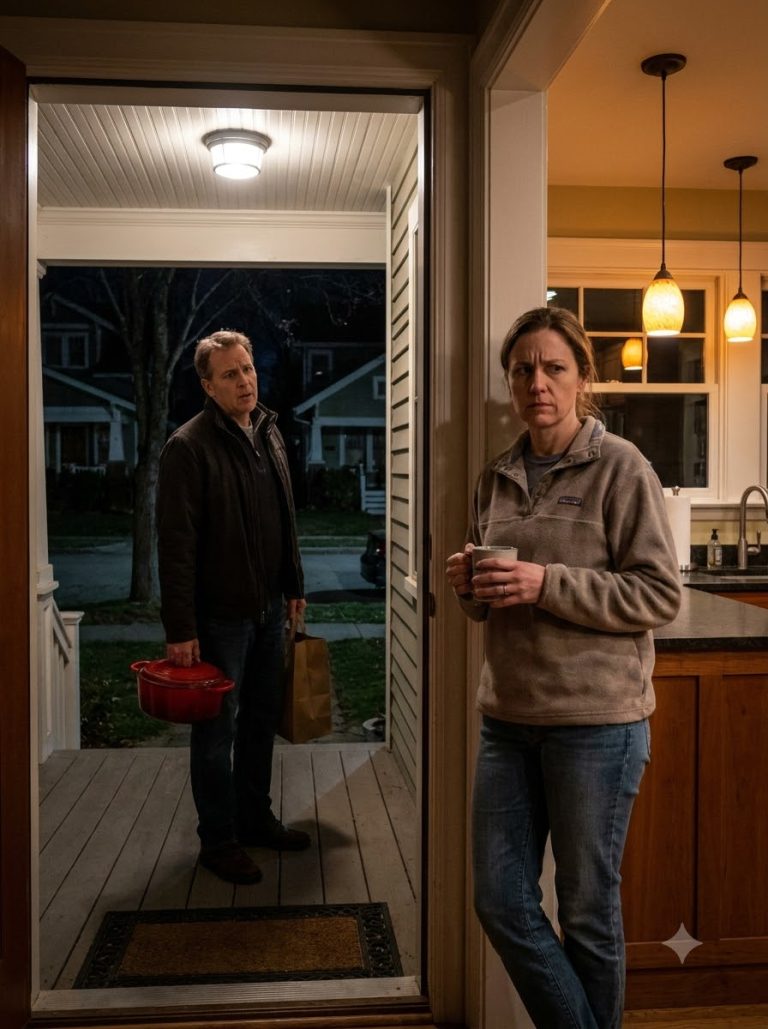
It was the same insulated carrier she had used at Marcy’s house in October. Andrea had owned it for years, but after that night she had started seeing it as evidence: the object she had carried into a conversation that changed everything.
On the first Tuesday in April, a request came from a man named Everett who had lived on Birchwood Circle for less than a month.
Meal help for three evenings.
No volunteer history.
No neighborhood history at all.
Andrea opened the clean intake sheet.
Name.
Request.
Dates.
Dietary notes.
Contact preference.
Capacity.
That was it.
For a second, habit made her wonder who Everett was, whether he knew anyone, whether he would ever volunteer.
Then she laughed at herself.
The sheet did not ask because the answer was irrelevant.
Two of the three dinner slots filled within an hour.
The third stayed open.
Andrea had promised herself she would not automatically rescue gaps during her coordinator month.
At five that afternoon, she opened the volunteer page.
The slot was still empty.
She looked at her own calendar.
No work deadline.
No family plan.
No other obligation.
She wanted to cook.
That was different.
Andrea clicked the slot.
Tuesday dinner — Andrea Mills.
No coordinator override.
No moral debt.
A choice.
She made chicken and rice, packed a green salad separately, and slid the dishes into the red carrier.
Before leaving, she printed the new request card the group had begun including with first deliveries.
What would help this week?
Meals.
Rides.
Errands.
A small task.
Something else.
At the bottom, one line:
Ask when you need help. Give when you can.
The same sentence as before, now supported by a process that meant it.
Andrea drove to Everett’s house.
He answered the door wearing paint-splattered jeans.
“You’re Andrea?” he asked.
“Yes.”
“Someone told me you run this.”
Andrea smiled.
“Not exactly.”
He looked confused.
“I’m the coordinator this month,” she said. “Next month someone else is.”
“That seems healthy.”
“You have no idea.”
He took the carrier.
“Do I bring this back?”
“When you’re done.”
“Anything else I’m supposed to do?”
Andrea knew what he meant.
The question might once have invited an invisible ledger.
“No,” she said. “Just eat dinner.”
Everett smiled.
“That I can manage.”
As Andrea walked back to her car, Brooke pulled up across the street with a grocery bag for another household.
They saw each other.
Brooke lifted one hand.
Andrea lifted hers.
No clipboard.
No private score.
No need to prove they had become perfect people.
They had only made the system smaller than their ambition and more honest than their fear.
Andrea put the empty passenger seat heater on because the night was colder than she expected.
The red casserole carrier would come back eventually.
Maybe Everett would volunteer someday.
Maybe he would not.
The meal had already been chosen.
That was enough.
Everett returned the carrier two days later.
He had washed it so thoroughly that the zipper smelled faintly of lemon soap. Inside was the printed request card Andrea had included with the meal. He had written one sentence on the back.
Thanks. New neighborhood. Rough week. Dinner helped.
Nothing about paying anyone back.
Andrea put the card in the recycling bin.
For a second she considered saving it as proof the new system worked. Then she laughed.
One grateful note did not prove a system either.
That had been part of the lesson too.
At the end of April, Luis sent the monthly numbers to the volunteer group. They were modest: fewer requests filled than the same month last year, fewer emergency coordinator pickups, more volunteers taking one or two tasks instead of a small group taking five or six.
Brooke replied first.
Looks sustainable. I hate it.
Andrea wrote:
High praise.
Marcy added a thumbs-up. Jo asked whether May could add two more ride slots because three new drivers had joined.
Andrea did not answer for the group.
May’s coordinator did.
Yes, two.
Andrea read the message and put down her phone.
The decision had happened without her.
She felt no loss of status.
Only relief.
A week later, Andrea walked past the community room on her way home from the pool and saw Brooke inside training two new coordinators. The door was open. A clean version of the spreadsheet was projected on the wall.
Andrea slowed without meaning to.
Brooke was explaining the capacity fields.
“Do not add a column just because you can measure something,” she said. “We learned that the annoying way.”
One of the new coordinators asked, “What if somebody keeps requesting and never volunteers?”
Brooke did not glance toward the doorway. She had not seen Andrea.
“You can notice it,” Brooke said. “You cannot invent a rule about it. If the group ever wants a reciprocity requirement, the group has to say so publicly. Until then, capacity is capacity.”
Andrea kept walking before she could turn the moment into a test Brooke had never agreed to take.
At home she found a message from her sister asking whether Andrea could build a spreadsheet for a family reunion.
Andrea stared at the request and started laughing.
Her sister called immediately.
“What?”
“Nothing.”
“You’re laughing at me.”
“I’m laughing at timing.”
“So will you build it?”
Andrea considered the weekend, the size of the family, and the familiar pleasure of making chaos line up in columns.
“Yes,” she said. “I’ll build the sheet.”
“Great.”
“I am not chasing RSVPs.”
“Fine.”
“I am not assigning beds.”
“Fine.”
“I am not becoming airport transportation command.”
Her sister sighed. “I was about to ask about that.”
“Ask someone else.”
“All right.”
Andrea smiled after they hung up.
The point was not to stop being useful. She liked being useful. She liked schedules, clean handoffs, and the moment a messy plan became workable.
The point was to stop treating usefulness as permission for other people to enlarge her role without asking.
That distinction had once seemed selfish.
Now it felt almost technical.
Define the scope.
Name the capacity.
Let the choice belong to the person making it.
She wrote those three lines on a sticky note and put it beside her work monitor. Not as a motto. Andrea distrusted mottos almost as much as files named Current. It was simply a reminder for the next time a useful favor started quietly turning into permanent jurisdiction. She could still say yes. She could still care. She could still build the sheet. She just did not have to become the rule.