Ninety Days After Her Husband’s Burial, They Gave Her a Choice That Wasn’t a Choice — She Asked One Question Instead

Now the council demanded Neca’s hand in her dead husband’s brother’s before sunset, calling it tradition and mercy. But Obiora had been strong as an iroko tree—iroko trees didn’t rot from within in seven days. As Chief Okereke raised his ceremonial staff to seal her fate, Neca asked the one question two hundred years of tradition had forbidden widows to ask—and the old man’s hand froze mid-air.
Neca did not sleep that night. She lay on the mat in the room that still smelled faintly of her husband — palm oil and river mud and the particular sweat of a man who worked the land from dawn until the light failed him — and let herself, for the first time since the burial, walk back through the seven days that had taken him.
Day one, he had come in from the riverbank complaining of a heaviness in his stomach.
“Too much sun,” he’d said, waving her off, “not enough pepper in the soup.”
Nothing more than any farmer complained of after a long season bent over yam mounds under a sun that showed no mercy. She made the soup anyway. He ate two bowls and laughed at her fussing, the way he always laughed at her fussing.
Day two, a fever that would not break, though the harmattan winds had not yet come and there was no sickness moving through the village that anyone had heard of. She pressed a wet cloth to his forehead through the night. Past midnight, his hand closed around her wrist — not weak, not yet, but urgent in a way fever alone shouldn’t have made him.
“Something is wrong inside me, Neca.”
“You’re imagining things.”
“I have never imagined anything in my life.”
She had wanted, so badly, for him to be wrong.
Day three, he could no longer hold his cup steady, and she fed him from a spoon like a child, telling herself it was only exhaustion working its way out of a strong man’s body the way fevers sometimes insisted on doing.
Day four, he asked her to bring him outside, to sit beneath the mango tree where he’d proposed to her eleven years before. She’d carried him there herself, his weight already frighteningly wrong against her shoulder, a man who should have been carrying her.
“Do you remember what I said to you here?”
“You said you’d build me a house with a red roof.”
“Did I build it?”
“You built it blue.”
He’d laughed — a real laugh, the first in three days — and for a moment she’d let herself believe the worst of it was over.
By day five, his skin had gone the color of old clay, his breath coming in small, careful sips, as though the air itself had grown too heavy to take in whole. She sent for the herbalist twice. Both times he shook his head, murmured about spirits, about old debts, about things no root or leaf of his could touch — and left without offering anything that might have saved him.
Okereke visited on day six.
She remembered him standing in the doorway, staff in hand, watching his brother’s son die with an expression she had mistaken, at the time, for grief. The stillness of it. The way he hadn’t moved to help or even to speak. Only watched — the way a man watches something he already knows the ending of.
She understood now she had never actually seen grief on that face.
Not once, in ninety days. Only patience.
By morning, she had made her decision. She would not wait for the council to reconvene on its own timeline, giving Okereke three more days to prepare his defense and remind the village which of them it had learned, over thirty years, to believe without question. She would go to Emecha first. Alone. Before his uncle had the chance to remind him where his loyalties were supposed to lie.
She found him at the edge of the family’s yam barn at first light, checking seedlings that did not need checking — the particular busywork of a man who wanted his hands occupied so his mind wouldn’t wander somewhere he was afraid to let it go.
“You know something.” Neca stopped a few feet from him, no greeting, no softness left in her voice for pleasantries. “I saw it on your face in the council house.”
Emecha’s hands stilled over the seedlings, dirt still caught under his fingernails from the morning’s work.
“I know that my uncle has hated your husband’s family for thirty years. I know that the land dispute between our grandfathers never healed the way people pretend it did.” He didn’t look up. “I did not know — I still do not know — whether that hatred became something more than hatred.”
“But you suspect it did.”
He was quiet long enough that the answer arrived before he said it.
“My uncle told me, the week before Obiora fell sick, that the land question would resolve itself soon. That I should be ready to accept my responsibilities to this family.” Emecha’s jaw tightened. “I thought he meant an old man was finally going to let an old grudge go. I did not think he meant this.”
Neca sat down on an overturned basket beside the yam barn. Tired. Not from one bad night — from ninety days of performing a grief that had never had room to ask a single real question.
“Mama Chidinma saw your stepmother buying ntu-ọkụ at the river market. Three weeks before Obiora fell sick.”
Emecha’s face went very still.
“Adaeze.”
“You don’t sound surprised.”
“I’m not surprised she’d do what my uncle asked.” Something bitter crossed his mouth. “Eleven years in that house, being told her place depends on his approval. If he told her to buy a root and never explain why, she’d have done it. No questions. The same way I’ve spent my whole life doing what he asks. No questions.”
“Until now.”
“Until you stood in that council house and asked the one thing none of us had the courage to ask in thirty years.”
Neca studied him. This young man handed to her like a consolation prize — a solution to a problem he’d never chosen. She remembered him at the burial, eyes fixed on the grave the whole ceremony. She’d read it as discomfort then.
Now she wondered if it had been guilt without a name yet.
“I’m not asking you to betray your family,” she said. “I’m asking you to tell me the truth about mine.”
“They’re the same family, Neca. That’s the whole trouble with this village.” He looked at her directly, finally. “But you’re right. There’s a difference between loyalty and silence. I’ve been calling the second thing by the first name for a long time.”
“How long have you suspected.”
The question cost him something.
“Since the sixth day. I came to see Obiora, and my uncle was already there. Standing over him the way you stand over a fire you set yourself, waiting to see how far it spreads.” His voice had gone quiet. Ashamed. “I told myself I was imagining it. That grief was making me suspicious of a man who’d only tried to hold this family together.”
“But you didn’t believe that.”
“It was easier to believe it than to believe what I actually saw on his face.”
“Then help me find proof. Not suspicion. Something that will stand in front of the council in three days.”
He looked toward his uncle’s compound — smoke rising from the cooking fire where Adaeze would already be preparing the evening meal, as though nothing had shifted at all.
“There’s a storehouse behind my uncle’s compound,” he said finally. “Old tools. Things no one’s touched in years. If he kept anything — a container, dried leaves, anything tying back to what Adaeze bought — that’s where a careful man would hide it. Somewhere no one thinks to look, because no one looks at what’s already forgotten.”
“When can we search it.”
“Tonight.” He met her eyes, and for the first time since she’d known him, nothing in his voice was uncertain. “Before he has three more days to decide he needs to move it.”
“And if we’re caught.”
“Then we’re caught.” He said it simply, the way a man says a thing he has already made peace with. “I would rather my uncle know exactly what I think of him than spend one more year letting him believe I’m still the boy who twists his agbada and says nothing.”
They went that night, when the cooking fires had burned to embers and the compound believed itself unwatched.
Emecha led her along the back wall, past the goat pen, to a low mud structure with a roof gone soft and gray with age. The door hung on a single hinge. It groaned when he pushed it open — loud enough that Neca’s whole body went rigid, waiting for a lamp to flare somewhere behind them.
None did.
Inside: dust, old yam seedlings, cobwebs strung between forgotten tools. A broken hoe. A cracked clay pot. Coils of rope gone brittle. The kind of room every compound had — a place where things went to be forgotten instead of thrown away.
“If it’s here,” Emecha said, barely more than breath, “it’ll be somewhere he thought no one would ever search.”
“How do you know your uncle so well.”
“Because I spent my whole life learning to read a room before he could get angry in it.” He didn’t look at her. “It kept me safe. It never once occurred to me it might be useful for something else.”
They searched by a single palm-oil lamp. Careful. Quiet. Neca’s heart beating loud enough in her own ears that she was sure it had to be audible outside.
A dog barked somewhere near the compound wall.
They froze. Both of them. Emecha’s hand found her arm in the dark, fingers tightening, the lamp trembling between them until the light nearly touched the thatch.
“Wait,” he breathed.
They waited. One heartbeat. Ten. The dog barked again, farther off this time, chasing something that wasn’t them, and the compound settled back into its careless sleep.
Neca let out a breath she hadn’t known she was holding.
“If someone finds us in here—”
“Then we tell them the truth.” Emecha’s voice was steadier than his hands. “That’s the only thing I have left to offer this family anyway.”
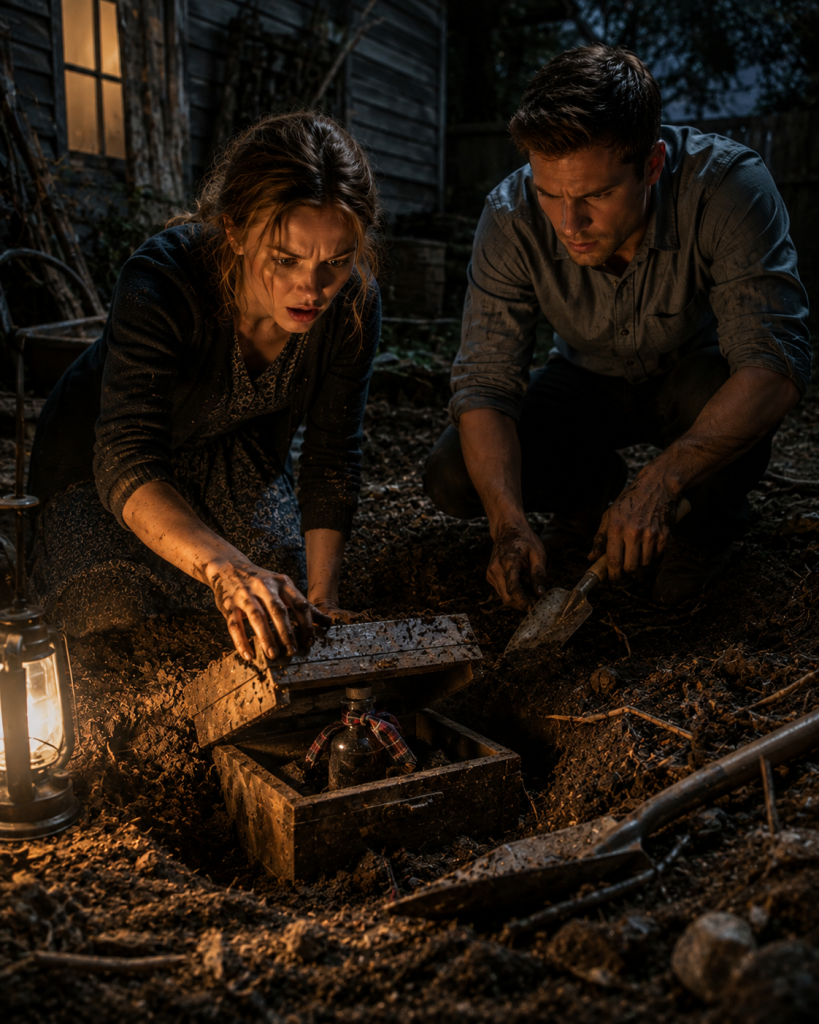
It was Emecha who found it — tucked behind a row of seedlings, in a corner no farmer would ever reach into. His fingers closed around something small and hard beneath a layer of undisturbed dust.
A clay vial. Stoppered with dried leaves. Half-empty of a dark, oily substance that caught the lamplight wrong.
Neca’s hand shook as she reached for it.
“Wait.” Emecha caught her wrist before she could lift it into the light. “Look at the cloth.”
Wrapped around the vial’s neck, holding the stopper in place, was a strip of woven cloth — red-and-black diamonds against deep indigo. The same pattern she’d watched cross Okereke’s shoulder three days ago in the council house.
Not Adaeze’s family pattern. Not market cloth. His own household’s weave.
Tied deliberately around the one thing that could undo him.
“He kept it.” The words barely left her mouth. “After everything he risked, he kept it.”
“Men like my uncle always keep something.” Emecha’s voice had gone hard. “They can’t quite believe anyone will ever be brave enough to look. Thirty years unquestioned does that. It makes a man careless in exactly the places he should be most afraid.”
They didn’t go to the council that night.
Neca understood, even in the heat of discovery, that a vial found in the dark by two people who wanted it to be true wouldn’t be enough. Okereke would call it a plant. Half the village — the half still comfortable inside two hundred years of not asking questions — would believe him.
“We could still take it to Nwabueze tonight,” Emecha said, turning the vial over once more in the lamplight before he wrapped it back in its cloth. “Let him decide what it’s worth.”
“And give your uncle three days of silence to explain it away before anyone else has even seen it?” Neca shook her head. “No. If this comes apart, I want it to come apart in front of the whole village, not in a private word between old men.”
She needed the truth to come from inside the household that had made it.
She found Adaeze the next morning at the river, alone, washing cloth at the water’s edge.
Neca sat beside her without asking permission.
“I found the vial.” No preamble. “Wrapped in your husband’s household cloth. Hidden in the storehouse.”
Adaeze’s hands went still in the water.
“I don’t know what you’re—”
“Mama Chidinma saw you buy the root. Three weeks before my husband fell sick.”
Neca kept her voice level. Ninety days of grief had left her no room for softness anymore.
“I’m not here to destroy you, Adaeze. I’m here because I buried a husband nine days after he was still strong enough to carry two baskets of yam alone. I want to understand what happened to him — before this village decides, again, that a woman’s silence is worth more than a man’s life.”
Adaeze’s shoulders began to shake. Silent, at first.
“He told me it was medicine.” Her voice had gone thin. “A tonic. For an old man’s pride, he said. To settle a debt of honor between brothers that had gone on too long.”
“And you believed that.”
“I didn’t ask what kind of debt requires a root that burns the blood.” She stared at the water. “I didn’t want to know. I haven’t wanted to know anything in that house for eleven years.”
“But you knew.”
“I knew enough not to ask.”
Her hands had gone still, the wet cloth forgotten between them.
“That’s its own kind of guilt, isn’t it. Knowing enough not to ask.”
Adaeze looked up at her then, for the first time, something raw moving behind her eyes.
“What will you do with what you know.”
“I don’t know yet.”
“If you take this to the council, they will destroy me. Not him. Me.” Her voice cracked down the middle. “You know that as well as I do. A chief’s wife who bought a root is a fool who should have known better. A chief who ordered it is still, somehow, only a chief doing what a chief must.”
Neca said nothing for a long moment, watching the river carry the current past both of them, indifferent to either woman’s fear.
“Then help me make sure it isn’t only your name in that room.”
Adaeze’s hands trembled once, and stilled.
“I have spent eleven years being the person no one in that house needed to explain anything to.” She said it quietly, almost to herself. “I don’t know how to be anything else.”
“You could start,” Neca said, “by telling the truth to one more person than you told it to yesterday.”
The three days before the council reconvened stretched long and strange. Market days. Cooking fires. Children chasing goats through the red dust. And underneath all of it, a much older machine quietly grinding to a halt.
Neca spent the time with Mama Chidinma, building the case the way the midwife had built diagnoses for forty years — patiently, from the smallest facts outward.
“You’ll get one chance to say this,” Mama Chidinma warned her, the second evening, the sky going orange and then grey above them. “Okereke has thirty years of authority in that room. You have ninety days of mourning and a clay vial. Make certain the second thing is heavier than the first.”
“It will be. If Adaeze speaks.”
“Will she?”
Neca thought of the woman at the river. Shoulders shaking. Eleven years of knowing enough not to ask.
“I don’t know,” she admitted. “But I think she’s tired of carrying it alone. A woman can only hold a weight like that for so long before she starts looking for somewhere to set it down. Even if setting it down costs her everything else.”
“That has always been true,” Mama Chidinma said, “of more women in this village than anyone with power here has ever cared to notice.”
“Say it again,” the old woman said. “The way you’ll say it in front of them.”
Neca stood. Straightened her spine the way she had in the council house three days ago, and spoke the words into the dark.
“I have proof it was not sickness.”
“Slower. Let them sit in it before you give them the next thing.”
“I have proof.” A pause, deliberate this time. “It was not sickness.”
Mama Chidinma nodded, once, the way a woman nods at work she’s satisfied with.
“Better. Now say it like you’re not asking permission to say it at all.”
On the third morning, Emecha came to her before dawn, sleepless, dust still on his sandals.
“My uncle knows something’s shifted.”
He told her about the evening meal — how his uncle had waited until the food was served, until refusing to answer would have been its own kind of rudeness, before he spoke.
“Family loyalty is the only inheritance that truly matters, Emecha. A man who forgets that forfeits his place in this compound entirely.”
Okereke hadn’t raised his voice. He never needed to. He’d simply set his cup down, the way he set his staff down in the council house, and waited for the silence to do the rest of the work.
“You understand me.”
“I understand you, Uncle.”
“Good. I would hate for this family to lose two sons in one season.”
Emecha hadn’t slept after that. He’d walked instead, out past the yam barn, past the storehouse he now couldn’t look at without his stomach turning, until the sky started going grey and he found himself, without quite deciding to, walking toward Neca’s compound instead of his own bed.
“What did you tell him?” she asked now.
“That I’d do what honors my brother’s memory.” His smile didn’t reach his eyes. “He heard what he wanted to hear. He always does.”
“Whatever happens today,” she said, “you didn’t have to help me.”
“My brother didn’t deserve seven days of dying while everyone called it sickness.”
His voice didn’t waver.
“And if the council doesn’t believe us? If thirty years of your uncle’s word outweighs a vial and a midwife’s memory?”
He looked toward the path already filling with the early sounds of a village gathering for something it sensed, without yet knowing why, was going to matter.
“Then at least it will be true. A true thing said out loud in that room can’t be unsaid tomorrow. Someone will remember it. Someone always does.”
The council house was fuller than it had been three days earlier. Word moves through Umuake the way water moves through cracked earth — finding every low place to pool.
Men who hadn’t attended a council meeting in years stood at the back. Women pressed close to the doorway, technically outside the gathering, technically listening anyway.
Neca found Mama Chidinma’s face in the crowd before she found her own seat. The old woman gave her nothing — no nod, no smile, only the same steady look she’d worn the first day, the look of a midwife who has delivered enough difficult births to know that steadiness, not encouragement, is what a woman in labor actually needs.
Emecha stood near the front, closer to Neca’s side of the room than his uncle’s, and if anyone in the gathering found that strange, no one said so yet.
Chief Okereke stood at the center again, staff in hand, composure fully rebuilt after three days of quiet preparation. A man confident the widow’s small rebellion had already spent itself against the wall of his authority — the way every small rebellion in this room had spent itself for thirty years before hers.
“Neca, daughter of Nwosu, widow of Obiora.”
His voice filled the room the way it always had.
“The council has considered your question. There is no mystery here. Your husband fell to sickness, as men do, and it is time to honor the tradition that protects—”
“I have proof it was not sickness.”
The room went silent in the way a room goes silent when something has genuinely, irreversibly shifted. No coughing. No shuffling feet. Only wind moving through the thatch overhead.
Neca stepped forward and set the clay vial on the packed earth — the strip of red-and-black cloth still tied around its neck, plainly visible to every man in the room who knew Okereke’s weave on sight.
Close enough that he couldn’t pretend not to see it. Far enough that dismissing it would mean walking toward it first.
“This was found in the storehouse behind Chief Okereke’s compound. It contains ntu-ọkụ. The slow fire. Mama Chidinma witnessed Adaeze purchase this root three weeks before my husband began to waste away.”
Okereke’s face went rigid. His voice held.
“This proves nothing. A vial. A story from an old woman’s memory.”
Somewhere behind Neca, a man’s voice rose from the gathering — one of Okereke’s own age-mates, thirty years of habit still thick in his throat.
“The chief speaks true. A widow grieving is not a widow with proof.”
“I’m not finished,” Neca said, and didn’t turn to look at him.
“It proves nothing alone.”
Neca’s voice didn’t rise. It didn’t need to.
“But Adaeze is here.”
She turned toward the doorway, where Adaeze stood framed in afternoon light, her hands twisted together the exact way Emecha’s had twisted three days earlier.
“Tell them.”
Not a command. An offer.
Adaeze’s eyes found her husband’s across the room. Whatever she saw there — some final calculation of what eleven years had cost her — seemed to settle something long undecided.
“He told me it was a tonic.”
Her voice shook. Then steadied, the way a wall steadies once the first stone has already fallen and there’s nothing left to hold back.
“For the debt between brothers. I bought the root because he told me to. And I have carried what that root did to Obiora every day since — because the moment the man began to waste, I understood exactly what I’d helped my husband do.”
A woman near the doorway made a small, sharp sound. Not quite a gasp. More the noise of someone watching thirty years of assumed authority crack open in a single sentence.
Okereke’s staff came down hard against the packed earth. An old man’s last attempt to command a room that was no longer entirely his.
“You will not stand in my council house and accuse me on the word of a midwife’s memory and a frightened woman’s confession.”
“Then explain the cloth.”
Emecha stepped forward for the first time, and every eye in the room moved to him — the nephew, the intended groom, the man everyone had assumed would defend his uncle without question, the way he always had.
“That is our household’s weave, Uncle. Not the market’s. Not borrowed. Ours.” His voice was flat. Final. “Explain to this council why our cloth was tied around a vial of poison hidden in our own storehouse. Or admit what every person in this room can already see.”
“You would take her side. Over your own blood.”
“I would take the truth’s side.”
His hands had curled into fists at his sides. He didn’t raise them.
“You spent thirty years telling this family the land dispute with Obiora’s father was ancient history. Forgiven. Forgotten. You lied to me the same way you lied to this council. My brother is dead because you couldn’t let an old grudge stay buried where it belonged.”
“Careful, boy.” Okereke’s voice had dropped to something quieter, and somehow that was worse. “You are still my brother’s son. You still eat from my table.”
“Not after today.”
The words landed harder in the silence that followed than any shout could have.
Okereke looked at his nephew as though seeing him for the first time — not the boy who twisted the hem of his agbada and did what he was told, but someone else entirely, someone he no longer recognized and couldn’t seem to stop staring at.
Around the room, the elders who had sat silent through Neca’s first question began to shift. To murmur. To look at Okereke with the particular scrutiny of men recalculating thirty years of authority in real time.
A village, slowly, remembering it had never actually agreed to be afraid of him.
It had only ever been trained to.
Chief Nwabueze rose to his feet, leaning on a walking stick worn smooth by decades of use. The oldest man in the council. The only one whose standing rivaled Okereke’s own.
“Bring the herbalist who sold this root.”
His voice didn’t need to be raised.
“Let him confirm what it is, and what it does. If what has been said here today proves true, Okereke — you will answer for it before this council, and before the ancestors whose customs you have spent your life invoking to serve yourself.”
He let the room sit with that a moment.
“And let no man here forget, when this is finished, that it was a widow’s question that brought us to this reckoning. Not the wisdom of the men who were meant to guard it.”
Somewhere near the doorway, a woman began to weep — not for Okereke, and not entirely for Neca either, but for something older and harder to name, the particular grief of watching a wall you’d built your whole life around finally come down.
The herbalist arrived within the week — an old man from three villages over, brought before the council under guard. They set the vial in front of him and waited.
He didn’t hesitate.
“Ntu-oku.”
He said the name the way old men say things they’ve said before, to other councils, about other deaths. “The slow fire.”
“You’re certain,” Chief Nwabueze said.
“I sold it myself. Twenty-three days before the young farmer died.”
The herbalist nodded toward the doorway, toward nothing in particular. “A woman came for it. I remember because it’s rarely asked for. I asked her what she needed it for.”
“And what did she tell you?”
“Pest control. For a yam barn.”
“Would you know the woman again,”
“if she stood in front of you.”
The herbalist’s eyes moved slowly across the gathering until they found Adaeze, standing where she’d stood through the whole proceeding, chin lifted the way a woman lifts her chin when there’s nothing left to hide behind.
“That one,” he said. “I don’t forget a face that came to me shaking, buying something she was afraid to name.”
Adaeze didn’t look away.
“I was afraid,”
“I am still afraid. But I am done letting that be the same thing as innocent.”
A silence moved through the gathering. Not the silence of a room deciding what to believe — the silence of a room that had already decided, and was only now admitting it to itself.
Chief Okereke did not confess.
Men like him rarely did, Mama Chidinma observed quietly, watching from the back as the council stripped him of his staff and his title. Same council house. Same gathered elders. Only now the man at the center had nowhere left to direct the room’s attention but back at himself.
He did not deny it either.
Faced with the herbalist’s testimony, his wife’s confession, and his own nephew standing against him, Okereke simply went silent — the same silence he’d spent thirty years demanding from every widow who ever sat on that mourning stool before Neca. Now settling over him instead. Unwelcome. Permanent.
It was, Neca thought, watching him led from the council house for the last time as a man of standing, a fitting enough punishment. He’d built his whole authority on the assumption that silence was permanent. He’d never once imagined it breaking in the other direction — aimed back at him, by a widow he’d assumed would be the easiest person in the village to control.
Adaeze wasn’t formally punished by the council. She left Okereke’s household within the month, returning to her father’s compound at the edge of the village — a woman finally free to want to know things again, however late that freedom had come.
Three days after Okereke’s disgrace, the council gathered one final time.
The question that had started all of this was still waiting for an answer: what would become of Neca, the land, and the tradition of covering that had nearly cost her everything.
She stood before them without the mourning stool this time. She’d asked that it be removed.
“You are free now to accept Emecha,”
Careful, a man aware he was standing at the edge of something the village had never navigated before. “Or to seek covering elsewhere, if that is your wish.”
Behind him, a younger elder shifted in his seat.
“There is no third option, Nwabueze. Custom gives her only these two.”
“Custom,” Nwabueze said, without turning to look at him,
“also once told a young herbalist’s daughter she could not speak in this house at all. Customs are not stones, Azubuike. They are agreements. Agreements can be widened when a woman shows this council exactly how narrow they had become.”
“I have a third answer.”
The council house had grown accustomed, this past week, to Neca’s answers arriving where no one expected them.
“Our ancestors also taught us that a woman is not only a widow to be covered, but a daughter with her own strength, her own trade, her own voice.” She let that sit a moment. “I invoke ebe. Let me stand as Obiora’s widow — whole and honored in my own right, head of his household, keeper of his land, until I choose otherwise.”
A murmur moved through the gathering. Not disapproval, this time. Something closer to recognition — a thread of their own tradition the elders had simply stopped reaching for.
She turned to Emecha, standing near the doorway where he had stood three months ago, twisting the hem of his agbada with nowhere to look but the ground.
“If you and I build something together one day,”
Quiet enough that it belonged only to the two of them, though the whole room could hear it,
“it will be as true partners, chosen freely. Not because a council decided it, and not because a dead man’s land required it of us.”
Emecha’s eyes lifted to meet hers, and this time there was nothing to twist in his hands, nothing to look away from.
“I would like that,”
“Whenever you are ready. Not before.”
Something in his voice, saying it, sounded less like a man conceding a decision and more like a man finally allowed to want something openly, after a lifetime of wanting things quietly, on someone else’s schedule.
Months later, Neca stood at the edge of the riverbank Obiora had tilled for nine years, watching the water move the same silver-brown it always had — indifferent to everything that had happened on its banks since the last time she’d stood here as a woman waiting for a council’s permission to grieve.
The yam seedlings were coming up green and strong along the row Obiora had planted the season before he died. Emecha had tended it in her name through the harmattan months, without being asked.
He came by most evenings now. Checked the water levels. Helped her carry baskets up from the barn.
“You don’t have to keep doing this,” she’d told him once, the second week.
“I know.”
He hadn’t looked up from the irrigation channel.
“I want to.”
“People will talk. About why you keep coming.”
“People have been talking about me my whole life.”
He’d finally looked up then, something almost like a smile at the corner of his mouth.
“I find I mind it less than I used to.”
She’d laughed then, the first real laugh she could remember since the burial, and something in his face had gone soft and startled, as though he hadn’t expected to be the reason for it.
“What,”
“Nothing.” He’d gone back to the water, but the smile stayed. “I just haven’t heard that in a while, is all.”
He left again before dark, every time, and neither of them had spoken again of the third answer she’d given the council — as though both understood some things were better allowed to grow at their own pace, the way the yam grew, unhurried, in soil that had finally been given room to rest.
Mama Chidinma found her there in the late afternoon light, moving slower than she used to, though her eyes hadn’t lost a bit of their sharpness.
“They are already telling your story to the new brides,”
Settling onto a flat stone beside the water with the careful, deliberate movements of someone whose knees had earned the right to take their time.
“The girls getting married this season. They tell it wrong, of course. Every story gets told wrong eventually. But the shape of it stays true enough — a widow who asked one question a tradition never required her to ask, and changed what the tradition required for every woman who came after her.”
“I didn’t set out to change anything.”
Neca watched the river carry a single fallen palm frond past them, unhurried, toward wherever rivers carried things. “I only wanted to know what happened to my husband.”
“That is usually how it happens.”
Mama Chidinma’s voice held the particular satisfaction of a woman who had spent seventy years watching truths take their own time to surface. “The women who change everything rarely set out to change anything at all. They only refuse to accept the silence they were handed, and the rest follows because it has been waiting, all along, for someone brave enough to ask.”
“And Okereke.”
“Farming his brother’s old plot at the far edge of the village now, I hear. No staff. No title. Just a man and his hoe and however many years the ancestors decide to give him to sit with what he did.”
Mama Chidinma’s mouth tightened, not quite satisfaction, something closer to a long-owed accounting finally settled. “It is not the punishment I would have chosen for him. But it is, perhaps, the punishment that suits him best. A man who spent thirty years making certain no one questioned his authority, spending whatever years remain to him with no authority left to protect at all.”
Neca knelt at the edge of the water and let it move cool and steady over her fingers, the same river Obiora had crossed every morning for nine years, still moving, still carrying everything downstream that the village had once tried to bury in silence.
She thought of the mourning stool, empty now in whatever storeroom it had been returned to, and of the ninety days she had spent learning to fold her hands the way a widow was taught to fold them — and of how little use she had found, in the months since, for hands that knew only how to be still.
Behind her, up the path toward the compound, the fenced yam rows stood green in the fading light — land that was hers now, fully and finally, not by any man’s covering, but by a question two hundred years of custom had never thought to let a widow ask.