The Portrait Was Supposed to Show Me Exactly as I Am — Until I Saw What My Friend Had Softened

PART 11
The exhibition stayed up for five weeks.
Nothing dramatic happened.
I had expected more fallout than that, and the ordinary quiet surprised me.
No article declared us revolutionaries. No angry crowd accused Beth of betraying beauty. No company offered us a skin-care sponsorship. People came in, looked, read, moved on, came back, preferred one portrait to another, and occasionally said things that proved wall text could not control the human mind.
A local arts columnist wrote that the show was “most interesting when its subjects resist a unified message.”
Beth hated that sentence for two days, then admitted she had earned it.
Print sales were modest.
Lorraine bought hers.
Noreen’s husband bought hers without telling her, which caused a new conversation about whether surprising someone with a four-foot portrait of herself was romantic or evidence of poor spatial planning.
I bought the eight-by-ten test print from Beth’s studio rather than the gallery-size version.
“Cheap,” Beth said when I picked it up.
“Practical.”
“You run an architecture office. Your walls can handle forty inches.”
“My walls did not consent.”
She rolled her eyes.
Our friendship was not exactly the same.
For a while, I noticed every time she raised a camera.
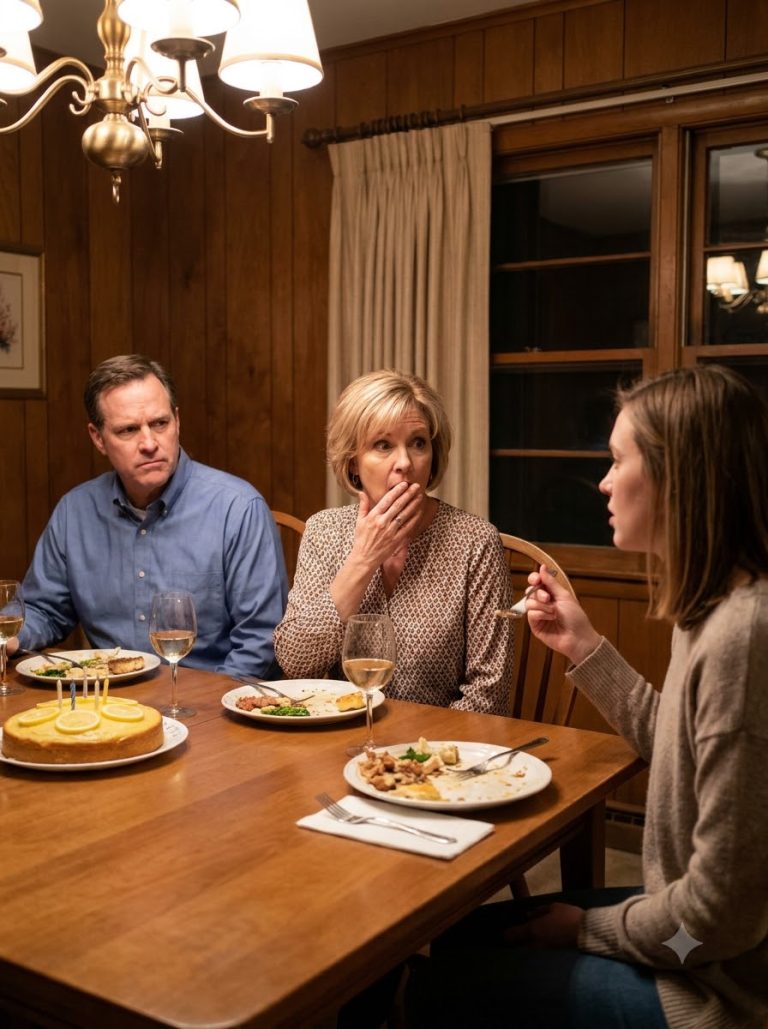
At Deirdre’s birthday dinner, Beth took a group photograph and I heard myself ask, “What are you going to do to it?”
The question landed badly.
Beth lowered the camera.
“Angela.”
I knew I had gone too far.
“Sorry.”
“Are you?”
“Yes. I don’t want you to spend the rest of your career defending every exposure slider to me.”
She looked at the group waiting behind us.
“Can we have this fight after the cake?”
“Please.”
She took the picture.
The next day she sent it without retouching anyone beyond basic color.
I looked tired.
Deirdre’s eyes were closed.
Beth herself was not in it because she had taken it.
We all survived.
A week later I went to the studio to return a frame Beth had lent me.
Her self-portrait was no longer turned backward.
It was leaning face-out against the wall, still unframed.
I stopped.
Beth noticed.
“Don’t say anything.”
“I wasn’t going to.”
“You were breathing an opinion.”
“That is not a thing.”
“With you it is.”
I set down the borrowed frame.
“Are you going to show it?”
“I don’t know.”
“Okay.”
“I have looked at it every day for nine days.”
“Do you hate it less?”
She considered.
“Differently.”
I understood that.
She had not restored the heavily edited version. The photograph leaning against the wall was closer to the original, but not raw. The light was warmer. The shadows had been opened. A small spot near her chin was gone.
Her jaw was still her jaw.
I did not ask which changes she had made.
Not because I no longer cared.
Because it was her face.
At work, our firm’s communications director scheduled new staff headshots in January.
The email produced instant complaints.
Can we use the one from 2022?
Do I have to wear a jacket?
Will they retouch?
I almost forwarded the entire thread to Beth as a joke.
Instead I booked a slot.
The photographer was a young man named Devon who had no connection to Beth and no interest in my personal growth.
He adjusted a light, told me to turn my shoulders, and took twelve frames in seven minutes.
Then he showed me the back of the camera.
I disliked three.
I liked two.
The rest were acceptable evidence that I possessed a face.
“This one,” I said, choosing a frame where I looked directly at the camera.
“Great. We’ll do normal cleanup.”
I almost asked what normal meant.
Then I did ask.
“What do you normally change?”
Devon answered without defensiveness.
“Temporary blemishes, stray hairs, color. Light skin smoothing. If you don’t want smoothing, I can note that.”
“No face shaping?”
“Not unless a client requests it.”
“Keep the silver in my hair. Keep permanent lines. Temporary blemishes are fine.”
He typed a note.
“Done.”
Seven seconds.
No fight.
No theory.
A question and an answer.
I walked back to my office wondering how many arguments are actually conversations that arrived several years late.
In February, Tess asked whether she could use my gallery portrait in a small framed collection of family photographs she was making for her apartment.
“You want that one?”
“Yes.”
“Why?”
“Because I like it.”
I waited for a more complex answer.
She did not provide one.
I sent her the file.
A few days later Beth and I had coffee without talking about photography for almost an hour. We complained about parking, Tess’s landlord, an architect at my office who believed deadlines were philosophical, and Beth’s decision to buy a chair online without measuring the doorway.
Then she said, “I submitted mine.”
I knew what she meant.
Her self-portrait.
“Where?”
“A regional photographers’ show in April. Small thing.”
I waited for the old reflex to tell her she looked beautiful.
Instead I asked, “Are you okay with it?”
Beth considered.
“I’m okay with having submitted it. Ask me about the picture in six months.”
“Fair.”
We finished our coffee. That was as close as either of us came to declaring the matter healed.