Her Cousin Was Carrying Away Grandma’s Recipe Chest — Then Leah Realized Her Sister Had Been Making Decisions for Her Without Asking

PART 3
Nora rubbed the bridge of her nose. “Ben might come for the Christmas village.”
Leah looked at Evelyn. “Grandma’s Christmas village?”
“The little ceramic houses,” Evelyn said.
“I know what it is.”
“You said you didn’t want Christmas decorations.”
“I said I didn’t want the artificial tree.”
Nora stood up. “This is exactly why I did the sorting ahead of time. We cannot hold a two-hour hearing over every bowl and plastic Santa in this house.”
“You can if you are using my answer.”
“I am trying to get Mom moved.”
“And I am trying to make sure you stop turning ‘Leah is practical’ into a power of attorney over my feelings.”
Evelyn flinched.
Leah regretted the phrase as soon as she said it. Not because it was legally inaccurate—she was not making a legal claim at all—but because it made the conversation sound bigger and colder than it needed to.
She crossed it out in her head.
“Sorry,” she said. “Bad wording. I mean you don’t get to speak for me.”
Nora looked surprised by the correction.
Then she looked tired.
That mattered.
For the first time since the doorway, Leah noticed the shadows under her sister’s eyes and the faint red line on her wrist where a moving-box handle had rubbed the skin. Nora had taken Evelyn to see four condos. Nora had met the realtor twice, arranged the donation pickup, called the moving company, and spent three weekends measuring furniture.
Leah had helped. But Nora had done more.
That did not make the blue labels harmless.
It did make the story less convenient.
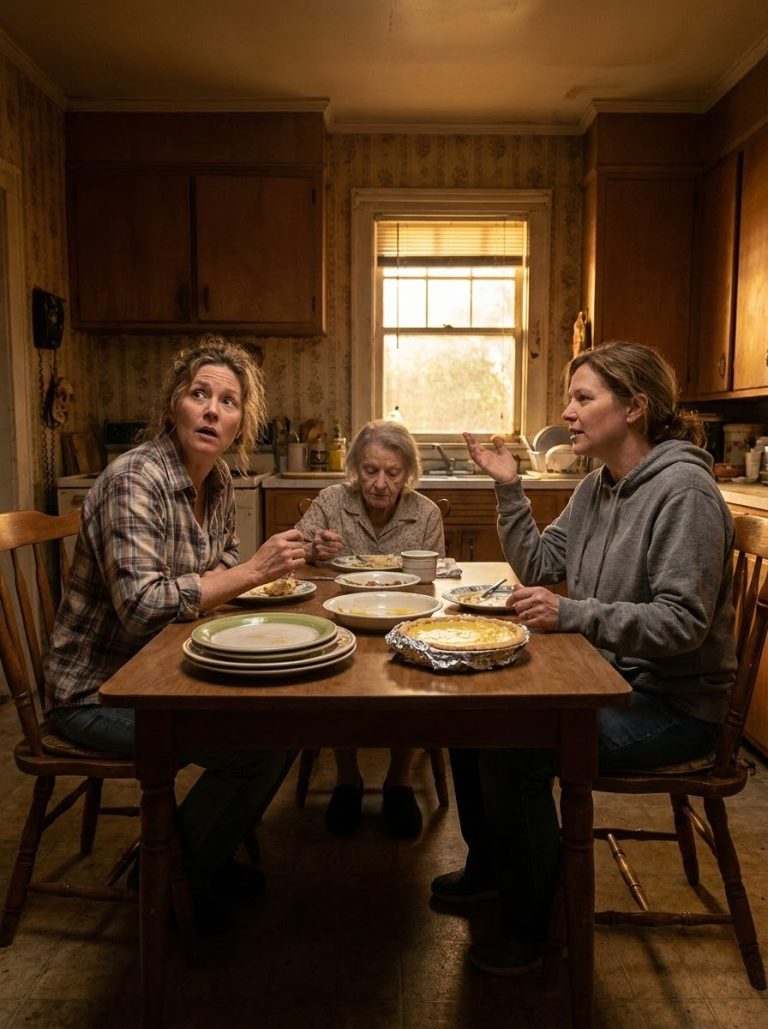
Evelyn stood and began stacking plates. “I wanted this to be easier.”
Leah reached for the plates. “I know.”
Nora said, “No, you wanted me to make it easier.”
Their mother stopped.
Nobody answered.
* * *
Five years earlier, when Leah’s marriage ended, she had learned that people confused getting rid of things with not caring about them.
The divorce itself had been plain and painful rather than spectacular. After twenty-one years, she and Mark had reached the point where every conversation sounded like a negotiation they had already lost. They sold the house, divided the furniture, and moved into separate places.
Leah’s new apartment had one linen closet, one coat closet, and no basement.
She kept what fit.
She kept the quilt her mother made when Leah graduated from college. She kept a chipped mug her father had used every morning before work. She kept three Christmas ornaments, not the plastic tubs of decorations she had accumulated out of habit. She kept photographs after scanning most of them. She kept Grandma June’s handwritten tomato soup recipe in a frame inside a kitchen cabinet where nobody else could see it.
She did not keep the china cabinet.
Nora had.
At the time, Nora had said, “I can’t believe you’re just letting this stuff go.”
Leah had said, “I can’t believe I ever thought I had to keep all of it.”
That sentence had become evidence.
At family gatherings, Nora teased Leah about her “museum of empty shelves.” Evelyn asked before giving Leah gifts whether the object was “small enough to survive inspection.” Leah had laughed along because some of it was funny.
She had not known laughter could harden into a policy.
That afternoon, after Nora went to the garage to break down boxes, Leah walked through the house looking only at blue tape.
A copper bowl on the buffet had KELLY.
A stack of old sheet music had NORA.
A shoebox of Christmas ornaments had BEN.
A framed photograph of Evelyn and Leah’s father on their first vacation had NORA FAMILY ARCHIVE.
A bundle of letters tied with fading ribbon had no name, only ARCHIVE.
Leah did not touch anything.
She took a photo of the labels with her phone.
Not because she planned to prove theft.
Because she wanted to remember what had already been decided before she knew there were decisions to make.
In the hallway closet, she found three boxes marked DONATE.
The first held winter scarves and old purses.
The second held kitchen gadgets.
The third held a small metal recipe tin painted with strawberries.
Leah sat back on her heels.
The tin had belonged to her mother, not Grandma June. Leah had written her first recipe card and tucked it into that tin when she was fourteen: boxed brownies with two extra spoonfuls of cocoa, which she had considered sophisticated.
She lifted the lid.
Empty.
“Nora?” she called.
Her sister appeared at the end of the hall. “What?”
“Where are the cards from this tin?”
Nora looked at it. “I copied them.”
“That isn’t what I asked.”
“They’re in the cedar chest.”
“All of them?”
“I think so.”
“And the originals are going to Amy?”
“They were.”
Leah stood.
Nora’s shoulders dropped. “Please don’t start again.”
“I’m not starting. I’m tracing.”
“Tracing what?”
Leah held up the empty tin.
“How a decision I never made got far enough that the original recipes were packed inside a chest with somebody else’s name on it.”
Nora looked at her for a long moment.
Then she said, very quietly, “You really don’t see how much of this you already gave up, do you?”
Leah felt the sentence land.
Not because it was true.
Because Nora believed it.
* * *
Amy called at eight that night.
Leah was at home in sweatpants, sitting at her small round kitchen table with a bowl of cereal she had forgotten to eat.
“I feel weird,” Amy said without greeting.
“That makes two of us.”
“I went back through my texts.”
Leah straightened.
“I didn’t ask Nora for the chest this week. She offered it in February.”
“February?”
“Yeah. I thought you knew.”
Leah looked at the dark window over her sink. It was September.
“What exactly did she say?”
There was a pause, then the faint sound of Amy tapping her phone.
“She wrote, ‘Mom wants the recipes used, not boxed forever. Leah said take whatever recipe things you’ll actually cook from. She is not sentimental about keeping originals.’”
Leah closed her eyes.
Amy continued, faster now. “Then I asked if you were sure because I know Grandma used to cook with you, and Nora wrote, ‘Completely sure. Leah kept what she wanted years ago.’”
Leah opened her eyes.
“Can you send me screenshots?”
“Already did.”
Her phone buzzed.
The messages appeared.
Blue bubbles. Gray bubbles. Dates.
Not interpretation remembered months later.
Words.
Amy said, “There’s more.”
Leah did not answer.
“Nora also asked if I wanted the red ornament box. She said you had moved on from family Christmas stuff after the divorce.”
Leah stared at the cereal until the milk stopped moving.
“I never told her that.”
“I figured.”
“Who has the ornament box?”
“I don’t. Ben might.”
Leah rubbed one hand over her forehead.
Amy said, “Leah, I’m sorry.”
“You didn’t do anything wrong.”
“I took her word for it.”
“So did Mom.”
That hurt to say.
Amy was quiet.
Then she said, “Do you want me to send the family group a correction?”
Leah imagined thirty messages arriving, everyone choosing sides before she understood what the actual sides were.
“No.”
“You sure?”
“Yes. Not yet.”
“What are you going to do?”
Leah looked at the screenshots again.
The wording was almost casual.
Leah said take whatever.
Leah is not sentimental.
Leah kept what she wanted.
Three sentences, none of them spoken by Leah, had already been traveling through the family for seven months.
“I’m going to find out how many decisions I supposedly made,” she said.
* * *