At A Neighborhood Dinner, Beth Learned Her Marriage Had “Separate Fridays”—An Arrangement Her Husband Had Never Mentioned

PART 7
That night, David slept in the guest room without asking Beth where he should sleep.
She noticed the small improvement and resented herself for noticing it.
In the morning, he had left for work before she came downstairs. A note sat beside the coffee maker.
We need to talk tonight. I’m sorry.
Beth read it once and left it there.
She spent the day at a new client’s house measuring a side yard for drainage changes. The work was satisfyingly physical: elevations, hose bib, existing grade, three mature trees that had to remain. Problems with constraints she could see.
At noon her daughter, Claire, called from Chicago.
“Dad texted me something weird.”
Beth closed her eyes.
“What did he text?”
“He asked if I ever thought you were happier when he was out of the house.”
Beth leaned against her car.
“What did you say?”
“I told him that was a question for you.”
Beth smiled despite everything.
“Good answer.”
“Mom, are you guys okay?”
Beth considered the reflex to reassure.
“We’re having a hard time.”
Claire was quiet.
“Do you need me to come home?”
“No.”
“Do you want me to call Dad?”
“No.”
“What do you want me to do?”
“Be my daughter.”
“That sounds suspiciously like nothing.”
“It includes telling me about your job and complaining about your upstairs neighbor.”
Claire laughed weakly.
They talked for ten minutes about a presentation Claire had to give and a neighbor who vacuumed after midnight.
When the call ended, Beth felt proud and sad. For years she and David had defined successful parenting as making their children feel secure in the marriage. Now security required something different: refusing to recruit them as witnesses.
David came home at six.
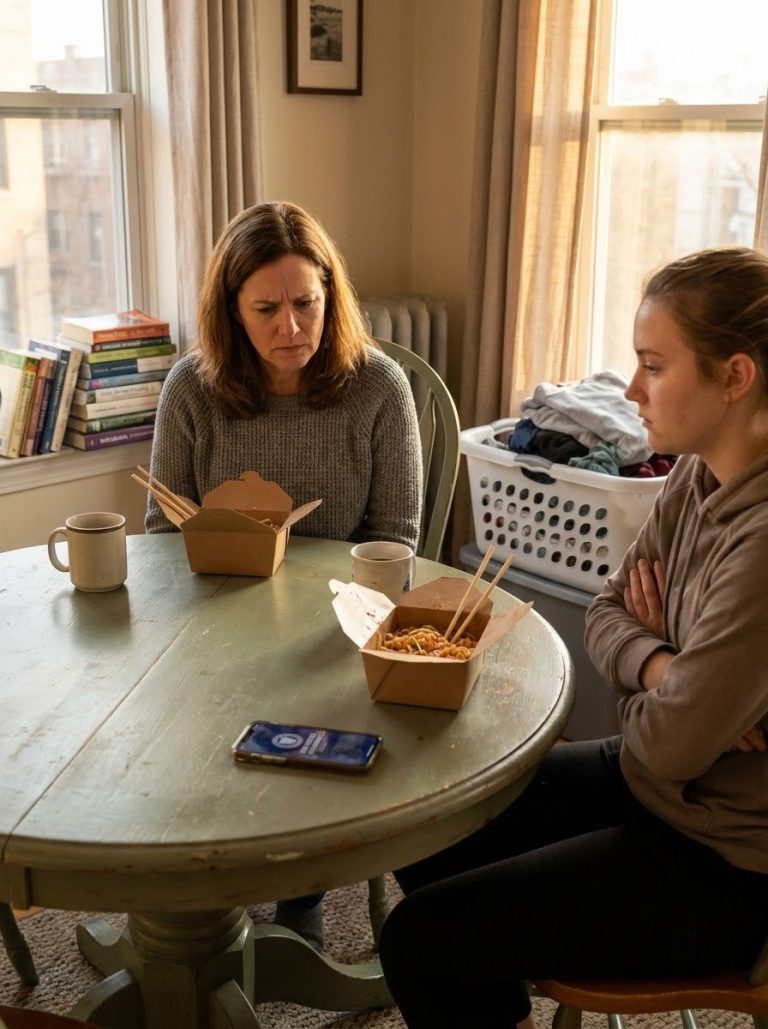
He did not change clothes. He sat at the kitchen table while Beth finished making a sandwich.
“I think I’ve been testing you,” he said.
The directness stopped her.
She sat across from him.
“What does that mean?”
He looked exhausted.
“When I started going out Fridays, I kept waiting for you to care more.”
“I did care.”
“You never told me not to go.”
“Why would I?”
“I don’t know. I thought you’d ask why I wanted to be gone every Friday.”
“You told me you were seeing Mark and Joel sometimes.”
“Right.”
“So I believed you.”
He looked down.
“I kept thinking if I mattered, you’d notice the pattern.”
Beth stared at him.
The absurdity was almost too large to hold.
“You wanted me to catch you having a separate social life.”
“I wanted to know if you noticed me leaving.”
“You live here. Of course I noticed.”
“But you didn’t seem bothered.”
“Because adults are allowed to have dinner with friends.”
David rubbed his forehead.
“I know how stupid this sounds.”
“It sounds cruel.”
His hand dropped.
“I wasn’t trying to hurt you.”
“You were creating a test I could only pass by distrusting what you told me.”
He opened his mouth, then closed it.
Beth felt years of their marriage rearrange around one habit. David had always disliked asking directly for reassurance. Before big work presentations, he would complain that the material was probably terrible until Beth told him it was good. When the children were small, he would announce that they probably wanted Mom, waiting for them to contradict him. Beth had treated it as insecurity, occasionally annoying but harmless.
Now the same habit had expanded into architecture.
“What answer were you hoping for?” she asked.
David’s eyes filled.
“That you’d want me home.”
“I did want you home sometimes.”
“You seemed happy without me.”
“I was happy sometimes. Those aren’t opposites.”
He shook his head.
“I watched you build this whole life after the kids left. I thought maybe I was the part you didn’t need anymore.”
Beth felt compassion rise before she could stop it.
Then anger rose beside it.
“You could have asked me.”
“I was afraid of the answer.”
“So you made me give you one without knowing the question.”
He flinched.
“I’m sorry.”
Beth looked toward the dark window over the sink.
She had imagined the main problem might be an affair, a hidden friend, a plan to leave. This was less spectacular and somehow more destabilizing.
David had been rehearsing distance while measuring her reaction.
He had used her trust as evidence that she did not care.
“I don’t know what to do with your apology tonight,” she said.
“What do you want me to do?”
“I don’t know.”
He looked frightened by the answer.
Beth understood why. For twenty-seven years, she usually knew the next practical step.
She let herself not know.