A Stranger Congratulated Me on My Daughter’s Podcast About My Divorce—But I Had Never Agreed to Be Her Story

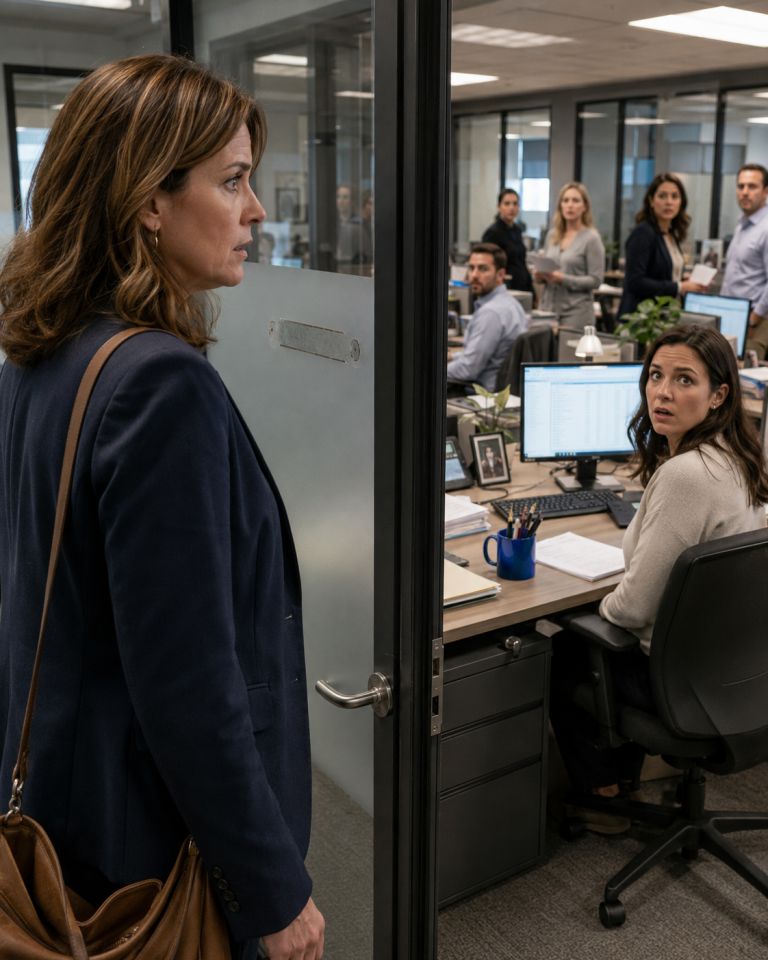
The woman in the navy blazer touched my elbow beside the coffee urn and said, “I just want you to know your daughter’s episode was incredibly brave.”
I turned with a paper cup in one hand and a name tag peeling off my jacket.
“I’m sorry?”
She smiled the careful smile people use when they think they are speaking to someone who has survived something publicly.
“The podcast. About your marriage. I listened on the drive here.”
For a second I assumed she had mistaken me for somebody else.
The breakfast was for regional communications professionals, sixty people in a hotel conference room outside Columbus, and I had spent the first half hour talking about municipal newsletters, crisis messaging, and why nobody should put twelve fonts on a public flyer. My daughter, Ava, had a podcast. That part was true. She was twenty-six and co-produced a show called Second Draft, about adult children reconsidering the stories they grew up with.
I had listened to three episodes. None of them was about me.
“What episode?” I asked.
The woman’s expression shifted.
“Oh.”
That single syllable told me more than her answer would have.
She glanced at my name tag. “Maybe I shouldn’t have said anything.”
“What episode?”
“It dropped yesterday. ‘The Parent Who Stayed.’”
My stomach tightened before I knew why.
That phrase belonged to my ex-husband, Mark.
He had used it once, twelve years earlier, during an argument about who had done more after our separation.
I stayed, Melissa.
He meant in the old neighborhood. In the school district. In the routines Ava already knew. I had moved twenty minutes away after we sold the house because the apartment I could afford was closer to work.
At the time, I said, “You stayed in a ZIP code. That is not the same as staying for a person.”
Nobody outside our family had heard that exchange.
At least I thought nobody had.
The woman touched my arm again. “I’m sorry. I assumed you knew.”
“What did she call me?”
“Not Melissa.”
That did not help.
“Did she use my job?”
“She said her mother worked in public communications.”
I stared at her.
“Did she say where?”
“Not exactly.”
“What else?”
Now she looked trapped between manners and accuracy.
“She talked about the divorce. About moving. About a Christmas when the mother worked through dinner because of an emergency.”
I put my coffee down.
In December 2014, a water-main break had shut down two blocks of downtown three days before Christmas. I was the communications manager for the city utilities department. I did not work through dinner. I left dinner twice to take calls, then drove to the emergency operations center at nine-thirty after Ava had gone to her father’s.
She had been fourteen.
She had cried in the car when Mark picked her up.
That night had lived in my memory as one of the moments I failed at being two places at once.
Apparently it now lived on the internet.
“Excuse me,” I said.
I walked out of the conference room, past the registration table, through the lobby, and into the small business center near the elevators.
My hands were steady. That irritated me. I wanted some physical sign that the morning had become abnormal.
I opened my phone and searched Second Draft.
The new episode was at the top.
THE PARENT WHO STAYED: WHEN STABILITY BECOMES A STORY
Fifty-three minutes.
The description said that Ava was talking with one parent about the quiet labor of keeping a family’s routines intact after divorce, and about what children misunderstand when the other parent chooses distance, work, and privacy.
One parent.
I pressed play.
Ava’s voice came first.
“When parents split, kids inherit explanations before they inherit context.”
Then Mark’s voice.
Older. Softer than I remembered from arguments. More practiced.
“I never wanted Ava to choose sides. I just wanted her to have one home base she could count on.”
I stopped the audio.
I called my daughter.
She did not answer.
I called again.
Straight to voicemail.
I sent one text.
I’m at a work event and a stranger just quoted your new episode to me. Call me before I listen to the rest.
Three dots appeared almost immediately.
Then disappeared.
Then appeared again.
Finally: Mom, I was going to call you tonight.
I stared at the message.
I typed: You published yesterday.
Her reply came faster.
I changed names and identifying details. Dad is the only parent interviewed. It is about my experience.
That sentence hurt because part of it was true.
The divorce had happened to Ava too. Her memories were hers. Her anger was hers. Her questions were hers.
But a stranger in a hotel ballroom had recognized me before breakfast ended.
I typed one more message.
If your version includes my job, the Christmas water-main call, and a phrase your father used in our kitchen, then you did not change enough.
This time there were no dots.
I put the phone down and pressed play again.
Mark was talking about the first year after the divorce.
“I learned quickly that routine mattered more than explanations,” he said. “Same bus stop. Same dentist. Same Friday pizza. I wasn’t perfect, but I was there.”
Ava asked, “Did Mom want something different?”
There was a pause long enough to sound thoughtful.
“She wanted a life that did not revolve around the old one.”
I stopped the audio again.
That was not a lie exactly.
I had wanted a life after divorce. I had also driven Ava to school on my mornings, kept every Wednesday overnight, attended parent conferences, paid half of every activity we agreed on, and spent two summers adjusting my work schedule because Mark traveled more.
The episode kept moving.
Ava described my apartment as “the place where everything felt temporary.”
She remembered cardboard boxes in the second bedroom for months.
True.
She remembered me missing a choir fundraiser.
True.
She did not mention that Mark had changed the date in a group email I never received until afterward.
Then Ava read a line from an email.
“I cannot keep reorganizing my life every time Mark decides the old arrangement should remain permanent.”
I knew the sentence before she finished it.
I had written it during mediation. Not to Ava. Not to Mark. Not to anyone who should have handed it to a podcast producer.
In the episode, the sentence sat alone. It sounded like a confession.
I called Ava again.
She answered this time.
“Mom.”
“Where did you get the email?”
Silence.
“The one you quoted. Where did you get it?”
“Dad had old records.”
“What records?”
“Emails. Calendars. Some photos. Stuff from that year.”
“Who gave you the source packet?”
She exhaled.
“Dad did.”
The problem had just changed.
“You had a source packet?” I asked.
Ava lowered her voice. “Mom, can we not do this while you’re at a conference?”
“You published while I was at a conference.”
“I didn’t know you were there today.”
“That is not the problem.”
“I know.”
“No. You know I’m upset. I’m not sure you know why.”
A man in a gray suit entered the business center, saw my face, and chose the printer farthest from me.
I stood and walked into the hall.
“Ava, I am not telling you that you cannot talk about being fourteen during our divorce.”
“Then what are you telling me?”
“I’m telling you that my private email, my job history, and events that identify me are not automatically yours to publish because you were present for some of the consequences.”
She was quiet.
I heard a door close on her end.
Then she said, “Dad said you knew I was working on it.”
I stopped walking.
“What?”
“He said you knew I was doing a divorce episode.”
“I knew you were thinking about an episode on how adult children reinterpret divorce.”
“He said you knew he was participating.”
“I knew you interviewed him about his retirement last spring. I did not know he was talking about our marriage.”
She exhaled hard.
“I should have called you.”
“Yes.”
“I thought you’d say no.”
“That is not a reason not to ask.”
“I know that now.”
I leaned against the wall beside a framed photograph of downtown Columbus at sunset.
“What did your editor fact-check?”
“Jules listened for legal risk and clarity.”
“That is not what I asked.”
Ava’s tone sharpened. “You are doing the communications-manager thing.”
“The communications-manager thing is asking what you verified before publishing claims about a real person.”
“We did verify. Dad had dates.”
“Dates are not context.”
“He had calendars.”
“Calendars are not motives.”
“Mom.”
“Did you ask whether there were documents that contradicted his memory?”
She went silent again.
That was the first moment I understood that Ava had believed she had done more than tell her own story. She believed she had researched ours.
I said, “I need the transcript and the source list.”
“I can send the transcript.”
“And the source list.”
“Some of Dad’s files are private.”
I laughed once.
“Do you hear yourself?”
She did. I could tell because she stopped defending the sentence.
Finally she said, “I’ll talk to Jules.”
“I want the episode temporarily unpublished while we do that.”
“I can’t just pull it because you’re angry.”
“Then pull the identifying description and the quoted private material while your editor reviews whether you had permission and context.”
“That could wreck our distribution numbers.”
“Ava.”
“I’m being honest.”
“So am I.”
The business-center door opened. The man in the gray suit left without looking at me.
I checked the time. The panel I was supposed to moderate started in twenty-two minutes.
“I have to go back in,” I said. “Send me the transcript today. I am not posting about this, contacting sponsors, or threatening anybody. I am asking you to pause identifiable material and let me see what claims you made.”
“Okay.”
“Okay what?”
“I’ll send the transcript. I’ll call Jules.”
“And the source list?”
“I’ll ask.”
We hung up.
I stood in the hallway for another minute, then went back to the breakfast.
The woman in the navy blazer caught my eye and looked away.
I did not blame her. She had accidentally walked into someone else’s family boundary.
For the next hour I moderated a panel on public trust while privately discovering how much I had relied on silence as if silence could protect anything by itself.
* * *
The transcript arrived at 1:17 p.m.
I opened it in my car before driving home.
Ava had changed our names to “Lena” and “David,” but she had kept my profession, the age of the child at divorce, the Christmas infrastructure emergency, the neighborhood layout, Mark’s Friday-pizza ritual, and enough chronology that anyone who knew us moderately well could connect the dots.
The episode was not vicious.
That made it harder.
Ava said kind things about me.
She described my competence, my work ethic, the way I had taught her to make lists before a stressful week. She also described me as “the parent who needed space” and Mark as “the parent who made continuity feel like love.”
I could understand why a fourteen-year-old had felt that way.
What I could not accept was the way the episode converted feeling into evidence.
A missed fundraiser became evidence of distance.
My smaller apartment became evidence that I had wanted less family.
An email about mediation became evidence that I resented routine.
At the end of the transcript, Mark said, “Melissa—sorry, Lena—always believed privacy was a form of dignity. Sometimes it was. Sometimes it was a wall.”
Ava left the correction in.
My real name had been spoken in the raw interview.
The transcript marked it as EDITED OUT.
That meant the production team had known exactly who the story was about.
At 1:42, another email arrived.
From Jules Moreno, producer, Second Draft.
Melissa, Ava explained the concern. I agree we should review the episode’s identifiability and source permissions. I’ve temporarily removed it from the public feed while we do that. I’m attaching the publication transcript and a list of source materials used in scripting. I’m not attaching Mark’s personal files without his permission, but I can identify them by description.
I opened the source list.
Three interview recordings with Mark.
Two school calendars.
Six family photographs.
A folder labeled DIVORCE TIMELINE.
Four email excerpts.
One handwritten note.
I knew the note from the description.
A yellow index card I had left in Ava’s lunchbox the week I moved into the apartment.
New house. Same mom. Call me whenever you need me.
In the episode, Ava remembered the card.
Mark supplied the photograph of it.
I had forgotten he ever had a copy.
I closed my eyes.
For the first time that day, the anger moved aside long enough for grief to get through.
The yellow card had been true.
That was what hurt.
I had not left my daughter when I left the marriage. I had been clumsy, scared, overworked, and occasionally selfish. I had also been there in all the unphotogenic ways that did not fit neatly into anyone’s memory: Wednesday pickups in freezing rain, orthodontist appointments, algebra at the kitchen counter, dropping off a forgotten uniform before a work presentation, driving across town because Ava could not sleep after a fight with her best friend.
None of that made Mark’s memories false.
It made his version incomplete.
I drove home and printed the transcript.
That sounds old-fashioned because it is. I think differently on paper. At my job, when a public statement gets complicated, I put a ruler under each sentence and mark what kind of statement it is.
Fact.
Interpretation.
Memory.
Claim.
Unknown.
By three-thirty, my dining table looked like a graduate seminar in my own failed marriage.
Ava: “Mom missed the winter fundraiser because of work.” Fact, but wrong date in the episode.
Mark: “I handled almost every school event that first year.” Claim.
Ava: “Dad kept the house.” False. We sold it seven months after the separation.
Mark: “Melissa wanted a clean break.” Interpretation.
Quoted email: accurate sentence, context missing.
I wrote beside it: SOURCE?
At four-ten, Ava called.
“Can I come over?”
I looked at the pages spread across my table.
“Yes.”
“I’m bringing Jules.”
“No.”
A pause.
“Why?”
“Because I want to talk to you before we turn this into an editorial meeting.”
“She can help.”
“She can help later.”
Ava came alone at five.
She still had the canvas tote bag she carried everywhere, the one printed with a cartoon microphone and the words ASK BETTER QUESTIONS. I had given it to her for Christmas two years earlier.
Neither of us mentioned the irony.
She stood in my entryway and looked younger than twenty-six.
“I’m sorry,” she said.
I stepped aside.
“Come in.”
She saw the transcript immediately.
“You printed it.”
“Yes.”
“That is the most Mom thing possible.”
“Do not make me like you right now.”
Her mouth twitched. Then her eyes filled.
That almost undid me.
I pointed toward the table.
“Sit.”
We sat across from each other, and for a while neither of us spoke.
Finally Ava said, “I should have told you before it went live.”
“Yes.”
“I thought anonymizing would be enough.”
“It wasn’t.”
“I know.”
“Did Jules tell you to contact me?”
“She suggested it.”
“And?”
“I said you would shut it down.”
I folded my hands.
“Would I?”
“You hate talking about the divorce.”
“I hate being told that privacy means denial.”
“That is not what I said.”
“It is what your episode says.”
Ava looked down.
I pushed the marked transcript toward her.
“I am not asking you to say I was a perfect mother.”
“I know.”
“I am not asking you to remove your memory of that Christmas.”
“I know.”
“I am asking you to understand the difference between saying ‘I remember feeling abandoned’ and saying ‘my mother chose distance and work over continuity’ as if that is a researched conclusion.”
She read my notes.
After a minute she said, “Dad had documents.”
“So do I.”
“I didn’t know that.”
“You didn’t ask.”
Her shoulders tightened.
“No. I didn’t.”
That admission mattered more than another apology would have.
I asked, “How did the episode start?”
She looked at me.
“What do you mean?”
“Whose idea was it?”
“Mine.”
“When?”
“February.”
I remembered February. Ava had called me after recording an episode about siblings who disagreed about their parents’ marriage.
She had said, Someday I want to do one about divorce from the kid’s perspective.
I had said, That could be interesting.
That was the consent Mark had apparently described as me knowing about this episode.
“What happened next?” I asked.
“I asked Dad if he would talk generally about the first year.”
“And he said?”
“He said yes immediately.”
“Did he bring documents to the first interview?”
Ava frowned.
“No. Not the first.”
“When did the source packet appear?”
“After the second interview.”
“What happened in the second interview?”
She thought.
“I asked him about the year you moved apartments.”
“And?”
“He said memory was slippery and he had kept old calendars. Then he emailed me a folder.”
“Did you ask him to build a timeline?”
“No.”
“Did Jules?”
“No.”
I felt the first clean edge of a new question.
Not whether Mark had given Ava material.
Why he had given so much.
Ava kept reading.
At the line about my mediation email, she stopped.
“I thought this was from a chain with Dad.”
“It may have been forwarded later. The sentence came from a mediation discussion. Look at what is missing.”
“What?”
“The subject. The paragraph before it. The paragraph after it. Who received it. Why it existed.”
She leaned back.
“I can ask Dad.”
“You can. But before you do, tell me what he said the folder was for.”
She looked toward the window.
“He said if we were going to tell the story, we should finally tell it accurately.”
There it was.
Not just memory.
A mission.
Ava stayed for dinner because neither of us knew how to end the conversation without making it feel like a verdict.
I made scrambled eggs and toast, which was what I cooked when the refrigerator contained ingredients but my brain did not.
At the stove, Ava said, “You know what the worst part is?”
“I have a list.”
“I thought I was being fair.”
I turned off the burner.
She was sitting at the kitchen island, shoulders rounded, phone facedown beside her.
“I interviewed Dad because you never talked about it,” she said. “I thought one parent willing to talk was better than two parents refusing.”
“I did not refuse a question you never asked.”
“I asked questions for years.”
That stopped me.
“When?”
“When I was sixteen and asked why you moved first. You said, ‘Because adults sometimes need separate space to make better decisions.’ When I was nineteen and asked if Dad cheated, you told me not every divorce needs one villain. When I was twenty-two and asked who wanted it, you said both of you had spent too long trying to prove the other person was the problem.”
I remembered every answer.
At the time, I had been proud of them.
Measured. Non-accusatory. Adult.
Now I heard what they had sounded like to a child who had grown into a woman who made stories for a living.
Doors closing softly.
“I thought I was protecting you,” I said.
“From what?”
“From becoming the jury.”
“I became the audience instead.”
The sentence was not cruel. That was why it landed.
I put the eggs on two plates.
“I am sorry for that,” I said.
She looked up.
I continued. “I am not sorry I refused to give you a prosecution brief about your father. I am sorry I treated all detail as dangerous, because it left you with two kinds of material: what you remembered and what he was willing to explain.”
Ava rubbed her eyes.
“I still should have called you.”
“Yes.”
“I know you’re going to keep saying that.”
“Yes.”
She laughed once through tears.
For the first time that day, I did too.
* * *
The next morning, Jules sent a proposed review process.
She was thirty-two, direct, and more serious than I had expected from the light conversational style of the show. We met on video with Ava at ten.
Jules started by saying, “I made an editorial mistake. I treated a family member’s documentation as corroboration without independently verifying the claims most likely to identify or characterize you.”
I appreciated the sentence because it did not hide behind intention.
I said, “Thank you.”
Ava looked miserable.
Jules shared her screen.
There were twelve disputed points. Some were small. One school event had the wrong month. A caption placed me in a different apartment six weeks early. Mark remembered moving furniture into my apartment; my lease showed I had hired movers because he had refused to help after an argument.
None of those details would have mattered alone.
Together, they created a posture: Mark as steady witness, me as unreliable absence.
Jules clicked to the source list.
“Mark’s folder included a document called ‘family timeline.’ Did either of you know he had created it?”
“No,” Ava said.
I shook my head.
Jules opened a metadata summary rather than the file itself.
Created March 18.
Modified April 2.
The second interview had been March 12.
The folder had not been a box of old records Mark happened to possess.
He had assembled it after Ava began asking questions.
I wrote the dates on my legal pad.
Ava leaned toward her camera.
“Dad said he’d kept a timeline for years.”
“Maybe he kept notes,” Jules said. “This file was created in March.”
Ava’s face went blank.
I knew that expression. It was the same one she had at fourteen when she realized two adults had given her incompatible explanations and she would be expected to live with both.
I said, “We do not know yet that the contents are false.”
She looked at me sharply.
I understood why. She expected anger to make me careless.
I had spent my career telling other people not to overclaim when facts were finally moving in their direction.
Jules said, “Correct. What we know is that the file was assembled for this project, not simply retrieved as a contemporaneous family record.”
That distinction changed the room.
The question was no longer whether Mark remembered differently.
It was what he had selected to make memory look documented.
Jules showed the list of four email excerpts.
Two came from chains that included Mark.
One came from a forwarded message between my old attorney and me.
The fourth came from an email I had sent to my sister, Karen, the night I signed my apartment lease.
I had written: I’m scared Ava will think I’m leaving her when what I’m trying to leave is the fight.
In the episode, only the first clause appeared in narration: I’m scared Ava will think I’m leaving her.
Ava covered her mouth.
“That is not how Dad sent it to me,” she said.
Jules looked at her. “What do you mean?”
“He sent the screenshot cropped after that sentence.”
Nobody spoke for a moment.
I felt anger then, but it was colder than before.
A cropped screenshot was not a faulty memory.
It was a choice.
We ended the meeting with three decisions.
The episode would stay offline.
Jules would not use any private document in a revised version unless its provenance and context were clear.
And Ava would ask Mark for the complete source files he had used to build his timeline.
“Not to trap him,” I said.
Ava gave me a look. “You keep adding that.”
“Because once people feel accused, they start answering the accusation instead of the question.”
Jules smiled faintly. “Communications-manager thing?”
Ava sighed. “Unfortunately.”
After the call, I went to work.
I had taken the morning from home, but by noon I needed an office that was not full of my divorce. I drove to the county public-information department where I had worked for six years, sat through a budget meeting, edited an emergency-notification template, and corrected a graphic that showed a phone number with one digit missing.
Ordinary work helped.
At three-fifteen, Mark called.
I let it ring once before answering.
“Melissa.”
“Mark.”
“Ava says you’re having the episode pulled.”
“I asked for an editorial review. Jules pulled it.”
“You know what I mean.”
“Yes.”
He sounded tired rather than angry.
“I told Ava the truth as I remember it.”
“That is allowed.”
“Then what exactly are we fighting about?”
“The part where you assembled a source packet to make your memory look like the only documented version.”
A pause.
“I gave her material she asked for.”
“She did not ask you to create a family timeline.”
“I already had notes.”
“The file was created in March.”
Silence again.
I did not fill it.
Mark said, “You’ve always believed dates settle emotions.”
“No. Dates settle dates.”
“That’s cute.”
“It is also true.”
He exhaled.
“Ava wanted to understand why she felt safer with me that first year.”
“And you wanted to explain it.”
“Yes.”
“So explain why you cropped my email to Karen.”
The silence lasted longer.
When he finally spoke, his voice had changed.
“What email?”
“The one where I wrote that I was scared Ava would think I was leaving her when I was trying to leave the fight. You sent a screenshot ending after ‘leaving her.’”
“I don’t remember cropping anything.”
“Then send Ava the original.”
“I’m not going through fifteen-year-old messages because you dislike how you come across.”
There it was.
Not denial.
A refusal to look.
I sat back in my chair.
“Mark, this is not about whether I come across well.”
“Of course it is.”
“No. It is about whether a published story distinguishes between our daughter’s memory and your edited evidence.”
“You cannot stand that she finally understands what I carried.”
The sentence was so familiar that for a moment I could see our old kitchen: the chipped white cabinet near the refrigerator, Ava’s school calendar held up by a magnet shaped like a tomato, Mark standing with both palms on the counter.
I had spent years after the divorce wondering whether leaving meant he had carried more.
Sometimes he had.
He lived closer to school for the first seven months. He handled more spontaneous pickups. He knew which neighbors would take Ava if traffic trapped him downtown. He absorbed the social convenience of staying where everyone already knew him.
I had never denied that.
What I refused now was the conversion of those facts into ownership of the whole story.
“I know you carried things,” I said. “I also know I did. Ava can tell what it felt like from her seat. You can tell what it felt like from yours. But you do not get to trim my words until they prove your thesis.”
“My thesis?”
“That you stayed and I left.”
“You did leave.”
“I left the marriage.”
“You left the house first.”
“We sold the house.”
“Seven months later.”
“Yes.”
He laughed without humor. “There. You always do this. You reduce everything to a correction.”
“And you turn every correction into evidence that I am cold.”
Neither of us spoke.
For the first time in years, the old pattern sat between us without either person pretending it was new.
Mark said quietly, “I was the one who stayed when she cried.”
I closed my eyes.
That was true too.
The first night in my apartment, Ava had called him from the bathroom because she did not want me to hear her cry.
He had stayed on the phone with her.
I had been eight feet away folding towels, thinking giving her privacy was kindness.
Different rooms. Different evidence.
“I’m not taking that away from you,” I said.
“Then stop acting like the episode is a fraud.”
“I did not call it a fraud.”
“Ava thinks I manipulated her.”
“Did you?”
“No.”
“Then send the complete files.”
He hung up.
* * *
That evening Ava texted me one sentence.
Dad says he needs time to find the originals.
The next morning she sent another.
He found some.
By lunch, Jules had a new folder.
It did not settle everything.
It did something more useful.
It made the omissions visible.
The complete email to Karen did not rescue me.
That mattered.
I had written angry things after the separation. I had called Mark inflexible. I had complained that every schedule discussion became a referendum on whether I cared enough. I had said I wanted one room in my life where his preferences did not arrive before I did.
Those sentences were mine.
The complete messages also showed what the cropped versions removed.
I was not asking for less time with Ava. I was asking for fewer last-minute changes on days Mark had agreed to cover.
I was not rejecting her school community. I was asking him to stop assuming my job could absorb every scheduling emergency because his was “less flexible.”
I was not trying to abandon tradition. I was trying to build a second household that did not operate as an annex of the first.
Jules made a comparison chart.
ORIGINAL.
SOURCE PACKET.
EPISODE USE.
The pattern was not dramatic enough for television. No forged signatures. No fake dates. No invented affair.
It was editing.
A sentence shortened here.
A calendar month shown without the following month.
A photograph captioned with who was present, not who had taken the picture.
A school schedule included without the work-travel schedule that explained why Mark handled those weeks.
Each choice was defensible alone.
Together, they always leaned the same direction.
At the bottom of the source folder was a document Ava had not seen before.
NOTES FOR AVA — POSSIBLE CONTEXT.
Created March 19.
Mark had written it after their second interview.
I did not read the whole thing at first.
I saw my name in the first paragraph.
Melissa will probably resist specifics because privacy has always been her way of controlling the frame.
I sat very still.
Ava was beside me at my dining table. Jules was on the laptop screen.
Ava whispered, “Oh.”
I kept reading.
Mark wrote that he wanted to help Ava understand the difference between what both parents claimed and what “the record actually shows.” He listed six episodes from the first two years after the separation. Beside each, he suggested documents that supported his memory.
Then came a sentence that made the past three days reorganize themselves.
If Ava is finally telling this story, I want her to have enough material that Melissa cannot reduce it to competing feelings.
I read it again.
Enough material.
Not enough context.
Not enough complexity.
Enough material that I could not call the story subjective.
Jules said, “That changes how I understand the source packet.”
Ava did not answer.
I looked at her.
She was pale.
“Say what you are thinking.”
She shook her head.
“Ava.”
“I thought he was helping me be rigorous.”
“He may have believed he was.”
“Mom, don’t.”
“Don’t what?”
“Make him sound reasonable because you think that makes you fair.”
The accusation was sharp enough that I almost defended myself.
Then I realized she was right about one thing.
I had a habit of sanding down other people’s behavior until nobody could accuse me of bitterness.
That habit had protected Ava when she was young.
It had also made me strangely absent from my own version of events.
I said, “Okay. I won’t do that.”
She looked at me.
I touched the page.
“This was not neutral research. He wanted your episode to produce a conclusion.”
Ava’s eyes filled.
“And I let him.”
“You trusted your father.”
“I also wanted the conclusion.”
That was the harder truth.
She closed the laptop halfway.
“I wanted there to be a reason,” she said. “A clean one. I wanted to know why his house felt easier. Why you looked relieved when you got your apartment even though I was miserable. Why Dad always acted like he had survived something you chose.”
I did not interrupt.
She continued. “When he gave me the timeline, it felt like finally there was an answer that wasn’t just both of you saying people are complicated.”
“That is a terrible answer when you’re fourteen.”
“It is a terrible answer when you’re twenty-six.”
“Unfortunately, it is still often true.”
She wiped her face with the heel of her hand.
Jules quietly turned off her camera.
It was a small kindness. She stayed in the meeting but made the room feel less observed.
Ava said, “Did you feel relieved?”
“Yes.”
The answer came so quickly she looked surprised.
“When I got the apartment, I felt relieved,” I said. “I could close a door and not hear your father moving around angry in another room. I could make a decision without negotiating the meaning of it. I could sleep.”
Her face folded.
“I thought you were relieved to leave us.”
“No.”
“I know that sounds childish.”
“It sounds like something a child could believe.”
She looked at the document again.
“Dad knew I believed it.”
“I think he believed his own version too.”
“That doesn’t make the cropping okay.”
“No.”
“Or this note.”
“No.”
We sat with that.
The main turn was not that Mark had lied about everything.
It was worse in a quieter way.
He had taken a daughter’s unresolved question and used documentation to turn his preferred answer into the researched one.
That evening Ava asked if I would come with her to Mark’s house.
I said no.
She looked offended.
“You’re making me do it alone?”
“I am letting you have a conversation with your father that is yours.”
“This is about you too.”
“Yes. And if I sit there, he will talk to me instead of answering you.”
She knew I was right.
I knew it too because I had spent seventeen years watching Mark redirect a hard question toward the person whose argument he already understood.
“What am I supposed to ask?” she said.
“Whatever you need to know.”
“That is not helpful.”
I considered giving her a list. It would have been easy. It would also have repeated the mistake we were trying to understand: one parent supplying the questions that led toward one parent’s conclusion.
So I said, “Ask him what he hoped the episode would make you believe.”
Ava stared at me.
“That’s it?”
“That’s enough.”
* * *
She called me two hours later from her car.
“He says he was correcting the imbalance.”
“What imbalance?”
“You never defended yourself.”
I closed the dishwasher.
“That is an interesting definition of imbalance.”
“He said for years he watched me assume you had left because you wanted freedom, and you never corrected it. He thinks that made him carry the emotional explanation and the practical work.”
There was pain in her voice now, but not the stunned pain of discovering a lie. This was older. More complicated.
“What did you say?” I asked.
“I asked whether that was why he cropped the email.”
“And?”
“He said he cropped it because the second half was you blaming the marriage, and the episode was about my experience.”
I leaned against the counter.
“So the half where I say I was leaving the fight was irrelevant to an episode about why you believed I was leaving you.”
“Exactly.”
“Did you say that?”
“Yes.”
“And?”
“He got angry.”
I could picture it. Mark did not shout often. He became precise. His words got flatter, as if emotion were evidence someone else had mishandled the meeting.
Ava continued. “Then I asked about the timeline note.”
“What did he say?”
“That he knew you would call everything subjective, and he didn’t want the story to disappear into ‘two sides.’”
I closed my eyes.
There it was again. His old fear that complexity would cancel what he had carried.
“Did he apologize?”
“To me. Not to you.”
“For what?”
“For putting me in the middle.”
I almost said, He put you in the middle twelve years ago.
I stopped myself.
That sentence would have been emotionally satisfying and historically lazy.
We had both put her in the middle sometimes. Mark with explanation. Me with silence. Neither of us got to erase that because one of us had behaved worse this week.
“Ava,” I said, “what do you want to do with the episode?”
“I don’t know.”
“You do not have to decide tonight.”
“Jules needs an answer.”
“Jules needs an editorial plan. You need an answer you can live with.”
There was a long pause.
Then she said, “I don’t want to put the old one back.”
Something in my chest loosened.
“Okay.”
“But I don’t want you to think that means I’m choosing your version.”
“I don’t have one version for you to choose.”
“That answer makes me crazy.”
“I know.”
She laughed weakly.
I said, “You are allowed to say that Dad’s house felt safer. You are allowed to say I seemed relieved. You are allowed to say my privacy hurt you. Those are things you experienced.”
“And the documents?”
“If you publish claims about me, you verify them with me or leave them clearly attributed to the person making them. You do not use private material supplied by one parent to make an inference about the other parent look settled.”
She was quiet.
“That sounds like a policy.”
“It is a boundary with bullet points.”
“That is also the most Mom thing possible.”
This time I smiled.
* * *
Friday morning, Jules sent us a proposed outline for a replacement episode.
It was not a correction disguised as a victory lap.
It was narrower.
Ava would open by saying the first version had been removed because she had treated one parent’s archive as neutral corroboration and had not adequately protected or verified the other parent’s private material.
Then she would talk about her own memory: why Mark’s house felt stable, why my apartment felt temporary, why my refusal to give her a simple villain left a vacuum.
She would not replay Mark’s interview.
She would not quote my emails.
She asked whether I would record five minutes answering one question: What did privacy mean to you after the divorce?
My first instinct was no.
My second was also no.
Then I noticed the old reflex underneath both answers.
Do not say anything that can be used against you.
That rule had been useful in conflict.
It had become a way of living.
I emailed Jules back.
I will answer one question in my own words if I can review my segment for factual edits but not rewrite Ava’s interpretation of it.
Ava called thirty seconds later.
“You said yes?”
“To five minutes.”
“I thought you hated podcasts.”
“I hate being turned into one without being asked.”
She was silent.
Then she said, “Fair.”
The recording was scheduled for Monday.
Monday afternoon I sat in a small recording booth at Jules’s coworking studio with headphones pressed over my ears and a glass of water I did not touch.
Ava sat on the other side of the window.
Jules’s voice came through the headphones.
“Ready?”
“No.”
“Good enough.”
Ava smiled despite herself.
The red light came on.
Jules asked the question exactly as promised.
“What did privacy mean to you after the divorce?”
I had prepared three pages.
I did not read them.
“Privacy meant I did not want my daughter recruited into an argument she could not solve,” I said. “It also meant I could avoid explaining myself. Those are not the same thing, and I treated them as if they were.”
Jules waited.
I continued.
“I believed that if I never criticized her father, then I was protecting her from loyalty conflict. I still think part of that was right. But I also refused to tell her ordinary truths because I was afraid any detail would become evidence in a case I did not want her judging. So she had feelings without context. Her father was more willing to explain. That made his explanation easier to live inside.”
Through the window, Ava looked down.
I said, “What I object to is not her memory that his house felt safer. I object to private material being edited to turn that memory into a verdict about what I wanted.”
Jules asked, “Did you want freedom?”
The question was not in our agreement.
I almost stopped the recording.
Then I thought about all the times Mark had used that word as if freedom were evidence against motherhood.
“Yes,” I said. “I wanted freedom from a marriage that had become exhausting. I wanted my own rooms. I wanted decisions that did not become negotiations. I also wanted my daughter. Adults are allowed to want more than one thing at once.”
Ava’s face changed.
There it was.
Not vindication.
Recognition.
Jules asked, “What do you wish Ava had known then?”
I took off one headphone and put it back on.
“That the fact that I looked relieved did not mean I was relieved to lose anything about her.”
My voice broke on the last word.
I hated that.
Then I decided not to.
We stopped after six minutes.
No dramatic music. No closing speech.
Jules saved the file and handed me the raw audio before anyone edited it.
“Your segment is yours until you approve its use,” she said.
That sentence mattered more than I expected.
* * *
The real climax came two days later, not in the booth.
Jules scheduled one final editorial meeting with Ava and me. Mark was invited because his interview and source packet were central to the first episode.
He attended.
The four of us sat in a conference room with a whiteboard, a laptop, and no audience.
Mark looked older than he had on the recording. Not fragile. Just less certain without a microphone making pauses sound wise.
Jules began.
“We are not here to relitigate the divorce. We are here to determine what the show can responsibly publish.”
Mark folded his arms.
“I still think the original episode was fair.”
Ava said, “It wasn’t.”
He looked at her, wounded.
She kept going.
“I am not saying your memories were fake. I’m saying I treated your packet like neutral evidence when it was built to support your interpretation.”
“I gave you records.”
“You cropped Mom’s message.”
“I excerpted it.”
“Toward one meaning.”
Mark turned to me.
“This is what you wanted.”
My old reflex arrived instantly: deny that I had influenced Ava, prove I had been restrained, establish that nobody could accuse me of turning her against him.
I let the reflex pass.
“No,” I said. “What I wanted was a chance to correct claims about me before they were published. Ava decided what the source problem meant to her.”
“You marked the entire transcript.”
“Yes.”
“You built a case.”
“I built a fact sheet.”
“You always have a better word.”
“Sometimes the word matters.”
Jules slid printed pages toward each of us.
“This is the revised structure. Every statement about Melissa is either her own statement, Ava’s memory clearly labeled as memory, or a factual claim we can corroborate from more than Mark’s selected packet. We are removing the private emails and the identifiable workplace details. We are also including a brief correction explaining why the first version was withdrawn.”
Mark stared at the pages.
“So my interview is gone.”
Ava said, “Yes.”
His face tightened.
“You asked me to do this.”
“I asked you to talk about your experience. I did not ask you to build the answer for me.”
“I was trying to help you understand.”
“You were trying to help me understand you.”
The room went still.
I could have taken that moment and won.
I could have listed every omission. I could have described the cropped email, the created timeline, the caption choices. I could have said, Finally.
Instead I asked Mark one question.
“Why did it matter so much that the episode not end with competing feelings?”
He looked at me for a long time.
Then he looked at Ava.
“Because I was tired of being the person who did the work and then hearing that we just remembered differently.”
Ava’s voice softened. “What work?”
“Everything that year. School. Dentist. Your friends. Your panic attacks. Keeping the house running.”
“I know you did a lot.”
“Your mother always had a reason.”
I said, “I usually did.”
He gave me a look.
Ava said, “Dad, a reason is not the same as an excuse.”
That was the sentence he could not argue with without arguing against his own standards.
He looked down.
For the first time, I saw his motive without needing to soften it.
He wanted credit for what he had carried.
He also wanted that credit to prove something larger: that the person who stayed had loved better.
The source packet had been his way of making that conclusion feel objective.
Jules asked, “Do you consent to any of your interview being used in the replacement episode?”
Mark stared at the page.
“No.”
“Then none will be used.”
He looked surprised.
Maybe he had expected a negotiation.
I was surprised too.
The show had a simpler power than our marriage ever did.
Consent could be asked.
Consent could be refused.
The result could change accordingly.
Mark left first.
He did not slam the door. He thanked Jules for her time, told Ava he loved her, and gave me the short nod we had perfected at graduations and medical appointments after the divorce.
When the door closed, Ava stared at the empty chair.
“I thought he’d apologize to you.”
“I didn’t.”
“That sounds smug.”
“It wasn’t meant to.”
She looked at me.
I corrected myself. “Maybe a little.”
She laughed despite the tears in her eyes.
Jules packed her laptop slowly, giving us room without pretending she had vanished.
Ava said, “I don’t know what to do with Dad now.”
“You do not have to do anything today.”
“He manipulated the episode.”
“Yes.”
“And he was there for me.”
“Yes.”
“I hate that both are true.”
“I know.”
She looked at me sharply. “You really do, don’t you?”
I understood the question.
For years she had assumed my refusal to simplify Mark was diplomacy. Sometimes it had been. Sometimes I had been trying to make room for the fact that a person could hurt me and still be a good father in ways that mattered.
“Yes,” I said. “I really do.”
We walked out together.
In the parking lot, Ava asked if I wanted coffee.
“I want lunch.”
“It’s three-thirty.”
“That is why I want lunch.”
We went to a diner near her apartment and ordered grilled cheese and tomato soup because neither of us had the energy to make sophisticated choices.
Halfway through the meal, she said, “I need to tell you something else.”
I put down my spoon.
“Please let it be small.”
“It is not a scandal.”
“Good start.”
“When I was in college, Dad used to say you didn’t call him back because you were still angry.”
“I often did not call him back because texting was enough.”
“I know that now.”
“What made you think of it?”
“He always made your distance mean something.”
I waited.
Ava continued. “I think I learned to do that too. If you did not explain, I treated the silence as an answer.”
I stirred my soup.
“That is fair.”
“No, it isn’t.”
“It is understandable.”
She gave me the look children give parents who use a technically different word to avoid the point.
I smiled.
“Fine. It was not always fair.”
She tore her sandwich in half.
“I’m going to change how we do episodes involving living relatives.”
“That sounds like a show problem, not just a family problem.”
“It is.”
“What are you changing?”
“Identifiability review before release. Direct contact when a living person is characterized beyond someone’s memory. Source labels. No private family documents without knowing who created them and why.”
I raised an eyebrow.
“You have a list.”
“I was raised by you.”
That made me laugh so hard the woman in the next booth turned around.
* * *
The replacement episode came out twelve days later.
It had a different title.
WHAT I THOUGHT STAYING MEANT
Ava opened with the correction herself.
She said the first version had blurred the line between one parent’s archive and a neutral record, and had included enough details to identify a person who had not agreed to participate. She did not call Mark dishonest. She did not call me misunderstood.
Then she told the story from where she actually stood.
At fourteen, she had needed sameness.
Mark had given her more of it.
I had given her space, which was not the same gift and did not always feel like a gift.
She talked about my apartment boxes, the Christmas emergency, the bathroom call to her father.
Then my voice came in.
Privacy meant I did not want my daughter recruited into an argument she could not solve. It also meant I could avoid explaining myself.
The first time I heard the final edit, I had to stop walking.
I was on a trail near my house, earbuds in, passing a woman with a golden retriever.
My own voice sounded older than I expected.
Not wounded.
Not victorious.
Present.
Ava included my sentence about wanting freedom and wanting my daughter at the same time.
She followed it with her own narration.
“As a child, I thought a relieved mother must be relieved to be away from me. As an adult, I know relief can belong to the end of a marriage without belonging to the end of a relationship with a child.”
I cried then.
Not because the podcast had finally declared me innocent.
It did not.
Ava still said I had been difficult to reach emotionally. She still said I sometimes answered a feeling with a logistical solution. She said there were years when she learned more about my work calendar than my fear.
Those statements were painful.
They were also hers.
The difference was that they were not disguised as findings from a file Mark had built.
When the episode ended, there was no swelling music.
Ava said, “Sometimes growing up is not discovering which parent told the truth. Sometimes it is learning what kind of truth each person was trying to tell.”
I sat on a bench until the dog walker passed me again from the opposite direction.
“Good episode?” she asked.
I laughed and wiped my face.
“Complicated episode.”
She nodded as if that explained everything.
The stranger from the networking breakfast emailed me the next week.
Her name was Beth Walker. I had finally remembered it from the attendee list.
I saw the revised episode, she wrote. I hope I did not make a bad morning worse. I also wanted you to know the correction felt thoughtful.
I stared at the message for a while before answering.
You did not create the problem. You just told me it existed. Thank you for being kind about it.
I almost added, And please forget everything you heard.
I deleted that line.
People could not unhear a published story. That was part of consequence.
My work was not to make the past private again by force. My work was to stop treating my own voice as the dangerous part of it.
Ava and I did not become instantly close in some new way.
We had always been close, which was part of why the violation hurt so much.
For several weeks, our conversations were more careful. She asked before mentioning the divorce. I overcorrected by asking whether ordinary memories were “on the record” until she told me to stop being annoying.
Mark did not call me.
He called Ava.
She told me only what she wanted me to know: that they had fought, then met for breakfast, then agreed not to talk about the podcast for a while.
I did not ask for details.
That was different from silence.
It was her relationship to manage.
A month later, Ava came over with a cardboard box.
“I found this in Dad’s source folder when I was returning things,” she said.
Inside were duplicate photographs, school calendars, old holiday cards, and copies of documents neither of us needed.
At the bottom was the photograph of the yellow lunchbox note.
New house. Same mom. Call me whenever you need me.
Ava held it by the edges.
“Do you want this?”
I looked at the photograph.
For years I would have answered based on what would cause the least friction.
Dad has the original? Fine, he can keep it.
You want it? Take it.
It’s just a picture.
Instead I asked, “Do you?”
She smiled.
“I have the actual card.”
“You do?”
“It was in a box from my college apartment.”
I laughed.
“So we have been fighting over a photograph of something you already own.”
“Very on brand for this family.”
I took the photo.
Not because it proved anything.
It did not prove I had been a good mother. It did not erase the bathroom call or the missed fundraiser or the way my relief had looked from fourteen years old.
It proved one narrow thing.
On a week when my daughter feared I was leaving her, I had tried to tell her I was not.
That was enough.
I put the photograph in the drawer beside my desk.
Then I handed Ava a small envelope.
“What is this?” she asked.
“A note.”
She looked suspicious. “For the podcast?”
“No.”
“Can I read it now?”
“If you want.”
She opened it.
I had written one sentence.
Privacy is not the same as silence, and love is not made truer by being published.
Ava read it twice.
Then she looked at me.
“Is this on the record?”
I laughed.
“No.”
She folded the note carefully and put it in her bag.
For once, that was exactly where I wanted the story to stay.
Two months after the replacement episode, I was invited to speak at another communications breakfast. Not because of the podcast. The invitation had been on my calendar before any of this happened.
This time, when I walked into the hotel ballroom, I noticed the coffee urn first.
Then I noticed that I had noticed it.
Beth Walker was there too. She waved from a table near the windows and, with admirable discipline, said nothing about Ava.
I sat beside her.
“Safe topic only?” she asked.
“Please.”
We spent ten minutes complaining about public meeting microphones.
It was wonderful.
During the first session, a speaker discussed corrections. Not family corrections. Institutional ones. A county had published an emergency notice with the wrong evacuation boundary and needed to fix it without making the correction sound smaller than the mistake.
The speaker put three words on the screen:
OWN. CORRECT. EXPLAIN.
I wrote them in my notebook.
For years, I had believed a correction was mainly about accuracy. If a date was wrong, fix the date. If a quote lacked context, restore context. If a person had been mischaracterized, identify the claim and repair it.
That was still true.
But I had learned something from Ava’s episode that did not fit in my professional templates.
Sometimes correction meant surrendering a satisfying story.
The original podcast had a clean shape: one parent stayed, one parent left, and a daughter finally understood what stability had cost.
The replacement was messier. It did not produce a hero. It did not produce a villain. It admitted that my silence had consequences without letting those consequences become evidence of motives I had never held.
Accuracy had made the story less elegant.
It had also made it more human.
At lunch, Beth asked, “Do you ever wish none of it had happened?”
I knew she meant the episode.
“Yes,” I said. Then I thought about Ava’s new editorial policy, the conversation we finally had about my relief, and the fact that I no longer answered every family question as if I were protecting a minor child from litigation.
“Also no.”
Beth smiled. “That sounds inconvenient.”
“It is.”
My phone buzzed.
A message from Ava.
Can I ask you something about 2016? Not for the show. Family question.
I looked at the words for a few seconds.
That distinction would once have made me suspicious. Now it made me grateful.
I wrote back: Yes. Call after six.
Then, because I had learned that clarity sometimes required saying the thing that seemed obvious, I added: If it ever becomes for the show, ask me again.
Her reply arrived almost immediately.
Deal.
* * *
The question that night was about her college move-in day.
Ava remembered Mark driving the rental truck and me arriving late with sheets and a lamp. She wanted to know why I had not ridden with them.
Old me would have said, “Work.”
Technically correct. Emotionally useless.
So I told her the ordinary truth.
I had been offered a promotion that summer and was trying to prove I could handle a larger regional portfolio. The move-in date landed on a Monday after a weekend system conversion. I had asked Mark whether we should shift our travel by a day. He had said no because Ava’s orientation started Tuesday morning.
“I could have taken the whole day,” I said. “I was afraid to.”
“Of Dad?”
“No. Of looking less committed at work.”
She was quiet.
“That sounds familiar,” she said.
“I know.”
“Do you regret it?”
“Yes.”
“You still came.”
“At three-forty.”
“You remember the time?”
“Of course I remember the time.”
She laughed.
Then she said, “Dad told me you had an important meeting.”
“I did.”
“He didn’t make it sound like you chose work over me.”
That surprised me enough that I said nothing.
Ava noticed.
“Mom?”
“I’m here.”
“You expected him to have made it worse.”
“Yes.”
“That’s not fair either.”
“No.”
There it was again: the story refusing to become convenient.
Mark had shaped the podcast source packet. He had also, on a day nine years earlier, protected my absence from becoming a moral lesson.
Both were true.
“I’ll try not to make one bad choice explain every earlier choice,” I said.
“That sounds like another policy.”
“It is exhausting having you as my daughter.”
“You trained me.”
“I know.”
After we hung up, I opened the drawer beside my desk and found the photograph of the yellow lunchbox note.
I no longer needed to look at it often.
That felt important.
Evidence is useful when something is disputed. It becomes a burden when you need it to reassure yourself every day.
I put the photo back and closed the drawer.
* * *
In November, Ava invited me to a live anniversary recording for Second Draft.
The topic was not our family. It was about how adults change their minds about stories they once told with certainty.
I went.
Mark did too.
Ava seated us on opposite sides of the small theater, which was both wise and funny.
Before the recording began, he walked over.
“Hi,” he said.
“Hi.”
We had not spoken since the editorial meeting.
He looked toward the stage.
“She’s good at this.”
“Yes.”
“She always has been.”
I waited.
He said, “I read the transcript of the replacement.”
Ava had told me he eventually listened.
“I figured.”
“I still think some of it makes what I did sound more deliberate than it felt.”
There were several answers I could have given.
The old Melissa would have supplied a careful distinction between intent and effect, then offered enough qualification that Mark could leave without feeling accused.
The new Melissa did not need to punish him. She also did not need to rescue him from discomfort.
“You built the packet deliberately,” I said. “How you justified it to yourself is yours to think about.”
He nodded once.
Not agreement. Not apology.
Acceptance that I was not going to argue him into a better version of himself.
Then he said, “I was angry that you got to be private.”
That was new.
I looked at him.
He continued. “People asked me what happened. Ava asked me. My parents asked me. I answered. You didn’t. After a while it felt like I was the only one exposed, and you got to stay above it.”
“I was not above it.”
“I know that now.”
The theater lights dimmed once, warning people to take their seats.
Mark looked embarrassed.
“I’m not asking you to forgive the packet.”
“I know.”
“I just wanted to say that part.”
I considered whether to tell him I understood.
I did understand.
But understanding was not the same as granting his premise.
“You were allowed to tell your experience,” I said. “You were not allowed to edit mine into proof.”
He nodded again.
“Fair.”
It was the closest thing to an apology I expected.
We returned to our separate seats.
Onstage, Ava adjusted her microphone. She looked toward me, then toward her father, then down at her notes.
For one irrational second I wondered whether she was about to tell our story again.
Instead she began, “Certainty is seductive because it lets a story end before the people in it are finished changing.”
I smiled.
Halfway through the event, she interviewed a woman who had spent years blaming her sister for selling their childhood home, only to learn later that their mother had asked for the sale. The point was not that the woman had been foolish. The point was that a story built from partial information could be emotionally sincere and still require revision.
I listened without trying to map every sentence onto my family.
That was progress too.
Afterward, Ava found me in the lobby.
“Well?” she asked.
“You used the word ‘nuance’ only twice.”
“High praise.”
“Three times would have been indulgent.”
She linked her arm through mine.
Mark was across the room talking to Jules. He glanced over but did not approach.
Ava said, “Dinner?”
“With your dad?”
“No. Just us.”
I thought about the first episode, the breakfast stranger, the source packet, the corrections, the fact sheet, the recording booth, the yellow card.
Then I thought about dinner.
“Sure,” I said. “But I pick the place.”
“Control issues.”
“Editorial discretion.”
She laughed and leaned her head briefly against my shoulder.
We walked out of the theater without needing to decide what the moment proved.
It was enough that it had happened.