My Mother Sent My Groceries Home And Canceled Our Tuesday Routine—Then She Told Me The Help I Gave Wasn’t What She Wanted

PART 6
I was angry with Paula for three days after that lunch.
Not because she had done something I could cleanly label unforgivable. I almost wished she had. Clean anger is easy to organize.
Instead I had a muddy mixture of embarrassment, gratitude, resentment, and the knowledge that she had spent months standing between Mom and a version of me I had not wanted to see.
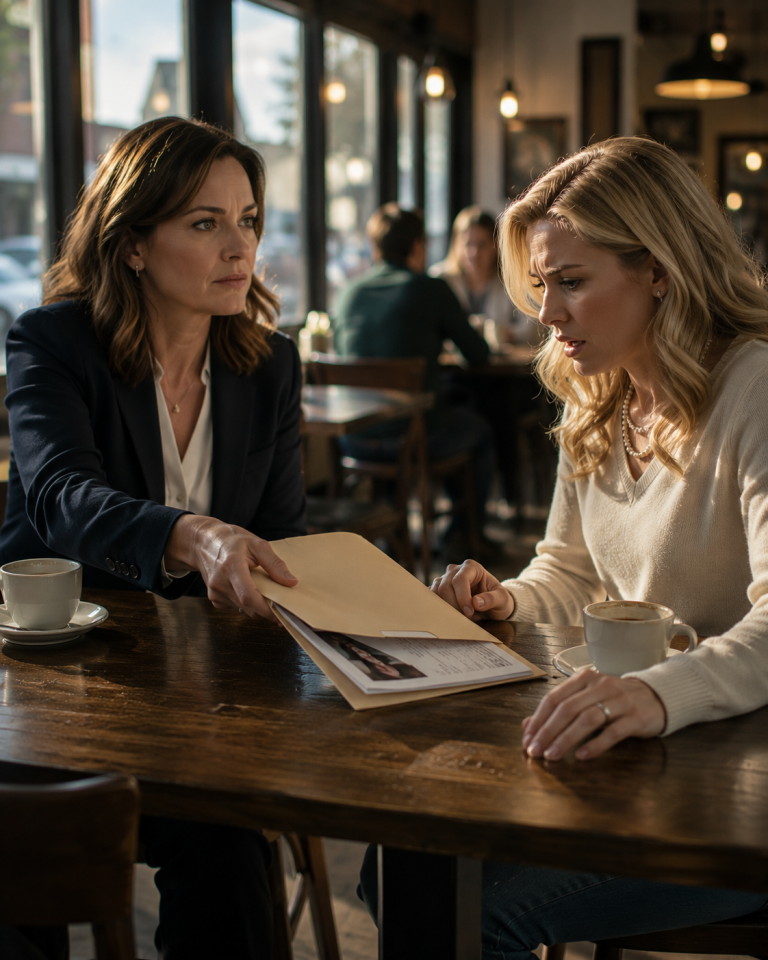
On Sunday I asked Paula to meet me for coffee.
She chose a bakery near her house, which I immediately suspected was so she could leave quickly.
“Don’t manage the exit,” she said when I told her.
“I hate that you can say things like that now.”
“I have been saying them for twenty years. You recently acquired hearing.”
We ordered coffee and split a cinnamon roll because neither of us wanted to admit we wanted a whole one.
“Mom told me,” I said.
Paula nodded.
“That she asked you to be the bad guy.”
Another nod.
“Why did you agree?”
Paula pulled apart a corner of the pastry.
“Because she asked me.”
I gave her a look.
“Also because I was mad at you.”
“There it is.”
“I was.”
“For what?”
“For making me report to you like an employee.”
“I never—”
She waited.
I stopped.
“Fine. Give me an example.”
“Dad’s last Thanksgiving.”
I remembered it immediately. Dad had still been strong enough to sit at the table but tired easily. Paula had brought mashed potatoes two hours later than I asked.
“You were late.”
“I was.”
“You knew he needed to eat early.”
“I did.”
“You see why—”
Paula held up her hand.
“This is the part. You are right about the potatoes.”
I blinked.
“What?”
“I was late. It made dinner harder. I should have called. You were right.”
The argument I had already begun assembling collapsed.
“But for the next year,” she continued, “you never asked me to bring anything time-sensitive again. You assigned me flowers, paper plates, or things that couldn’t go wrong. You didn’t yell. You didn’t punish me out loud. You just quietly changed my category.”
I stared at her.
“That was efficient.”
“Yes.”
“And awful.”
“Yes.”
I rubbed my thumb along the cardboard coffee sleeve.
“I thought I was reducing stress.”
“For yourself.”
“And Dad.”
“Probably. But you never asked whether I wanted another chance to get it right.”
There it was again: the part of competence I had always treated as neutral. If someone disappointed me, I redesigned around them. If something failed, I eliminated the weak point. At work, that made schedules more reliable.
In a family, it could turn people into fixed descriptions.
Paula was late.
Mom was vulnerable.
Evan was inexperienced.
I was dependable.
Once assigned, the roles became hard to escape.
“I’m sorry,” I said.
Paula looked suspicious.
“I mean it.”
“I know. I just don’t know what to do when you apologize before I’m finished.”
“Keep going.”
She smiled.
“I also used your competence when it suited me,” she said. “I let you take Dad’s hardest appointments because I hated hospitals. I let you deal with insurance calls. I let you be the one Mom called at midnight because I knew you would answer.”
“You had two kids at home.”
“I still had a phone.”
We sat quietly.
That was the first conversation Paula and I had ever had about our father that did not end with an argument over who had done more.
The answer, it turned out, was both of us and not enough and too much and whatever we could live with.
“I don’t want Mom to need nobody,” I said.
“She doesn’t.”
“I know. I mean I don’t want independence to become the new performance. She shouldn’t have to prove she can do everything alone just so I won’t take over.”
Paula nodded slowly.
“That’s fair.”
“What if we ask one question?”
Her eyebrows rose.
“I know how that sounds.”
“It sounds like a system.”
“One question is not a system.”
“It is the larval stage of a system.”
I laughed.
“What question?” she asked.
“When Mom mentions a problem, we ask, ‘Are you telling me or asking me?’”
Paula considered it.
“That could work.”
“And we do not text each other behind her back unless there is an actual emergency.”
“Define emergency.”
I pointed at her. “You’re the one who said no systems.”
“Fair.”
We agreed on something intentionally vague: if Mom was conscious, coherent, and capable of asking for what she wanted, we would start with her.
Not each other.
Not our fear.
Her.
Before we left, Paula pushed the last piece of cinnamon roll toward me.
“You want it?” she asked.
“Yes.”
“See? Beautiful. Consent.”
I ate it just to stop her from enjoying herself too much.
On the drive home, Evan called.
“Are you busy?” he asked.
My old answer would have been, Never too busy for you, which sounds loving until you realize it gives the other person no useful information.
“I have about fifteen minutes,” I said. “What’s up?”
He wanted to complain about a supervisor who kept rewriting his work instead of explaining what she disliked.
I almost laughed.
Instead I listened.
After five minutes I said, “Do you want advice or do you want me to agree she’s annoying?”
“Second one.”
“She sounds extremely annoying.”
“Thank you.”
That was all he needed.
It was almost offensive how well it worked.