Three Makers Came to Empty My Shop Because Their Payouts Were ‘Frozen’—Then I Found Ten Holds Entered Under My Manager’s Login

Three women walked into my shop on a Tuesday morning carrying empty plastic bins, and I knew before any of them spoke that they had come to take their work home.
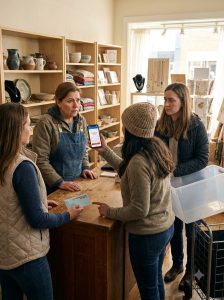
Mara Velez was first through the door. She made ceramic planters with tiny carved windows along the sides, the kind customers picked up and turned in their hands even when they had no intention of buying a planter. Behind her came June Halloway with two rolling totes, then Keiko Mason holding a stack of flattened cardboard boxes against her coat.
None of them smiled.
I was behind the register opening the daily sales report.
“Good morning,” I said.
Mara set one bin on the counter.
“We need our inventory.”
Not some inventory.
Our inventory.
The sentence belonged to a breakup.
I looked at the clock. Nine-fifteen. We had been open fifteen minutes.
“Okay,” I said. “Is something wrong?”
June laughed once.
“You tell us.”
I turned the tablet so the sales screen faced down.
“What happened?”
Mara looked toward the back room.
“Is Paige here?”
“No. She opens at eleven on Tuesdays.”
The three women exchanged a look.
That bothered me more than the bins.
Paige Collins had been my assistant manager for three years. She was twenty-nine, quick with displays, good with customers, and better than I was at remembering which maker had a market every second Saturday and which one refused to sell anything with glitter within ten feet of it.
“What did Paige tell you?” I asked.
Keiko’s voice was quiet.
“That payouts are frozen.”
I stared at her.
“What?”
“She said the shop is having cash-flow trouble,” Mara said. “That vendor payments are delayed until you can stabilize things.”
My body reacted before my mind did. Heat rose under my collar.
“That is not true.”
June folded her arms.
“Then where is my November payout?”
“It went out Friday.”
“No.”
I reached for the register laptop.
June said, “Nina, please do not tell me the software says it went out. I checked my account.”
I stopped.
“What amount?”
“Eight hundred forty-two dollars and sixty cents.”
I knew the number. June sold hand-sewn linen aprons and table runners. November had been a good month.
I opened the vendor portal.
JUNE HALLOWAY.
November sales: $1,203.72.
Vendor share after commission: $842.60.
Status: HOLD — MANAGEMENT REVIEW.
I stared at the screen.
The hold date was Friday at 4:41 p.m.
I had left the shop at four for a dentist appointment.
Mara slid her phone across the counter.
A message from Paige filled the screen.
I’m really sorry. Nina is trying to keep things together, but all vendor payouts are temporarily paused while the shop works through a cash crunch. Please don’t put her on the spot right now. She’s embarrassed and doing her best.
I read it twice.
The first thing I felt was anger.
The second was something worse.
Humiliation.
Not because we were in financial trouble.
Because a woman I trusted had told people I was too ashamed to speak for myself.
I handed the phone back.
“I am not embarrassed because the shop is not having a cash crisis.”
June looked at the screen in front of me.
“Then why is my money on hold?”
“I do not know yet.”
Keiko said, “Mine is too.”
Mara nodded. “And Paige said if we need cash flow ourselves, she has another place we can move inventory temporarily.”
Every sound in the shop seemed to sharpen.
The heating vent.
A delivery truck outside.
The small metal sign on the front door swinging after a customer had left fifteen minutes earlier.
“What place?” I asked.
Mara reached into her tote and handed me a business card.
The card was pale blue.
COMMON THREAD MARKETPLACE
Local goods. Fair terms. Direct maker relationships.
A web address sat underneath.
No owner’s name.
I looked at Mara.
“Who gave you this?”
“Paige.”
“When?”
“Saturday.”
I put the card on the counter.
“Please give me twenty minutes before you pull anything.”
June’s expression tightened.
“Nina—”
“You do not owe me twenty minutes. If you want your work back now, I will help you count it out. But I am asking because I need to know whether your inventory records are clean before anything leaves.”
That landed differently.
June looked at Mara.
Keiko said, “I can wait twenty minutes.”
Mara nodded.
June exhaled.
“Twenty.”
I locked the front door.
A customer walking up to it frowned. I turned the sign to BACK AT TEN and closed the shade halfway.
Then I called Paige.
She did not answer.
I called again.
Voicemail.
I sent one text.
Do not access vendor payouts or inventory from home. Come to the shop at eleven as scheduled. We need to review account activity together.
Then I opened the management log.
The person who had placed June’s payout on hold was PCOLLINS.
So was Keiko’s.
So was Mara’s.
And seven more.
Ten makers.
All within forty-three minutes on Friday afternoon.
My shop was not in financial trouble.
But somebody had built a convincing imitation of one.
* * *
I opened Alder & Finch eleven years earlier with twenty-seven thousand dollars, twelve local makers, and a landlord who gave me three free weeks because the previous tenant had left a mural of dancing vegetables on the back wall.
I kept the mural.
At first I did everything.
I checked in inventory. I swept floors. I built displays. I paid vendors twice a month from a spreadsheet that required more prayer than accounting knowledge.
By year three, I had seventy-two makers.
By year six, I had a real inventory system and a part-time bookkeeper named Celeste who spoke about reconciliations with the calm authority of a person who had never accidentally paid the same potter twice.
By year eight, I hired Paige.
She arrived wearing yellow sneakers and carrying a notebook full of ideas.
Within two weeks she reorganized the back room so I could find every maker bin without moving six others. Within six months she knew which customers bought local gifts for out-of-town relatives and which customers bought candles because they liked pretending their houses were clean.
I trusted her.
That was not an abstract feeling.
Trust had permissions.
Paige could adjust inventory quantities, issue returns, mark vendor payouts for review, schedule social posts, and access our maker communication list.
She could not initiate bank transfers. Celeste or I did that.
But a hold inside the vendor system happened before the bank stage.
Paige had not taken money.
She had stopped money from moving and told the makers why.
I pulled the Friday activity log.
Ten payout holds.
Then a series of inventory exports.
Not full exports.
Selected makers.
Mara.
June.
Keiko.
Lena Hart.
Drew Samuels.
Five others.
The list made sense in a way I did not like.
They were strong sellers with portable work.
Ceramics.
Textiles.
Paper goods.
Jewelry.
Nothing that required a custom wall display or seasonal installation.
I opened the bank dashboard.
Operating account: healthy.
Tax reserve: funded.
Vendor clearing account: exactly where it should be.
No crisis.
No missing cash.
I printed the account summary and the vendor-clearing reconciliation because I wanted paper in front of me when Paige arrived.
At nine-thirty I reopened the door.
Mara, June, and Keiko were sitting in the small workshop area in back, drinking the coffee I kept for maker nights.
I brought them the payout list.
“I found ten manual holds entered Friday afternoon.”
June looked at the names.
“By whom?”
“Paige’s account.”
Mara’s face changed.
Keiko lowered her cup.
I said, “I am not going to ask you to leave inventory here while I figure this out. If you want it back, we will count it together and print a signed removal list. Your held payouts will be released today after Celeste verifies them.”
June looked at me.
“You believe us now?”
“I believed you when you showed me your account.”
“That is not what I mean.”
I sat across from her.
She had sold through Alder & Finch for seven years.
“I believe Paige told you what you say she told you.”
June nodded.
“Good.”
Mara said, “She said you were behind on rent.”
My jaw tightened.
“I am not.”
“She said the holiday inventory orders got ahead of you.”
“I do not buy your inventory. That sentence barely makes sense.”
“I know.”
“Did she tell you why she knew?”
“She said she was helping you restructure.”
June pulled out her phone.
“She told me not to call you because you had barely slept.”
I laughed once because the alternative was swearing.
“I slept eight hours Friday night.”
Keiko looked miserable.
“I should have called.”
“You should have been able to trust my manager.”
She looked up.
The sentence surprised me as I said it.
I could be angry at Paige without making the makers responsible for detecting the betrayal earlier than I had.
Mara touched the Common Thread card on the table.
“She said it was temporary.”
“What?”
“The other site. She said it was a backup marketplace a friend was starting. Lower commission. Weekly payouts.”
“Did she ask you to move everything?”
“Not exactly. She said we could list a smaller set there until Alder & Finch stabilized.”
June said, “She told me the same thing.”
Keiko nodded.
I looked at the card again.
“Did any of you sign anything?”
Mara said, “An online maker form.”
My stomach tightened.
“Can I see it?”
She opened the form confirmation on her phone.
COMMON THREAD MARKETPLACE — MAKER ONBOARDING
The questions were ordinary.
Business name.
Tax information.
Preferred payout method.
Product categories.
Inventory count.
Then one question stopped me.
Current retail partner, if applicable.
Mara had entered ALDER & FINCH.
Another field asked whether the maker authorized Common Thread to coordinate inventory transfers with the current retailer.
Mara had checked yes.
“Did Paige tell you she was involved with this business?” I asked.
Mara frowned.
“No. She said her friend was.”
“Which friend?”
“She did not say.”
I opened the Common Thread website.
The homepage was polished but thin. A logo. A maker waitlist. Photos of pottery, candles, woven bags.
One photograph showed a shelf display I recognized.
It was mine.
Not the shelf itself.
The display.
The angle.
The grouping.
Three years earlier Paige had photographed our spring ceramics table for Alder & Finch social media.
Now the image was cropped tight enough to remove our sign.
I felt my hands go cold.
The site’s footer listed COMMON THREAD MERCANTILE LLC.
I did not know the company.
I wrote the name down.
Not because an LLC name would solve anything.
Because it was one more piece of a pattern.
At ten-forty-five Celeste arrived.
She was sixty-two, wore red reading glasses on a chain, and greeted crisis with the same tone she used for lunch.
“What broke?” she asked.
I handed her the payout report.
She read three lines.
“Paige?”
“Yes.”
Celeste took off her coat.
“All right.”
June stared at her.
“That is your reaction?”
Celeste looked over the top of her glasses.
“I save emotional collapse for tax notices.”
She sat at the register laptop.
Within fifteen minutes she verified the vendor clearing balance.
“No cash issue,” she said. “Release the holds.”
I did.
One by one.
Ten makers.
The system marked the payouts for the next bank batch.
Celeste printed the confirmation.
Then she said, “Now change Paige’s permissions.”
I looked at the clock.
Ten fifty-eight.
“She is due in two minutes.”
“Exactly.”
I disabled remote vendor and inventory access.
At eleven-oh-three, Paige came through the front door carrying an iced coffee.
She saw Mara, June, and Keiko in the workshop area.
Then she saw Celeste.
Then me.
Her face lost color.
“Nina.”
“Put your phone on the counter.”
She stopped.
“What?”
“Your phone. On the counter. You can keep it with you, but I do not want you accessing shop accounts while we talk.”
Her eyes sharpened.
“You locked me out.”
“Yes.”
She looked toward the makers again.
“This is not what it looks like.”
June said from the back, “That sentence never helps.”
I almost smiled.
“Office,” I said.
Paige followed me into the tiny room behind the stock shelves.
Celeste came too.
Paige closed the door.
“You embarrassed me in front of vendors.”
I stared at her.
“Ten vendor payouts were put on hold under your login Friday. You told makers the shop was in financial trouble. You told them I was too ashamed to speak to them. Then you gave them onboarding information for another marketplace.”
Her mouth tightened.
“I was trying to prevent a panic.”
“There was no reason for panic until you created one.”
“You do not understand what people have been saying.”
“Then tell me.”
Paige looked at Celeste.
“Does she have to be here?”
“Yes,” I said.
Celeste said nothing.
Paige took a breath.
“Several makers have been complaining about commission.”
“That is not a cash-flow crisis.”
“No. But they were already considering leaving.”
“Which makers?”
“Mara. Lena. Drew.”
“Did they tell you that?”
“Not exactly.”
“What exactly?”
“They asked about selling other places.”
“They are allowed to sell other places.”
“That is the point.”
“No, Paige. It is not. Why did you hold payouts?”
She looked at the floor.
“I needed time.”
“For what?”
“To show them another option.”
The room became very quiet.
Celeste leaned back in her chair.
I said, “Common Thread?”
Paige looked at me.
“You found it.”
“Is it yours?”
A pause.
“Partly.”
The word did not surprise me.
I had already known.
Knowing did not reduce the hurt.
“How partly?”
“My friend Tessa and I started it.”
“When?”
“We have been building it for a few months.”
“Without telling me.”
“It is online. It is not the same business.”
“You used my maker list.”
“I talked to people I have relationships with.”
“Relationships you built while being paid to manage my shop.”
“They are not property.”
“I did not say they were.”
Paige’s voice rose.
“Then why are you acting like I stole them?”
“Because you lied to them about my business so they would consider yours.”
“I did not lie.”
Celeste looked up.
Paige glanced at her.
I said, “The shop is current on rent. Vendor clearing is funded. No payout needed to be frozen. Which part of cash-flow trouble was true?”
Paige pressed her lips together.
“I thought December was going to be bad.”
“Based on what?”
“Returns are up.”
“Returns are up six percent.”
“Holiday buying is softer.”
“Sales are four percent above last year.”
“You always do this.”
“What?”
“Reduce everything to the current report. I am telling you the model is changing.”
“Then make that argument without inventing a crisis.”
She looked at me with a frustration that felt older than Friday.
“You take thirty percent from people who make the work.”
“And I pay rent, utilities, staff, insurance, card fees, packaging, marketing, and the people who stand here explaining why a two-hundred-dollar handmade coat costs two hundred dollars.”
“I know.”
“Do you?”
“Yes. I know the numbers better than most of them because I work here.”
“Then why did you tell them I could not pay?”
Her face changed.
For the first time I saw the answer before she spoke.
“Because if I just asked them to try Common Thread, you would call it poaching.”
Celeste quietly said, “So you created a reason for them to leave without feeling poached.”
Paige looked at her.
Then away.
I felt something settle in me.
Not rage.
Clarity.
“You are done for today,” I said.
Paige’s head snapped back.
“Nina.”
“Leave your shop keys.”
“You cannot seriously fire me in ten minutes after three years.”
“I did not say fired.”
“What else does leave your keys mean?”
“It means I am removing access while I reconcile what you changed.”
She laughed sharply.
“That is convenient.”
“No. Convenient was letting you manage systems I trusted you to manage.”
Paige pulled the keys from her bag and put them on the desk.
“I built half this place with you.”
The sentence hurt because part of it was true.
“You helped build it,” I said. “That is why this is worse.”
* * *
By lunchtime, all ten held payouts were in the bank batch.
I sent each affected maker the same email.
Your payout was manually placed on hold in our vendor system. The shop’s vendor-clearing funds were available, and the hold did not reflect a shop-wide cash shortage. The hold has been released. I am reviewing how and why the communication occurred. You are free to retrieve or leave inventory, and I will provide a complete itemized count either way.
I did not mention Paige’s side business.
Not yet.
I did not write “betrayal,” “poaching,” or “scheme.”
Facts first.
Emotion later.
By two o’clock, two makers collected their work.
Three decided to leave it.
Mara took half.
“That is not a punishment,” she said while we counted planters.
“I know.”
“I want to try the other platform too.”
“You should sell wherever makes sense.”
She looked surprised.
“What?”
“I thought you would be angry.”
“I am angry.”
“At us.”
“No.”
She studied me.
I said, “I might have opinions about what commission should be or whether online marketplaces can do what stores do. But you do not owe me exclusivity.”
Mara nodded slowly.
“That helps.”
“What would help more is if I stop pretending my manager’s behavior had nothing to do with my shop.”
Her face softened.
I hated the sentence.
It was still true.
Paige had acted behind my back.
I had given her the access.
Not irresponsibly. Not foolishly. But enough that the makers’ first experience of the lie came from someone with my title under hers.
At three, a customer came in looking for one of June’s aprons.
“We are temporarily out,” I said.
June was standing ten feet away packing them.
The customer looked at her.
June looked at me.
Then she said, “Actually, I am taking them home today.”
The customer looked disappointed.
June added, “I might be back.”
That tiny sentence gave me more hope than I deserved.
* * *
That evening I stayed late with Celeste.
We ordered Thai food and went through the logs.
Payout holds were only the first layer.
Paige had exported selected inventory lists six times over the previous seven weeks.
She had also downloaded maker contact data.
The export tool existed because vendors sometimes asked for their current stock list or because we built market-season reports.
Each action looked ordinary by itself.
Together they looked different.
Celeste circled dates on a printout.
“Look at the sequence.”
September 14: maker contact export.
September 18: selected inventory report.
September 20: calendar note, MAKER CHECK-IN — M.V.
September 27: selected inventory report.
October 3: maker contact export.
October 6: calendar note, DREW COFFEE.
October 19: selected inventory report.
November 1: Common Thread domain registered, according to the public site information Paige had listed in a footer policy page.
November 8: selected inventory report.
November 22: ten payout holds.
I put down my chopsticks.
“She did not build the other site because people panicked on Friday.”
“No.”
“She needed Friday because the site was ready.”
Celeste looked at me over her glasses.
“Likely.”
I rubbed my forehead.
“I need more than likely before I say that to anyone.”
“Good.”
“What if she really believed the shop was weakening?”
“Then she can show the numbers she relied on.”
“What if the makers were going to leave anyway?”
“Then the truth would have been sufficient.”
I looked at the logs.
That was the part I kept coming back to.
Paige had arguments she could have made honestly.
Our commission was higher than Common Thread’s posted fifteen percent.
A physical store did have overhead an online marketplace did not.
Some makers wanted faster payouts.
Some wanted more control over customer data.
Those were real pressures.
If Paige had resigned and opened a competing marketplace, I would have been hurt.
I also would have understood.
Instead she had created a fake weakness in my business to make hers feel necessary.
Celeste said, “Do you know what you are going to do about Paige?”
“No.”
“You do.”
“I know what I am not going to do.”
“Which is?”
“Pretend she can come back as assistant manager.”
Celeste nodded.
“That seems wise.”
“I also do not want to turn maker night into a prosecution.”
“You should not.”
“I need them to know what happened.”
“Yes.”
“But I do not want them choosing us because they hate her.”
Celeste smiled faintly.
“That is the first intelligent thing you have said since dinner.”
“Thank you.”
“You are welcome.”
* * *
The next morning Paige emailed me before seven.
Subject: I CAN EXPLAIN THIS BETTER
Nina,
Yesterday got hostile fast, and I said things badly. Common Thread was never designed to hurt Alder & Finch. I have been hearing maker frustration for months, and I believed some vendors needed an option before the shop’s slower holiday cash cycle put them in a difficult position. The holds were temporary while I sorted what was due and what inventory might transfer. No money was missing. I should have told you first.
I read the email standing in my kitchen.
The phrase slower holiday cash cycle was creative.
Our payout account did not depend on holiday sales after the makers’ items sold. Their share was already theirs in our books.
Paige knew that.
I forwarded the email to Celeste.
Then I read it again.
One sentence bothered me more than the rest.
The holds were temporary while I sorted what was due and what inventory might transfer.
Inventory might transfer.
The payout holds and inventory migration were connected in her own explanation.
At nine, I met Paige at a coffee shop because I did not want the conversation inside Alder & Finch.
She looked exhausted.
“I am sorry,” she said as soon as I sat down.
“For what?”
Her face tightened.
“Do not do that.”
“Do what?”
“Make me list crimes.”
“I am asking because I need to know what you understand.”
She looked at the table.
“I should not have held payouts.”
“Agreed.”
“I should not have told people you were embarrassed.”
“Agreed.”
“I should have told you about Common Thread.”
“Yes.”
She looked up.
“But I am not sorry I started it.”
“I did not ask you to be.”
That surprised her.
“I think makers need another model.”
“Then build it.”
“I am.”
“Without false information about mine.”
Paige leaned back.
“Nina, Alder & Finch depends on makers accepting your terms.”
“It depends on them choosing my terms.”
“Thirty percent is not much of a choice if you are the best foot-traffic store in town.”
“That is still a business argument, not a reason to freeze money.”
She looked frustrated.
“You keep isolating Friday from everything before it.”
“No. I am trying to understand everything before it.”
I took out the activity timeline.
Her face changed.
“You printed logs.”
“Yes.”
“This is insane.”
“September fourteenth. Maker export. September twentieth, meeting with Mara. September twenty-seventh, selected inventory. October third, maker export. October sixth, Drew. When did Common Thread begin?”
Paige folded her arms.
“We were talking about it in summer.”
“Before the payout holds.”
“Obviously.”
“Before you told makers Alder & Finch might fail.”
“I never said fail.”
“Cash-flow trouble. Payouts frozen. Behind on rent.”
“I did not say behind on rent to everyone.”
I stared at her.
She realized what she had admitted.
“How many did you tell?”
Paige looked away.
“Two.”
“Who?”
“Mara and Lena.”
“Why?”
“Because they were hesitant.”
There it was.
Not panic management.
Sales.
I felt sadness more than anger.
“You needed them to believe leaving me was the safer choice.”
Paige’s eyes flashed.
“They are adults.”
“Yes.”
“They can evaluate information.”
“Not if you invent part of it.”
She stood.
“I am not going to sit here while you act like you own people.”
“I do not own them.”
“You act like anyone who leaves betrayed you.”
“No. You betrayed me. They can leave.”
The distinction stopped her.
I continued. “If Mara sells on Common Thread and does well, I will be happy for Mara. If you build a better marketplace than my store, that is competition. I can survive competition or I cannot. What I will not accept is you creating a false crisis so the makers believe their choice is stay with a failing shop or go with the person rescuing them.”
Paige’s eyes filled.
“I did not want to be the villain.”
The sentence was so honest I stopped.
She sat back down.
“I knew if I told you I was building Common Thread, I would have to leave Alder & Finch,” she said. “I need my salary. Tessa and I cannot pay ourselves yet.”
“So you stayed.”
“Yes.”
“And used the shop to build the next thing.”
Her mouth twisted.
“I know how that sounds.”
“It sounds accurate.”
She wiped under one eye.
“You have no idea how long I have felt like the employee who does the modern part of your business while you get to be the owner everyone loves.”
I let that land.
There was truth in it.
Paige had pushed me into better online inventory photos. She built maker newsletters. She argued for faster vendor reporting. She had good ideas.
I had praised her.
Maybe not enough.
Maybe not in the ways she wanted.
None of that changed Friday.
“I should have talked to you about your future here,” I said.
She laughed bitterly.
“You would have offered me five percent more and a nicer title.”
“Maybe.”
“That is why I did not ask.”
“Then you chose.”
She looked at me.
“So did I.”
“What?”
“You are not coming back as an employee.”
Her face went still.
“Nina.”
“I will pay all earned wages through today and any unused time according to our normal policy. Celeste will send the details. I am not going to discuss Common Thread with customers. I am not going to tell makers they cannot use it. But your access to Alder & Finch is over.”
She stared at me for several seconds.
“You are firing me.”
“Yes.”
“Because I started a competitor.”
“Because you used your management access to hold vendor payouts and gave vendors false financial information about this shop to steer their decisions.”
She looked away.
The distinction mattered.
I wanted it to be clean because nothing else felt clean.
* * *
By Friday, the rumor had escaped the ten makers.
A customer asked whether we were closing.
Then a maker who had never been on hold emailed, Should I be worried about December payout?
I posted a short statement in the private vendor portal.
Alder & Finch is operating normally. A limited set of vendor payouts were manually placed on hold last Friday and have been released. Those holds did not reflect insufficient funds in the vendor-clearing account. We are reviewing internal access and communication practices. Any maker who wants an itemized balance or inventory count can request one directly from me or Celeste.
No mention of Paige.
No mention of Common Thread.
That afternoon my landlord came in carrying a tape measure.
I almost laughed from nerves.
“What are you measuring?”
“Window trim.”
“Why?”
“Because I am replacing it.”
“Oh.”
He looked at me.
“Did you think I was measuring you for a coffin?”
“People have heard we are failing.”
He frowned.
“Who said that?”
“Long story.”
“Well, your rent cleared.”
“Thank you for that deeply romantic vote of confidence.”
He left ten minutes later.
I stood alone near the front window and realized how quickly a business could be converted into a story.
The truth was boring.
Rent paid.
Vendor account funded.
November sales steady.
One employee gone.
The false story was vivid.
Owner in trouble.
Payouts frozen.
Makers rescued.
New marketplace waiting.
People remembered vivid.
If I wanted trust back, I would need to make boring visible.
* * *
I scheduled a maker meeting for Sunday evening after close.
Thirty-eight people came.
Some brought folding chairs because they knew the workshop area only seated twenty-four.
Mara sat in the front row with her arms folded.
June stood in back beside the wrapping counter.
Keiko brought cookies.
Celeste sat at a small table with printed payout reconciliations available by maker name.
I stood near the register.
“I am going to tell you what I know, what I do not know, and what changes starting tomorrow,” I said.
No microphone.
No slide deck.
Just facts.
“Last Friday ten vendor payouts were manually placed on hold using assistant-manager access. The funds were available. All ten holds have been released. Some affected makers were told the shop was in cash-flow trouble and that I was embarrassed or unable to talk. Those statements were false.”
A murmur moved through the room.
I continued.
“Paige Collins is no longer employed by Alder & Finch. She is involved in another marketplace called Common Thread. Some makers were invited to list there. I am not asking anyone to choose between us. I am asking you to make choices using accurate information.”
Drew raised a hand.
“Are you saying she stole our data?”
“I am saying maker contact and selected inventory data were exported under her account. I am still reviewing exactly how each export was used. I will not claim more than I know.”
A woman near the window asked, “Can she legally use our names?”
I did not answer a legal question I could not answer.
“If you submitted information directly to Common Thread, ask them what they retain and how they use it. For Alder & Finch, I am changing our access so no one employee can export the full maker directory without a second approval.”
Celeste nodded.
June raised her hand.
“What about payouts?”
“Starting next cycle, every vendor gets an automatic email when a payout changes status. A management hold will show who placed it and why. If the hold lasts more than one business day, Celeste and I both get an alert.”
Someone said, “That sounds like you do not trust staff.”
“I trusted one person more broadly than our controls justified. Good systems should not require perfect people.”
The room went quiet.
That was one of the hardest sentences I had said all week.
Mara raised her hand.
“What is your commission going to be?”
A few people laughed.
I smiled.
“Still thirty percent tonight.”
“Tonight?”
“I am reviewing what services are actually included and whether some categories need options. I am not promising a lower number because I have not finished the math.”
“Common Thread is fifteen.”
“I know.”
Drew said, “They do not have a storefront.”
Mara turned. “They also pay weekly.”
June said, “Can we not turn this into a sales meeting for either company?”
That got another laugh.
I held up my hands.
“Please sell where it works for you. The only commitment I need tonight is that inventory physically in this store matches the itemized list you approve. If you leave pieces here, we both sign the count. If you remove pieces, we both sign that count.”
Then we did exactly that.
For two hours.
No speeches.
No loyalty pledges.
Tables filled with earrings, mugs, scarves, prints, candles, carved spoons.
Makers checked their lists.
My staff checked tags.
Celeste verified payouts.
Some people left everything.
Some took half.
Four removed all inventory.
It hurt each time.
I did not stop them.
At nine-thirty, Mara came to the counter with a signed sheet.
She was leaving twelve planters and taking eighteen.
“I am going to try Common Thread,” she said.
“I figured.”
“I also want to keep some here.”
“Okay.”
“Are you sure?”
“No,” I said. “But okay.”
She smiled.
“That is fair.”
I stapled our copies together.
Mara looked toward the empty chairs.
“Paige told me you would make us choose.”
My hand stopped.
“When?”
“Before the payout thing. Maybe October.”
“What exactly did she say?”
“That if you knew she was building another marketplace, you would blacklist anyone who helped.”
Heat moved up my neck.
“I have never blacklisted anyone.”
“I know that now.”
“Why now?”
“Because you just watched four people walk out with their inventory and did not threaten them.”
I looked at her.
There are moments when you realize the most important evidence is not a document.
It is behavior someone can see.
* * *
Monday morning was the first day in three years that Paige was not supposed to open the shop with me.
I arrived at seven-thirty anyway.
The silence felt wrong.
Paige used to come in carrying two coffees and a new complaint about our front display. She would turn on the pendant lights before the ceiling lights because she said no handmade object deserved fluorescent lighting before eight a.m. She played old soul music while we counted cash. She hated the broom I bought because the handle was too short and refused to let me replace it because, in her words, “I have already invested emotionally in resenting this broom.”
I had expected anger to make those memories irrelevant.
It did not.
I stood in the stockroom looking at the hook where her yellow raincoat used to hang and missed her.
That made me furious all over again.
Nia did not work for me yet. My two current part-time employees, Sam and Lacey, arrived at eight.
They both looked nervous.
Sam put his backpack under the counter.
“Are we allowed to ask what happened?”
“Yes.”
Lacey said, “Paige texted me that she was fired for starting her own business.”
I closed my eyes for half a second.
There it was already.
Another clean story.
I said, “She was terminated after using her shop access to put vendor payouts on hold and giving makers inaccurate information about our finances while inviting some of them to another marketplace she helped start.”
Sam blinked.
Lacey said, “Oh.”
“I am not asking either of you to take sides.”
“Did she steal money?” Sam asked.
“No.”
“Did she steal inventory?”
“Not that I know.”
“Then what are we supposed to say if people ask?”
“Nothing on my behalf. Tell them to ask me.”
Lacey looked relieved.
Then she looked worried again.
“Are you going to check all our messages now?”
The question stopped me.
“No.”
“You changed permissions.”
“Yes.”
“Paige said you are locking everything down.”
“I am changing what the system allows one person to do. That is different from reading everybody’s private messages.”
She nodded, but I could see she was not fully convinced.
I realized that controls designed after betrayal could easily become punishment for people who had not betrayed me.
“Let me be specific,” I said. “You can still contact makers. You can still adjust an item count if a piece is broken or returned. What changes is that payout holds, full-directory exports, and large inventory exports require a second approval. I am not interested in making this place unworkable because I am angry.”
Sam said, “That seems normal.”
Lacey looked at him. “You think everything is normal.”
“It is my best quality.”
They went to work.
At nine-fifteen, I found a sticky note on the staff bulletin board in Paige’s handwriting.
MARA — wants spring display, talk after Thanksgiving.
I stood there longer than necessary.
I could have thrown it away.
Instead I moved it to my desk.
Paige’s work here had been real.
Her betrayal was real too.
I was going to have to learn how to hold both without turning one into evidence that the other had never existed.
That was harder than changing a password.
* * *
Tuesday afternoon, Tessa Rowan came into the shop.
I recognized her from Common Thread’s about page.
She was tall, maybe thirty-one, wearing a camel coat over black jeans. She carried a laptop sleeve and the expression of a person entering a building where she expected to be disliked.
“Nina?”
“Yes.”
“I’m Tessa.”
“I know.”
She nodded.
“Can we talk?”
I looked at the sales floor. Sam was at the register. Only two customers were browsing.
“Workshop table.”
We sat in back.
Tessa kept both hands on the laptop sleeve.
“I want to be clear that Paige did not send me.”
“Okay.”
“She is furious I am here.”
“That makes two of us surprised.”
Tessa almost smiled.
Then she took a breath.
“I did not know she was holding payouts.”
I waited.
“I knew she was talking to makers. I knew she was exporting her own contact notes.”
“Her own?”
“That is what she told me.”
“What did she say Alder & Finch knew?”
Tessa looked down.
“She said you knew she wanted to eventually leave.”
“I knew she wanted more responsibility. I did not know she was building Common Thread.”
“She told me you knew about the concept.”
“I did not.”
Tessa’s mouth tightened.
“I thought that might be true.”
“What changed your mind?”
“She showed me the Sunday vendor-portal message.”
I stared at her.
“She still had a screenshot.”
“What about it?”
“You wrote that the holds were manually entered and did not reflect insufficient funds.”
“Yes.”
“Paige told me the shop was having a temporary cash squeeze and that she used the holds because she did not want the bank batch to overdraw.”
I felt anger return, clean and immediate.
“That is impossible. She could see the vendor clearing balance.”
“I know that now.”
“How?”
Tessa opened her laptop.
“I asked her to show me why she thought the account was short.”
She turned the screen toward me.
A photo of a handwritten note appeared.
PROJECTED VENDOR GAP — HOLIDAY.
Numbers underneath.
Expected December sales.
Expected maker payouts.
Rent.
Payroll.
The categories were mixed in a way Celeste would have hated. Vendor funds were treated as if they were simply part of operating cash.
“This is not how our accounts work,” I said.
“She said it was simplified.”
“It is fictional.”
Tessa closed the laptop.
“I think she built the explanation after the fact.”
The sentence did not make me feel better.
“Why are you telling me?”
“Because I am her business partner, and she used our company while doing something I did not agree to.”
I studied her.
“That sounds familiar.”
Tessa winced.
“Yeah.”
We sat in silence.
Finally I asked, “What did you think Common Thread was?”
“A new marketplace. Lower commission. Mostly online, pop-ups quarterly. We were going to recruit makers through markets, social media, referrals.”
“Not through my store?”
“I knew Paige would invite people she knew.”
“That means my store.”
“Yes.”
“But did you know she had a migration list?”
Tessa frowned.
“What list?”
I had not found it yet.
At that point, neither of us knew the file existed.
“I only know she exported selected inventory repeatedly.”
Tessa leaned back.
“She told me she was building market-size estimates.”
“Using my sales data?”
“She said aggregated examples.”
I laughed once.
The same behavior had a cleaner name in every room.
Tessa rubbed the edge of the laptop sleeve.
“I am not asking you to forgive her.”
“Good.”
“I am asking you not to assume Common Thread was built around hurting you.”
“I do not.”
She looked surprised.
“I think Paige wanted Common Thread because she wanted something she owned. I understand that.”
Tessa nodded.
“I think she also wanted to avoid the cost of leaving honestly.”
Tessa looked down.
“That I understand too.”
When she left, I felt no alliance with her.
But the story became more complicated.
Paige had lied sideways as well as upward and downward.
To makers, I was failing.
To me, Common Thread was merely a friend’s backup site.
To Tessa, I knew the concept and Paige was using harmless relationship notes.
Every person had been given the version that removed the hardest conversation.
* * *
By Wednesday, the shop was operating well enough that I began to feel foolish for how catastrophic Tuesday had seemed.
The payouts cleared.
No vendor balance was missing.
Customers kept coming.
The front window needed changing because the Thanksgiving display suddenly looked exhausted.
Lacey asked whether she could build the new one.
Normally Paige would have done it.
I said yes.
At four, I watched Lacey arrange red paper stars around a set of wooden serving boards.
The first version was terrible.
My instinct was immediate.
Move the tallest board left. Reduce stars. Add height under the ceramics.
I opened my mouth.
Then closed it.
Lacey stepped back.
“Hate it.”
“I did not say anything.”
“Your eyebrows did.”
She rearranged two boards.
Still bad.
Sam came over.
“Needs something dark.”
“Thank you,” Lacey said. “A useful person.”
I went to the office.
Ten minutes later Lacey called me back.
The display was good.
Not how Paige would have done it.
Not how I would have done it.
Good.
That small moment embarrassed me.
I had spent the whole week thinking about Paige’s misuse of freedom while giving almost no thought to how difficult I sometimes made it for people to have ownership inside my shop.
Again, explanation was not excuse.
But I wanted to learn something other than suspicion.
That evening I called my younger sister, Carla.
She lived in Denver and had never worked a day at Alder & Finch, which made her useful.
“Are you asking whether you are controlling?” she said after I told her the situation.
“No.”
“Because the answer is yes.”
“I am asking whether I missed that Paige wanted something of her own.”
“Oh. Also yes.”
“Wonderful.”
“Nina, you talk about the shop like it is a person you gave birth to.”
“It has more reliable hours than a baby.”
“You know what I mean.”
I leaned back in my desk chair.
Carla said, “Did Paige ever ask about equity?”
“Once.”
“And?”
“I told her I was not ready.”
“How long ago?”
“Eighteen months.”
“Did you ever revisit it?”
“No.”
“Why?”
“I forgot.”
There was a pause.
I heard how bad it sounded.
Carla said, “She did not forget.”
“No.”
“That does not make freezing payouts okay.”
“I know.”
“But if you are asking whether the betrayal came from nowhere, probably not.”
I looked at the old sticky note on my desk.
MARA — spring display.
Paige had done work worthy of being remembered.
I had also assumed the shape of her ambition could fit forever inside the job I had created.
That assumption belonged to me.
The manipulation belonged to her.
I wrote both sentences in my notebook because I did not trust myself to keep them separate when I was angry.
* * *
Friday afternoon, Mara called me from her studio.
“Common Thread wants thirty planters for a December launch,” she said.
“That is a lot.”
“Yes.”
“Can you make thirty?”
“That is not why I am calling.”
I waited.
“They want me to move the twelve still at Alder & Finch because they want a complete exclusive launch online.”
My stomach tightened.
“Do you want to?”
“I do not know.”
“Then do not decide on the phone with me.”
“She said I need to decide today.”
“Who?”
“Paige.”
I stared at the wall.
“What exactly did she say?”
“That Common Thread is trying to build cleaner brand relationships and does not want split stock during the launch.”
I almost laughed.
The woman who had accused me of acting like makers were property was now asking for exclusivity.
Mara said, “I know what you are thinking.”
“No, you don’t.”
“You are enjoying this.”
“A little.”
“Fair.”
Then her voice softened.
“I still do not know what to do.”
“What will sell more planters?”
“I do not know.”
“What will make you more money?”
“Also do not know.”
“Then ask for the numbers and the terms. Do not decide because Paige needs her launch clean or because you are afraid I will be hurt.”
Mara was quiet.
“Why are you making this hard?”
“What?”
“It would be easier if one of you were obviously the bad choice.”
I leaned my forehead against the office wall.
“I know.”
She laughed softly.
“I am going to keep the twelve with you.”
“Because?”
“Because they are already there and you have weekend traffic. I will make a different batch for Common Thread.”
“That sounds like a business decision.”
“Annoying, isn’t it?”
“Very.”
After we hung up, I realized that was the future I wanted.
Not makers proving loyalty.
Makers having enough accurate information that their choices did not need to flatter me.
For a few days, I believed that was where the story was settling.
Paige gone.
Payouts restored.
Controls changed.
Makers free to test both models.
A painful business breakup, but a comprehensible one.
I almost let myself call it resolved.
Then Celeste found the August spreadsheet.
* * *
Monday morning, Paige sent another email.
This one had no apology.
It said she wanted her personal files from the shop computer and accused me of portraying Common Thread as dishonest.
I replied that I would provide any clearly personal documents after review and that I had told makers only verified facts about Alder & Finch access and her role.
Then I stopped replying.
At noon, Celeste called me into the office.
“You need to see this.”
She had found a folder in the shop’s shared design archive.
The folder name was OLD SOCIAL.
Inside were display photographs, vendor product shots, and graphics created for Alder & Finch.
One subfolder was called CT TEMP.
I stared at it.
“Common Thread temporary?”
“That would be my guess.”
The files were copies.
Some had been cropped.
Some had our logo removed.
One was the ceramics image from the Common Thread website.
I felt sick.
Then I noticed the file dates.
July.
August.
September.
Common Thread’s public site had only gone live in November.
But the materials existed months earlier.
Celeste clicked another file.
A spreadsheet titled MAKER MIGRATION — PHASE 1.
I stopped breathing for a second.
Columns:
Maker.
Current monthly sales at A&F.
Commission concern.
Likely to move.
Needs reassurance.
Inventory portability.
Priority.
Mara: HIGH.
June: HIGH.
Keiko: MED-HIGH.
Drew: HIGH.
I sat down.
“This was on our shared drive?”
“In a folder Paige had access to.”
“Can we tell when it was created?”
Celeste showed me the file metadata.
August 12.
The first vendor payout hold happened November 22.
The migration plan came first.
I read the notes.
Mara — worried about margin. Emphasize weekly pay + low risk.
June — loyal to Nina. Needs reason to test elsewhere without feeling disloyal.
Keiko — cautious. Frame as backup channel.
Drew — hates commission. Easy.
I could barely read the next line.
General: avoid making this feel like poaching. Position as overflow / stability option if A&F tightens.
There was the story.
Not created Friday.
Designed in August.
The payout holds were not a panic response.
They were a conversion tool.
Celeste said nothing.
I closed the spreadsheet.
“Make a read-only copy for our records. Do not circulate it.”
She nodded.
I called Mara.
Then June.
Then Keiko.
Not to recruit them back.
To tell them that the assumptions we had made Sunday were incomplete.
I said the same thing each time.
“I found an August planning file that identifies certain Alder & Finch makers as migration targets for Common Thread and specifically discusses avoiding the appearance of poaching. You are named. I am telling you because it changes the context of the Friday payout holds. I can show you your row if you want to see it.”
Mara went silent.
Then she said, “She had me on a list?”
“Yes.”
“Before she told me the shop was in trouble?”
“Yes.”
“Do you want me to stop using Common Thread?”
“No.”
“Why not?”
“Because your business decision is still yours.”
She exhaled.
“I do not know what to do with that.”
“Neither do I.”
* * *
The false resolution came on Wednesday.
Paige asked to meet.
She chose the same coffee shop.
This time she arrived with a printed letter.
“I will shut down the vendor side of Common Thread for sixty days,” she said. “Tessa and I talked.”
I stared at her.
“Why?”
“So everyone can calm down.”
“That is not my decision.”
“It would stop this from getting uglier.”
“What is this?”
She slid the letter toward me.
It proposed that Common Thread pause onboarding any current Alder & Finch maker for sixty days, that I not discuss Paige’s conduct publicly, and that we both describe the conflict as a disagreement over business strategy.
I read the first paragraph.
Then the second.
Then I put it down.
“No.”
Her eyes narrowed.
“You have not even read all of it.”
“I do not need you to close Common Thread.”
“I am offering.”
“You are offering a story.”
“What?”
“A disagreement over business strategy.”
“That is what this is.”
“No. We have a business-strategy disagreement. We also have payout holds, false financial claims, and a migration file created months earlier.”
Her face changed.
“What migration file?”
I watched her carefully.
If she had looked confused, perhaps something in me would have softened.
She looked scared.
“August twelfth,” I said. “Maker Migration — Phase 1.”
She went still.
“That was brainstorming.”
“June is described as loyal to Nina and needing a reason to test elsewhere without feeling disloyal.”
Paige looked toward the window.
I continued. “General note: avoid making this feel like poaching. Position as overflow or stability option if Alder & Finch tightens.”
“It was a draft.”
“Before the crisis.”
“There was no crisis.”
The words came out before she could stop them.
We both heard them.
Paige closed her eyes.
I felt no triumph.
Only grief.
“You knew,” I said.
She rubbed her forehead.
“I knew the shop was not broke.”
“Then why tell them?”
“Because they would never leave you otherwise.”
The answer was quiet.
It was also the entire story.
Paige had not stolen people.
She had tried to manufacture their freedom from loyalty by turning me into someone unsafe to stay with.
“You could have asked them to choose,” I said.
“They like you.”
“That is not a trap.”
“It is when they feel guilty.”
“So you made them afraid instead.”
Paige’s eyes filled.
“I wanted one thing that was mine.”
The sentence reached me because I understood it.
Alder & Finch was mine.
Paige had helped build it, but her name was not on the door.
Customers thanked me for displays she designed.
Makers texted me about ideas she had executed.
She had spent years inside someone else’s ownership.
That resentment was real.
It still did not grant permission to falsify weakness.
“You should have built Common Thread,” I said.
“I did.”
“You should have left me and built it honestly.”
“I was scared.”
“I believe you.”
“That is all you have to say?”
“No.”
I slid the letter back.
“I am not agreeing to a shared public story. I am also not running a campaign against you. If someone asks me why you no longer work at Alder & Finch, I will say you used management access to place vendor payouts on hold and gave makers inaccurate financial information while developing another marketplace. If they ask whether they can sell with you, I will tell them that is their choice.”
Paige stared at me.
“You are going to destroy me.”
“No.”
“You know what that sounds like.”
“Yes.”
“Then what is the difference?”
“The difference is I am not creating a crisis to make people leave you.”
* * *
December was not a disaster.
It was not a triumph either.
Sales finished one percent below the previous year.
Seven makers reduced inventory.
Three left completely.
Two new makers joined.
Mara sold out of a planter line on Common Thread and brought a different collection to Alder & Finch.
That surprised both of us.
“Different customers,” she said when she delivered the new pieces.
“Apparently.”
“Your customers touch everything.”
“They do.”
“Online customers buy faster.”
“That sounds plausible.”
She smiled.
“You hate admitting the other model works.”
“I hate admitting almost everything before coffee.”
She laughed.
The shop changed.
We built a vendor dashboard that showed pending payouts, hold reasons, inventory counts, and commission charges clearly.
We added a fifteen-percent “shelf only” option for a small group of experienced makers who handled their own packaging, product descriptions, and restocking, while the full thirty-percent model remained for makers who wanted store merchandising and active sales support.
The math did not work for every category.
We adjusted where it did.
Not because Paige had been right to manipulate people.
Because she had been right that the model was changing.
Those truths could coexist.
I hired a new operations coordinator in February.
Her name was Nia Greene.
During her second interview, I showed her the new access matrix.
“No single person can export the full maker directory or place a payout hold over one business day without a second approval,” I said.
Nia raised an eyebrow.
“That sounds like a story.”
“It is.”
“Do I get the story?”
“After ninety days.”
She laughed.
I hired her two days later.
* * *
In March, Common Thread held its first pop-up market in an old warehouse three blocks away.
I knew because half my Instagram feed knew.
Paige’s face appeared in photographs beside Tessa’s under a blue Common Thread banner.
For several minutes I stared at the images.
She looked happy.
That hurt in a complicated way.
I had imagined that accountability would produce visible regret.
Instead Paige had built the thing she wanted.
Some makers I knew stood behind tables.
Mara was there.
Drew too.
June was not.
I closed the app.
Then reopened it.
Not because I wanted to punish myself.
Because I wanted to know whether seeing her succeed changed what had happened.
It did not.
Competition was not betrayal.
Success was not innocence.
Failure would not have been justice.
I finally understood that I had been waiting for the market to morally grade us.
It would not.
The only thing I controlled was the shop I ran and the truth I told inside it.
That afternoon June came in with a new spring apron line.
She set a box on the counter.
“You look weird.”
“Common Thread pop-up.”
“Ah.”
“Did you go?”
“No.”
“Why not?”
June shrugged.
“I did not want to.”
“Because of Paige?”
“Partly.”
“Do not stay here because you think I need loyalty.”
She gave me an exhausted look.
“Nina, I am fifty-four. Please stop trying to manage my motives.”
I laughed so hard Nia looked over from the back room.
June continued. “I stay because my aprons sell here, you pay when you say you will, and customers bring their friends back to argue about pocket size. If that changes, I will leave.”
“That is strangely comforting.”
“It should be.”
We checked in the aprons together.
At the bottom of the box, June had included a new style with deeper pockets.
“Customer feedback?” I asked.
“Apparently women want to carry their entire lives while making soup.”
“Reasonable.”
I printed the inventory labels.
June signed the count.
So did I.
The paperwork took two minutes longer than our old casual system.
I liked the two minutes.
The new system got its first real test six weeks later.
Not a dramatic one.
That was why I trusted it.
A maker named Alyssa Grant came in on a Wednesday carrying a tray of silver earrings and an expression I recognized from the Tuesday with the bins.
Not anger yet.
Preparation for anger.
She waited until two customers left, then placed her phone on the counter.
“My payout email says two hundred sixty-four dollars,” she said. “My portal says one hundred ninety-eight.”
Under the old version of me, I would have felt accused before I had enough information to deserve either guilt or confidence.
I would have said, “That cannot be right,” because I wanted the shop to be the kind of place where it could not be right.
Instead I said, “Let’s look at both numbers.”
Nia joined us from the stockroom.
We opened Alyssa’s account together.
The difference came from three earrings that had been marked sold at a holiday pop-up but returned to active inventory when the customer’s payment failed. The sales report had included the first status. The payout report had included the corrected one.
Nothing had been stolen.
Nothing had been frozen.
The reports were simply pulling at different times.
Alyssa looked from one screen to the other.
“So which one is mine?”
“One ninety-eight this cycle,” I said. “And the other three pairs are still yours and still here.”
I brought the tray from the locked jewelry case and matched all three tags to the live inventory.
Alyssa counted them herself.
Then she nodded.
“That makes sense.”
I did not feel triumphant.
I felt relieved in a much smaller, healthier way.
“Would you have called me six months ago?” I asked.
She gave me a look.
“Before all this?”
“Yes.”
“Probably not.”
“Why?”
“Because I would have assumed I was reading it wrong.”
The answer embarrassed me.
Not because of Paige.
Because of me.
I had spent years telling makers my door was always open while maintaining systems complicated enough that most questions still had to pass through a person with authority. My warmth had hidden some of the asymmetry.
The new portal did not make us equal in every way. I still owned the shop. I still set commission rates, accepted or declined inventory, and decided what belonged on the floor.
But it made ordinary facts less dependent on whether a maker felt comfortable interrupting me.
That mattered.
Nia printed a one-page explanation of how pending, sold, reversed, and payable statuses worked. Alyssa read it, crossed out two sentences she said sounded like software instructions written by a toaster, and rewrote them in the margin.
We used her version.
At the next maker night, I handed out the new sheet.
I also put one question at the top of the meeting agenda.
WHAT CAN YOU SEE NOW THAT YOU COULD NOT SEE BEFORE?
The answers surprised me.
June wanted the date an item entered the shop visible next to the payout line.
Drew wanted a report showing items older than ninety days so he could decide whether to rotate them out.
Keiko wanted return reasons separated from damage notes because she hated reading “customer return” and wondering whether a mug handle had fallen off.
Mara wanted nothing.
“I have reached my maximum desired level of administrative enlightenment,” she said.
“Noted.”
Then a younger maker named Tessa raised her hand.
“Can we talk about Common Thread without everybody getting weird?”
Everybody got weird.
Chairs moved.
Someone coughed.
Mara looked at me.
I said, “Yes.”
Tessa had joined both platforms after the crisis.
She liked Common Thread’s online reach. She liked our local customer base. She disliked feeling as though using both made her disloyal to somebody.
“I know no one has said that,” she added. “But it feels like it.”
I looked around the workshop.
There it was again.
The temptation to make loyalty do work that clarity should do.
“You do not owe Alder & Finch exclusivity unless we have a written exclusive agreement on a specific item or line,” I said. “Most of you do not. If another platform serves you, use it. I would rather know why you stay here than have you stay because leaving feels socially dangerous.”
June pointed at me.
“That sounded rehearsed.”
“It was expensive personal growth.”
People laughed.
The laugh loosened something.
Drew said Common Thread sold his smaller pieces better online but that he preferred launching new work with us because customers could touch it.
Keiko said she had tried two listings there and stopped because shipping made her nervous.
Mara said she sold everywhere and refused to join anyone’s emotional custody battle.
I wrote that down.
“You are not putting that in policy,” she said.
“I might embroider it.”
By the end of the meeting, three makers had reduced inventory with us, two had increased it, and nobody had been asked to prove allegiance.
That was the first month our total consigned inventory shrank on purpose.
I went home worried anyway.
The store looked thinner in two sections. Our spring forecast was lower than the one Celeste and I had made before Paige left. I spent a Friday night with the sales reports open on my dining table and had to resist the old impulse to interpret every smaller number as punishment.
Celeste came by Saturday morning with bagels and no patience.
“You said you wanted a smaller model,” she reminded me.
“I wanted a stronger model.”
“You cannot become smaller without first becoming smaller.”
“That sounds fake-deep.”
“It is arithmetic.”
She sat across from me and tapped the margin report.
Our revenue was down nine percent from the previous spring projection.
Our handling costs were down fourteen.
Returns were easier to trace.
Vendor questions were up sharply because the portal now gave people information to ask about.
Complaints were down.
“What does that tell you?” she asked.
“That people are bothering us more efficiently.”
“It tells me they are looking.”
I knew what she meant.
Visibility created questions.
Questions were not failure.
For years I had treated smoothness as evidence that everything was fine. Paige had exploited that instinct because she knew I liked being the place where problems were quietly solved before anyone felt them.
Quiet could mean competent.
Quiet could also mean nobody knew enough to object.
The next Monday I changed one more practice.
Every quarterly maker report would include not only sales and payouts, but inventory adjustments, holds, returns, and the names of the staff accounts that made them.
Nia read the draft policy.
“You know this means if I make a dumb correction everyone sees my name.”
“Yes.”
“If you make one?”
“Mine too.”
She nodded.
“Okay.”
That answer mattered more than if she had told me she would never make a mistake.
I had hired Paige partly because she seemed able to carry complexity without making me look at it.
With Nia, I wanted something different.
Not less trust.
Less mystery.
The distinction had taken me eleven years and one manufactured crisis to learn.
* * *
A year after the Tuesday with the plastic bins, Mara brought me one of her new planters.
Not for inventory.
For me.
It was dark green with three tiny carved windows.
“I do not accept bribes,” I said.
“It is an anniversary gift.”
“For what?”
“Surviving me taking eighteen planters out of your store while you tried not to cry.”
“I did not try to cry.”
“You absolutely did.”
I took the planter.
“Thank you.”
Mara leaned on the counter.
“Common Thread is changing its payout schedule.”
I looked at her.
“Do you want me to pretend not to enjoy that?”
“Yes.”
“Done.”
She smiled.
“It is still fine. I sell there. I sell here. I do markets.”
“Good.”
“You know what is weird?”
“What?”
“Paige was right that I needed another channel.”
“I know.”
“And wrong that I needed to be tricked into it.”
I looked at the planter in my hands.
“That is the whole thing, isn’t it?”
“Pretty much.”
After Mara left, I put the planter on the shelf behind the register.
Then I noticed the old consignment tag hanging from one of the hooks beneath the counter.
It was from the shop’s first year.
Handwritten in black ink.
MARA VELEZ — WINDOW PLANTER — $38 — 70/30.
I had kept a handful of old tags because I was sentimental about paper evidence of survival.
Our new tags were printed, barcoded, linked to live inventory, and visible in the maker portal before an item hit the floor.
I held the old tag beside the new planter.
For years, I thought trust was the absence of paperwork.
A handshake.
A remembered promise.
Knowing a maker’s dog’s name and whether she preferred email or text.
Now I understood trust could also look like a visible number both sides could check.
A reason entered where both sides could see it.
A system that did not require one person to be perfect.
I slipped the old tag into the drawer where I kept shop mementos.
Then Nia called from the back.
“Nina, vendor hold request on Keiko. She entered a duplicate tax form and the system wants second approval.”
“I’m coming.”
I walked to the office.
Keiko’s account was on the screen.
Hold reason visible.
Amount visible.
Requested by Nia.
Waiting for me.
I checked the duplicate form, called Keiko, and cleared the issue in six minutes.
Before I approved the hold, I typed the reason into the shared field.
Keiko would see it too.
No embarrassment.
No invented story.
No one person deciding what another person needed to believe.
Just the work, visible on both sides.