The Woman Everyone Called Crazy Was the Only One Who Knew What Was Really Inside Sweet Ruby’s Cart

The rain hadn’t stopped for an hour. Ruby Calhoun’s hand still hadn’t moved off the latch. Her knuckles had gone white around it. Behind her, half of Bellhaven stood frozen in the downpour, cups of cherry-red cordial still warm in their hands. They were watching a woman they’d trusted for eleven years refuse to let anyone look under the cart she’d wheeled down Magnolia Street every day of their lives. And somewhere in that crowd, a homeless woman they’d laughed at for over a decade had finally stopped shouting. Because for the first time, nobody was laughing back.
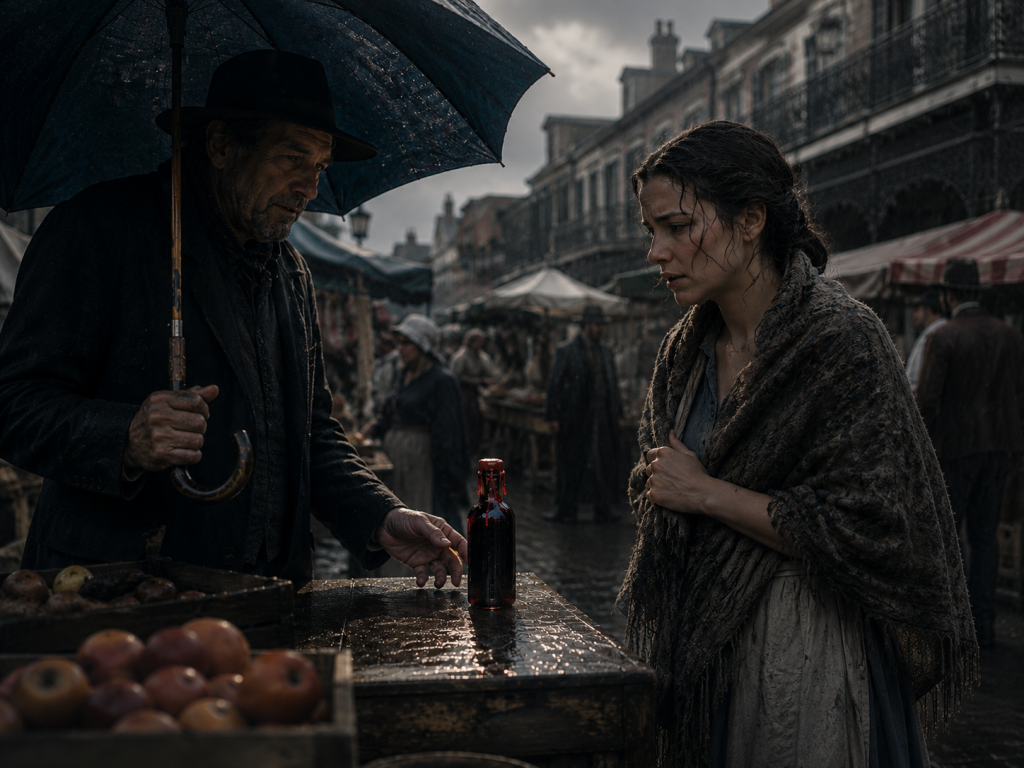
The rain hadn’t let up in an hour.
Ruby’s hand still hadn’t moved off the latch.
“Ruby.” Otis’s voice, low. “Let him look.”
“There’s nothing to look at.”
“Then it costs you nothing to move your hand.”
She didn’t move her hand.
Delphine stood at the edge of the crowd, soaked through. Not shouting.
It was the not-shouting that unsettled people most.
She’d traded volume for something quieter. Something heavier.
And heavier carried further.
“You’ve known this was coming,” Delphine said. “Longer than any of us.”
Ruby’s eyes cut to her. Sharp. For just a second.
“You don’t know what I know.”
“I know you stood under that umbrella and heard exactly what I heard.”
Delphine’s voice didn’t rise.
“I know you heard him say there’s no price for you. I know you decided not to ask the rest of that sentence. I know, because six years before he ever found you, he stood in front of me and said the exact same thing.”
The crowd’s attention swung between the two women.
“That’s not true.”
“Ask me what I said back to him.”
Ruby’s jaw worked. She said nothing.
“I said no.” Delphine let the silence carry it. “I asked who pays the price he wasn’t naming. When he wouldn’t answer straight, I walked away and never looked back.”
She took one small step closer.
“You didn’t ask him that question, Ruby. I know you didn’t. Because I’ve watched you not ask it for eleven years. Every single time I stood on this street and gave you the chance to.”
Alden’s hand finally found the small hinged panel.
Ruby’s fingers, still resting on his wrist, loosened.
Not surrender exactly.
More like a woman too tired to keep holding a door shut that everyone could already see was cracked.
The bottle he drew out was smaller than anything Ruby had ever sold.
Nearly black in the gray light. Sealed with dark wax the color of something old, best left unnamed.
Two women near the front — regulars, women who’d bought from Ruby every week for years — looked down at the cups still warm in their hands.
Slowly, without a word, they set the cups down on the wet pavement.
Like something that had just revealed itself to be alive.
“What is it,” Otis said again.
Ruby’s eyes went to the bottle. Then to Delphine. Then somewhere past both of them, toward a horizon none of the rest of them could see.
“You want the whole story,” she said. “Fine. You’ll get the whole story.”
The market was three hundred miles from Bellhaven and thirty-one years in the past.
It smelled like rain on old brick, and river water, and fish just off the boats.
Ruby Calhoun was twenty-six years old. Eleven dollars in her coat pocket. A rent payment due she already knew she couldn’t make.
The stall was tucked between a fruit vendor and a woman selling secondhand church dresses.
It sold nothing Ruby could put a name to. Small dark bottles. Dried roots she didn’t recognize. Things that looked wrong sitting so close to peaches and plums.
The man behind it stood under a blue umbrella, even though the rain hadn’t started yet.
Like he already knew it was coming.
He had kind eyes. She would remember that detail for the rest of her life.
“You look tired,” he said.
“I am tired.”
“Tired of what, exactly?”
She almost laughed. Almost told him it was none of his business.
But something in the way he asked it kept her standing there.
“Being nobody,” she said. “Being poor. Being so tired I can’t remember what I wanted before I got tired.”
He reached under the table and set a small dark bottle between them.
“I could change that.”
“With what. A drink?”
“With a recipe.” He nodded at the bottle. “And something to go with it. People will love you. You’ll never be poor again. Your tongue will turn to honey.”
Ruby looked at the bottle. Then at him.
“What’s it cost?”
He held her gaze a long moment.
“There’s no price for you.”
Something in Ruby’s chest loosened at those words. A held breath she hadn’t known she was holding.
Twenty-six years old and so tired of being nobody, she heard exactly what she wanted to hear.
And let the rest of the sentence go unasked.
Six years earlier, at that same stall, under that same umbrella, a younger Delphine Boudreaux had stood in almost the exact same spot.
Twenty-four years old. Three years into night shifts at the parish hospital. Her hands still smelling faintly of antiseptic.
“You look tired,” he’d said to her too.
“I am a nurse. Tired is the job.”
He’d set the same bottle down.
“I could change that.”
“Change it how.”
“A recipe. Something to go with it. People will love you—”
“What’s it cost?”
He smiled the exact same patient smile he’d give Ruby six years later.
“There’s no price for you.”
Delphine hadn’t let that sentence sit unfinished the way Ruby would.
She’d worked nights in a hospital long enough to know nothing costs nothing. That every bill eventually comes due to somebody — even when the somebody standing in front of you isn’t the one who’ll be handed it.
“No price for me,” she said slowly. “So who’s it cost?”
His smile hadn’t moved. But something behind his eyes had gone very still.
“Does it matter, if it isn’t you?”
“It matters to me.”
She’d already started backing away.
“I’ve held enough dying hands to know better than to take something free that somebody else is going to bleed for.”
She walked away from that market and never told a soul.
There was nothing yet to tell. No proof. No bottle. No cart. Just a strange man under a blue umbrella and a bad feeling she couldn’t fully explain, even to herself.
Six years later, her husband died. Her house went with him.
The thread of her days came loose in a way thirty years of steady nursing hadn’t prepared her for.
One ordinary afternoon, wandering Bellhaven with nowhere in particular to be, she heard a bell.
Small. Brass. Bright.
She turned the corner by the feed store and saw a cart painted red and gold. A woman with a straw hat and a honeyed laugh.
Something in her stomach turned over like spoiled milk.
She recognized the bottle before she ever saw it. In the sweetness of the cordial itself. In the particular ice-cold brightness of it.
“Ma’am.” Delphine approached the cart that very first afternoon. Quiet. Careful. “Where’d you get your recipe?”
Ruby’s smile hadn’t wavered.
“Family secret, baby.”
“Was it a man under a blue umbrella?”
Ruby’s smile flickered. Just once. Just barely. A crack so fast most people would have missed it.
Delphine hadn’t missed it.
She’d spent thirty years reading faces for the truth underneath what patients said out loud. She read that flicker the way she’d once read a pulse.
“I don’t know what you’re talking about,” Ruby said.
She turned the cart’s wheel toward the next customer in line. Rang the little bell once, brightly, like punctuation.
That was the last calm conversation the two women ever had.
Everything after that — eleven years of it — was Delphine shouting from the sidewalk what Ruby refused to say from behind the cart.
The fog came slow. That was the part nobody in Bellhaven understood until it was already over.
It didn’t arrive like a storm. It arrived like a Tuesday.
Otis Dunmore had run the tailor shop on 3rd Street for twenty-two years by the time it happened to him. Twenty-two years of closing his eyes, running two fingers along a bolt of fabric, and knowing — not guessing, knowing — exactly what he was holding.
A traveling salesman came through that spring with a wagon full of bolts he swore were fine English wool.
“Feel that.” The salesman held out a corner of gray cloth. “Tell me that’s not the best weave you’ve touched all year.”
Otis ran his fingers over it. Something in the gesture felt the same as it always had.
Familiar. Automatic.
“Where’s it milled?”
“Manchester.” The salesman didn’t blink. “Same house my father bought from.”
Otis nodded slowly, still holding the fabric, and something in him — some small, quiet certainty that had never once failed him — simply said yes.
Not check the weave count. Not ask for papers. Just yes.
“I’ll take the whole lot.”
His wife would ask him later, standing in the ruined storeroom, why he hadn’t done what he’d done every single time in twenty-two years before signing for a shipment.
“I don’t know,” he told her. Turning a damp, moth-eaten bolt over in his hands like it belonged to a stranger. “I just knew. The way I always know.”
“You didn’t always know, Otis. You always checked.“
He didn’t have an answer for that. Not that day. Not for a long time after.
Three doors down, Coralee Fontenot’s hands started failing her the same spring, in a smaller, quieter way that took longer to notice because a seamstress’s mistakes hide inside fabric until a bride is already standing in front of a mirror.
She’d been sewing the Ashworth wedding gown for six weeks. Lace sleeves, a full train, the kind of dress women in three parishes still talked about years later.
“Miss Coralee.” The bride’s mother stood in the doorway of the fitting room, voice careful in the way people get careful right before they say something unkind. “The seam here. On the left sleeve.”
Coralee looked. Her stomach dropped before her mind caught up with why.
The lace ran backward. Not badly — not so a stranger would notice — but wrong all the same, the pattern reversed against the grain in a way her hands had never once done in fifteen years.
“I’ll fix it,” she said. “Give me the afternoon.”
She sat alone at her worktable after the Ashworths left, holding the sleeve up to the window light, and found she couldn’t say, looking at her own careful stitches, whether the reversal had happened yesterday or three weeks ago. She simply hadn’t seen it. Her hands had done it and her eyes had let it pass.
“It’s like something’s come between my knowing and my doing,” she told her sister that night, turning her own palms over in the lamplight like they belonged to someone else. “Like there’s a fog I can’t see. But it’s there. Like reaching for something through water.”
Her sister didn’t have an answer either. Nobody did yet. That was the whole problem with a fog — you couldn’t point at it, couldn’t hold it up to the light and say here, this is what’s wrong. You could only watch people you loved reach for things that used to come easy, and come back with their hands empty, over and over, and call it bad luck because bad luck was easier to live with than the alternative.
At the high school on the edge of town, three seniors were three weeks out from finals that same spring, and all three of them were losing something they couldn’t yet name either.
“I had this cold.” Marcus Webb sat across from his study group at the library table, a stack of chemistry notes untouched in front of him. “Last week. I swear I knew this whole unit cold.”
“You still do.” His friend Denise didn’t look up from her own notes. “You got a ninety-four on the practice test.”
“I don’t remember getting a ninety-four.”
That was the part that scared him more than any bad grade could have. Not failing. Forgetting that he hadn’t failed. Sitting in a classroom afterward with a graded test in his own handwriting, unable to locate the memory of having taken it at all — like the knowledge itself had been moved to a room in his mind he could no longer find the door to.
He passed his finals that June. Walked out of the schoolhouse pale, describing it to his friends in a voice that didn’t sound entirely like his own.
“It’s like it’s all still in there,” he said. “I can feel it. I just can’t get to it anymore.”
Even the Peabody sisters — three elderly women who’d sat on their porch on Magnolia Street for as long as anyone in Bellhaven could remember, the town’s unofficial living newspaper, the ones who could tell you whose marriage was in trouble before the couple themselves admitted it — began losing threads they’d never once dropped before.
“Did I tell you the Hendersons are selling?” Miss Ida Peabody rocked slowly on the porch swing, glass of Ruby’s cordial sweating in her hand.
“You told me that yesterday.” Her sister Opal didn’t look up from her knitting. “And the day before.”
“Did I?”
“You did.”
Ida frowned, searching for the memory of having said it, and coming up with nothing at all — just a smooth, blank patch where a conversation should have been, the way a chalkboard looks after it’s been wiped clean.
“That’s strange,” she said, quiet. “I don’t remember telling you at all.”
Nobody connected any of it. Not Otis’s ruined fabric, not Coralee’s backward stitches, not Marcus’s vanishing memory of his own success, not the Peabody sisters’ fraying threads. They were small, separate sadnesses scattered across a town with a hundred other things to worry about — the price of cotton, the coming storm season, whose truck needed a new transmission.
And every single evening, while the fog thickened over one life after another, Ruby Calhoun’s cart rolled down Magnolia Street with its bell singing bright and clear, and her laugh got warmer, and her comebacks got sharper, and the whole street leaned toward her the way plants lean toward a window.
Delphine watched all of it happen. That was the cruelest part of her eleven years — not that she didn’t know, but that she knew exactly, in granular, specific detail, and had no way to make any single person on that street connect what was happening to them with the sweet drink cooling in their own hands.
She tried differently, some years. Quieter, some years. Louder, others.
“Mr. Dunmore.” She’d caught Otis outside his ruined shop that same spring, voice low, careful, nothing like the shouting she’d later become known for. “Have you noticed anything strange about your hands lately?”
Otis had looked at her the way most of Bellhaven looked at her by then — not unkindly, exactly, but the particular polite distance people keep from a woman they’ve already decided is unwell.
“I appreciate you asking,” he said. “I’m fine, Miss Boudreaux.”
“You’re not fine. You bought ruined fabric on a feeling you’ve never once trusted wrong before, and you can’t tell me why you trusted it this time.”
Otis’s face had closed like a door.
“Have a good afternoon.”
He’d walked back into his shop, and Delphine had stood on the sidewalk a long moment, hands shaking with something that wasn’t quite anger and wasn’t quite grief, and understood — not for the first time, and far from the last — that quiet didn’t work. Quiet let people walk away with their dignity intact and their blindness untouched.
So she got loud. And loud is what Bellhaven remembered.
It became, over the years, something close to a ritual. Ruby’s cart would round the corner by the feed store, bell singing, and a few paces behind it, Delphine would appear, shouting the same warning in whatever new arrangement of words she could find that week, hoping one version might finally land where a hundred others hadn’t.
Ruby found a use for it, the way she found a use for nearly everything.
“Delphine, baby, come on over here.” She’d wave her over in front of a full crowd, cordial bottle already uncorked. “Let me pay you for the show.”
She’d press a couple of dollars into Delphine’s palm, loud enough for the tourists to hear, loud enough for the joke to land exactly the way she wanted it to.
“Free advertising,” Ruby told the crowd, grinning, and the crowd laughed, and somewhere in that laughter, eleven years of a genuine, desperate warning folded itself down into a running gag that tourists would stop their cars to watch.
Delphine took the money most days. Not because she needed it, though she did. She took it because refusing it would have meant a scene, and a scene would have meant Ruby telling the story of it afterward — the crazy woman who wouldn’t even take a kindness — and Delphine had already lost the argument for her own sanity in this town so many times that she’d stopped spending what little credibility she had left on small refusals.
She spent it, instead, on showing up. Every day. For eleven years. Even when showing up cost her whatever was left of her dignity in the eyes of a street that had already decided, long before that rainy Thursday, exactly what kind of woman she was.
There was one night, in the seventh year, when Ruby almost told someone the truth.
She’d known Bess Calloway since her second month in Bellhaven — the two of them closing up their carts and shopfronts within an hour of each other most evenings, walking the same stretch of Cypress Lane home, trading the kind of easy, half-tired conversation that builds into something like real friendship without either party quite noticing it happening.
That particular evening, Bess had asked her, offhand, the way you ask something you don’t expect to matter.
“You ever think about what’s actually in that cordial of yours? Twenty years running a store next to that cart, and I still couldn’t tell you.”
Ruby’s step had faltered. Just slightly. Just enough that Bess noticed and slowed to match her.
“Ruby?”
“It’s a family recipe,” Ruby said, too quickly, the same line she’d given a thousand times before.
“I know what you always say.” Bess studied her face in the porch light spilling from a house they were passing. “I’m asking what’s true.”
For one long moment, standing on that ordinary sidewalk on an ordinary evening, Ruby had felt the whole weight of it rise up in her chest — the market, the blue umbrella, the sentence she’d never let herself finish. She’d opened her mouth. Felt the shape of the truth sitting right behind her teeth, ready.
“Bess, there’s something I—”
A car horn sounded somewhere down the block. A child called out for her mother. The moment cracked, the way ordinary life is always ready to crack a moment like that, and by the time the street went quiet again, Ruby had already decided.
“There’s something I should tell you,” she said instead. “I’ve been meaning to raise my prices. Sugar’s gone up something awful this year.”
Bess laughed, easy, unsuspecting, and the two women kept walking, and Ruby spent the rest of that walk hating herself in a small, quiet, manageable way that she’d gotten very good at managing by then.
She thought about that night more than she ever let on. Some years, she told herself she’d try again — find the right evening, the right friend, the right words. But the right evening never quite arrived, and the cart kept doing better every season, and the comfortable lie kept being easier to live inside than the alternative, right up until a rainy Thursday made the choice for her, the way she’d always half-known, somewhere underneath the honey, that it eventually would.
“I tried to tell you quietly first.” Delphine, back in the rain now, thirty-one years and eleven more folded into this one gray afternoon. “You remember that, don’t you. That very first week. I asked you plain, and you looked me dead in the eye and lied.”
Ruby’s face had gone the color of the storm clouds overhead.
“I didn’t lie. I just didn’t—”
“You lied.”
Delphine let the word sit.
“And then you spent eleven years turning me into a joke so nobody would ever ask me the same question and get a truer answer.”
Otis’s hand tightened slightly on Ruby’s elbow. Not comfort anymore.
Something closer to holding someone still.
“Twenty-two years,” he said. “I trusted my own two hands for twenty-two years, Ruby. You know what that shipment of ruined wool cost me? My family?”
“Otis, I never meant—”
“I don’t care what you meant.” His voice didn’t rise, but something under it had gone hard. “I care what happened. And what happened is I lost the thing I was best at in this whole world. The same years your cart got famous three streets over.”
Coralee pushed to the front of the crowd. Her hands — steady now, weeks healed, though nobody yet understood why — pressed flat against her own chest.
“Fifteen years,” she said. “Fifteen years of the finest stitchwork in three parishes. And I couldn’t sew a straight seam to save my life.”
Her voice cracked.
“Do you know what that felt like? Reaching for something you’ve always known how to do — and finding a fog where it used to be?”
Ruby’s eyes filled.
For the first time in eleven years, nobody on that street could tell if it was performance or the real thing.
For the first time, nobody particularly cared to find out.
“I told myself it wasn’t real,” she said. “I told myself people just get older. Hands shake. Memories slip. That’s just—”
“That’s just what you needed it to be.” Delphine’s voice had gone gentler now, though it still carried across the whole silent street. “So you wouldn’t have to look at what you actually were.”
“And what was I.”
Delphine’s answer came without hesitation. Like a truth that had been ready for eleven years and finally had somewhere to land.
“A woman who got warmer every year the rest of us got colder. A woman who never once asked herself why.”
Rain dripped off the edge of Ruby’s straw hat. Off the ribbon gone the color of wet rust.
She looked at the small dark bottle like she was seeing it for the first time herself.
“I was going to stop,” she said. Quiet. Almost to herself. “Every year, I told myself, this is the last year.”
She shook her head slowly.
“And every year the cart made more than the year before. And I told myself just one more season.”
“That’s what he counts on.” Delphine’s voice had softened further. “That’s the whole trick of it. He doesn’t have to make you evil. He just has to make you comfortable enough, for long enough, that you stop asking questions you already know the answers to.”
Ruby’s hand came up to her own mouth. Pressing hard.
Like she could physically hold back whatever wanted to come out of it.
“What happens now,” Otis said. Not unkind. Just tired.
Delphine looked at the bottle one more time.
“Now she stops,” she said. “Now the cart stops. And now, God willing, all of you get back whatever it was you lost.”
Nobody remembers exactly who moved first.
Some folks on Magnolia Street will tell you it was Coralee, reaching out to take the bottle gently from Alden’s hand — like it was something fragile and something dangerous all at once.
Others swear it was Otis, stepping back from Ruby’s elbow. Letting her stand — or not stand — entirely on her own.
What everyone agrees on is what happened next.
Ruby Calhoun stepped back from her own cart.
The cart she’d painted red and gold every spring for eleven years. The cart with the bell that sang two minutes before anyone ever saw her coming.
She didn’t say goodbye.
She didn’t try to explain herself further. Didn’t apologize, or ask forgiveness from a street that wasn’t ready to give it to her even if she had.
She just turned, and walked.
Her straw hat left behind on the cart’s seat, already darkening in the rain.
Nobody followed her.
Bess Calloway stood near the back of the crowd, one hand pressed flat against her own mouth, watching Ruby’s straw hat darken on the abandoned seat of the cart.
She was thinking, though she’d never say it out loud to anyone that day, about a walk home four years earlier. About a sentence that had started and never finished. Bess, there’s something I—
She hadn’t thought about that unfinished sentence in years. She thought about nothing else for the rest of that afternoon.
“You knew her a long time,” Otis said, low, coming to stand beside her once the crowd had begun to loosen and scatter into smaller, murmuring clusters.
“I thought I did.” Bess didn’t take her eyes off the empty cart. “She started to tell me something once. Years back. I never let her finish. I don’t think I even noticed I hadn’t.”
Otis didn’t have anything to say to that. Neither of them did. They just stood together in the thinning rain, looking at a straw hat with a ribbon gone the color of wet rust, thinking about all the ordinary evenings a truth could have found its way out into the open, if only somebody had been quiet enough, at exactly the right moment, to let it.
Delphine watched Ruby go the longest of anyone. Longer than Otis. Longer than Coralee. Longer than the two women whose cups still sat untouched on the wet pavement.
There was no triumph on her face.
Otis would say later it looked like something closer to grief. Like watching the last chapter of a story she’d spent eleven years trying to keep from ending this way.
“You could’ve stopped her sooner,” someone in the crowd finally said. Not accusing, exactly. Just thinking out loud, the way people do after a storm passes. “If you’d told us the whole truth from the start. About the market. About knowing him.”
Delphine turned toward the voice, unhurried.
“Would you have believed me? Eleven years ago, before any of you had lost anything yet? A woman in torn coats telling you the sweetest thing in this town was poison?”
Nobody answered.
“That’s what I thought.” Not unkindly. “Some truths, you can only hand people a little at a time. Enough to make them look. The rest, they have to find on their own — or it doesn’t stay found.”
The cart stood abandoned in the rain the rest of that afternoon.
Gold paint running faintly pink down its sides.
Until Otis finally walked out from beneath his own shop awning, took hold of the handle with both hands, and wheeled it quietly away.
He wasn’t sure yet what he meant to do with it. Only that it couldn’t stand there a moment longer.
The healing that followed came the same slow way the fog had come.
So gradually, most people almost didn’t notice it happening until it already had.
Three weeks later, Otis was sorting a fresh bolt of wool for a wedding suit.
His fingers found a flaw in the weave before his eyes ever caught it.
He stood very still in his own storeroom, fabric held between two fingers.
Something in his chest loosening that he hadn’t fully realized had been clenched for years.
“Otis?” His wife’s voice, from the doorway. “You alright?”
He didn’t answer right away. Just kept his fingers on the fabric, testing it again.
And again.
Like a man checking a pulse he’d feared was gone.
“I’m alright,” he finally said. “I think I might actually be alright.”
Coralee’s hands steadied within the month.
She cried, alone in her shop, the Sunday she finally cut a length of fabric cleanly along the grain on the first try. Cried in a way that had nothing to do with sadness at all.
“I got my hands back,” she told her sister that night. Turning her own palms over and over in the lamplight, like she still didn’t quite trust them.
“I didn’t know how much I’d already grieved them,” she said, “until I didn’t have to anymore.”
Marcus Webb was two years out of Bellhaven by then, a sophomore at the state university, when he called his mother on an ordinary Sunday evening for no particular reason he could name.
“Mama. You remember that chemistry final I told you about? Senior year?”
“I remember you worrying yourself sick over it.”
“I remember the whole test now.” He said it slowly, like he was still testing whether it was true as the words left his mouth. “Every question. I couldn’t do that before. It’s just — there. Like it was always there and something was standing in front of it.”
His mother was quiet on the other end of the line long enough that he asked if she was still there.
“I’m here,” she said. “I just didn’t know you’d lost it in the first place.”
“I don’t think I did either. Not really. Not until I got it back.”
On the porch on Magnolia Street, Ida Peabody rocked slowly in the autumn light, a fresh glass of sweet tea sweating in her hand — plain tea now, from a jar she brewed herself, since nobody on that street had touched a bottle of cordial since the rainy Thursday.
“Did I tell you the Hendersons finally sold that house?” she asked her sister.
“You told me last week.” Opal didn’t look up from her knitting.
“I know I told you last week.” Ida smiled, small and satisfied, testing the shape of her own memory the way you’d test a chair before sitting all the way down in it. “I’m telling you again because I remember telling you the first time. That’s the part that’s new.”
Opal’s needles paused.
“That is new,” she agreed, and went back to her knitting, and neither sister said anything else about it, because there wasn’t anything else that needed saying. Some kinds of relief don’t require conversation. They just settle into a body, quietly, the way warmth settles into a room after a long winter.
Three weeks after the rain, a young reporter from the county paper found Delphine sitting on a bench outside the courthouse.
A coffee cup warming her hands. One she wasn’t drinking from.
“Mrs. Boudreaux.”
“Miss.” Delphine didn’t look up right away. “Never remarried.”
The reporter sat down at the far end of the bench. Notebook closed on her knee. Not opened yet.
“Can I ask you something?”
“You’re going to anyway.”
“You could have told someone the whole story. Years ago. Not just the warning — the whole thing. Why didn’t you?”
Delphine looked out at Magnolia Street a long moment.
Watched an ordinary Tuesday move past. A mail truck. Two kids on bicycles. Nothing at all like the rainy Thursday three weeks behind them.
“I told you,” she said. “I told all of you. Every single day. For eleven years.”
“That’s not what I asked.”
A small, tired smile moved across her face. The first the reporter had seen from her.
“No,” she said. “It isn’t.”
The reporter waited. Let the silence do the work Delphine seemed to need it to do.
“You want to know why I never sat somebody down the way I’m sitting with you now,” Delphine said finally. “Told it slow. Told it plain. Market, umbrella, the whole thing, start to finish.”
“I do.”
“Because a story like that, told all at once, to a woman who’s never lost anything yet — it doesn’t land as truth. It lands as a woman with too many coats telling you a fairy tale.” She turned her coffee cup slowly on the bench between her hands, watching the surface of it settle. “You have to lose something first. Then the story finds somewhere to land.”
“That seems like a cruel way to have to wait for people to believe you.”
“It was.” Delphine didn’t dress it up any softer than that. “Eleven years cruel, if you want a number for it. I’m not going to sit here and tell you I made peace with the waiting. I didn’t. I just decided the waiting was better than staying quiet, and some days that’s the only choice a person gets.”
She set her coffee cup down on the bench between them. Untouched.
Finally turned to look the younger woman full in the face.
“I don’t need you to believe I was right,” she said. “I never did.”
She paused.
“I needed, just once, for somebody to look. That’s all a warning ever really is, if you think about it hard enough. Not proof. Just somebody asking you to look before it’s too late for the looking to matter.”
She stood. Gathered her coat around her shoulders, though the October air had finally turned mild.
“Where will you go now?” the reporter asked.
Delphine considered the question like it deserved real weight.
“Somewhere nobody has to decide whether or not to believe me first,” she said. “Somewhere the looking comes easy.”
“Do you think you’ll be believed faster there? Next time?”
“There’s always going to be a next time somewhere. That’s just the shape of the work, I think — the kind I ended up doing, whether I meant to or not.” She stood a little straighter. “I don’t need to be believed faster. I just need somewhere to start the asking again, if it comes to that. A person can live with slow, as long as it isn’t never.”
She walked away down the courthouse steps without waiting for a response.
Coat drawn close. Her steps unhurried, in a way they’d never been able to afford in eleven years of chasing a cart down Magnolia Street.
Nobody in Bellhaven ever saw Ruby Calhoun again.
Her little blue house on Cypress Lane sat empty through that winter. Curtains still hanging in the windows.
New owners moved in by spring, never quite understanding why the neighbors went quiet whenever the old cordial cart came up over the fence.
There’s an old saying that gets passed around the bayou towns of Louisiana, worn smooth from generations of retelling.
The one you push away with your own hand is the one whose voice you’ll wish you’d kept.
Bellhaven learned that the hard way. On a gray Thursday, after eleven years of a warning shouted plainly in daylight.
Evidence that was never hidden. Offered up over and over, by a woman the whole town had decided was easier to laugh at than to believe.
Otis kept the cart in his own storeroom through that whole winter, unsure what else to do with it, until one gray morning in early spring he finally hauled it out to the back lot behind his shop and set it on fire himself, alone, before the street had woken up.
He didn’t tell anyone he was going to do it. He just stood there in the cold, watching the red-and-gold paint blister and curl, until there was nothing left of it but ash and a few blackened fittings nobody would ever think to ask about.
Nobody in Bellhaven ever mentioned the cart to him again. Nobody had to.
The bell doesn’t sing on Magnolia Street anymore.
But on quiet afternoons, some folks in Bellhaven swear they can still hear it. Faintly. Underneath the ordinary sounds of an ordinary street.
Not as a warning against sweetness itself.
But as a reminder of exactly how long a town can go on drinking something sweet without once asking who was really paying for it.
Somewhere past the edge of town, on a road nobody in Bellhaven ever thought to follow, a woman in a coat too heavy for the weather walks on toward whatever comes next.
No cart behind her now. No crowd left to warn. No bell announcing her two minutes before anyone’s ready to see her coming.
Just a woman, finally, walking toward a place where somebody looked.
The very first time she asked.