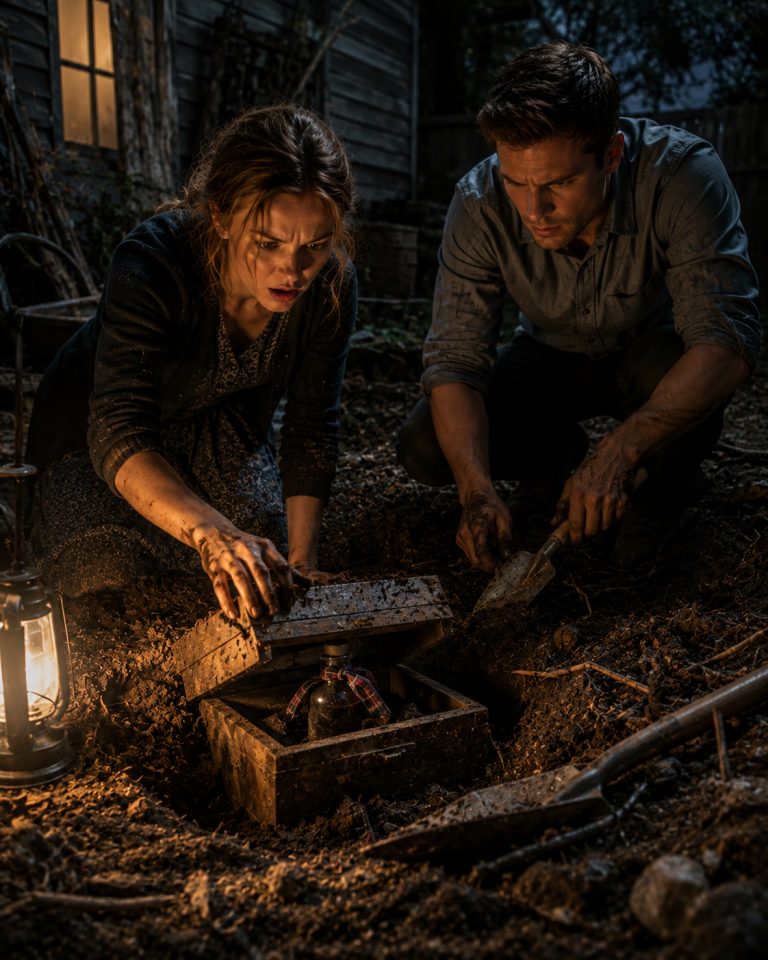
MY MOTHER WAS BEING POISONED BY HER OWN NIGHTLY TEA — AND GRANDMA SWORE SHE NEVER FILLED THAT JAR

The toxicology report came back at 2 a.m., and Claire read it twice before she let herself believe it. Digitalis. Foxglove. In her mother’s blood — three times in four months. Foxglove had no business near that kitchen; her grandmother kept it fenced off, marked with a warning sign, respected for sixty years without exception. So how had it ended up, night after night, in the jar her mother drank from before bed? Before sunrise, Claire was already driving to her grandmother’s house, the evidence bag still warm in her coat pocket, ready to ask the question no one in this family had dared ask out loud. The answer waiting for her there was not the one anyone expected.
[PART 3]
Chapter 1 — The Shed
David’s silence lasted four seconds too long.
Claire had spent six years reading rooms in crisis — waiting rooms, family consultation rooms with the tissue box angled just so and never quite close enough, the exact second a face changes from worry to guilt. She’d watched husbands hear the word overdose and go pale in one very specific way, and wives hear the word malignant and go pale in another. She recognized what crossed her father’s face now, and it belonged to neither of those categories.
It belonged to a man calculating what he could still get away with.
“What shed.”
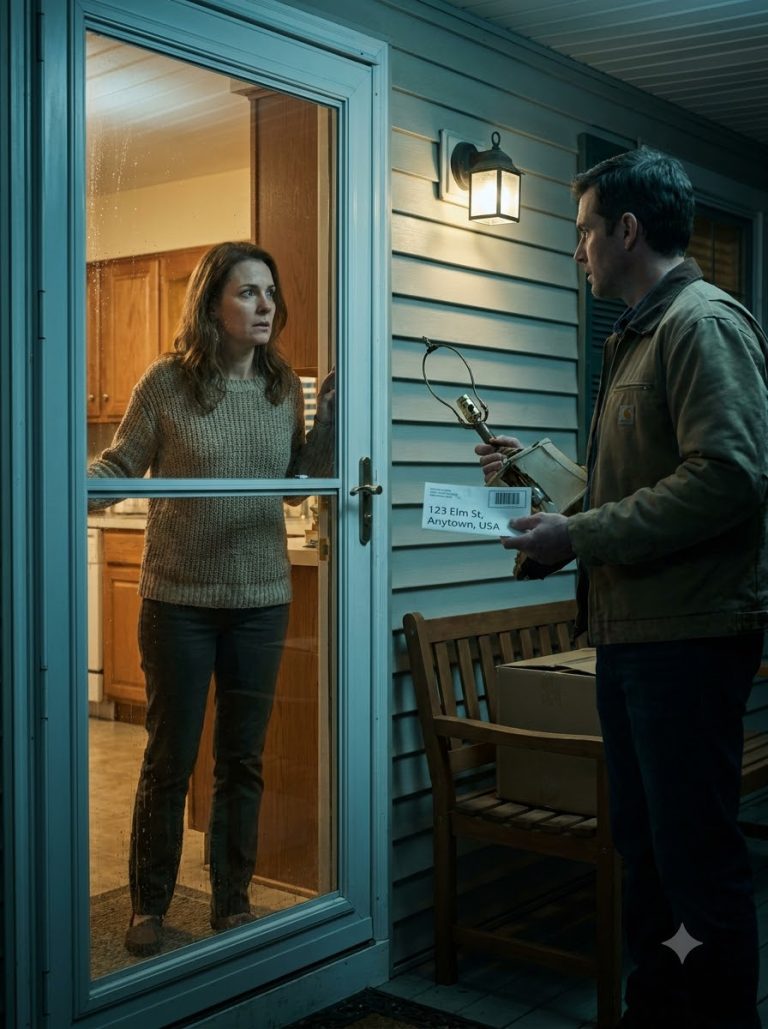
Eleanor didn’t wait for him to answer. She pushed back from the table, joints stiff with the effort, and crossed to the window over the sink — the one that had looked out on her garden every morning for forty years. Vegetable rows gone silver in the porch light. Herb beds she still weeded on her knees despite three different doctors telling her not to. And past all of it, at the property line, the tool shed where she kept her canning jars, her trowels, and, in a locked cabinet at the back, the foxglove she’d once dried and pressed into an arthritis salve before her physician sat her down and told her, in no uncertain terms, that the compound was too dangerous to keep handling with her own two hands.
She hadn’t made that salve in six years. But she’d kept the shed locked out of habit, the way a person keeps a childhood fear even after the thing that caused it is gone.
“Someone has been in there since spring.” Eleanor’s reflection sat faint and pale in the dark glass. “The lock stopped catching properly in April. I told myself the hinge had warped in the heat.”
“Why didn’t you say something?” Grace’s voice cracked down the middle of the sentence.
“Because I did not know what I was seeing.” Eleanor did not turn around. “And this family has spent two years teaching me that my instincts are no longer reliable. So I stopped trusting them myself.”
The words landed on David and he didn’t flinch, which was somehow worse than if he had. A man who flinched still had something to protect. A man who absorbed an accusation without moving had already decided how this would end.
Claire crossed the kitchen and stood close enough to see the pulse ticking in her father’s jaw.
“Dad. Look at me.”
He did. And for one terrible second — less than a second, really, gone before she could be entirely sure she’d seen it — something moved behind his eyes that had nothing to do with fear for his wife.
Calculation. The particular stillness of a man doing math.
“I don’t know what your grandmother thinks she saw.” His voice had found its boardroom register, calm and reasonable, the voice Claire remembered from every argument of her childhood that David had won simply by refusing to raise it.
“You haven’t asked what’s in the bag.” She held it up between them, close enough that he’d have to look at it or look away, and he looked away. “Everyone else in this kitchen asked. You haven’t asked once.”
The silence that followed had weight to it — the kind that pressed into the corners of the room and made the ticking of Eleanor’s old wall clock sound like something counting down instead of just keeping time.
Ryan was the one who finally broke it, and his voice carried none of the deference it usually held around their father. None of the easy warmth of a son who had spent thirty years assuming the best of the man who taught him to ride a bike, coached his Little League team, walked him through his first business plan at the kitchen table with a legal pad and two cups of coffee.
“What was in the shed, Dad.”
Something almost like regret crossed David’s face — there and gone so fast Claire couldn’t swear to it later, when she tried to reconstruct this moment for the detective, for herself, for the version of this story she’d have to live with for the rest of her life.
“Nothing. I go out there sometimes. To get away from the hospital calls.”
“You hate gardening.” Grace’s voice had gone very small, the voice of someone re-reading a sentence she thought she already understood and finding it said something else entirely. “You used to joke about Mom’s ‘witch garden.’ Every Sunday for twenty years.”
“Grace—”
“Don’t.” She turned her face toward the window her mother had just left, toward the dark shape of the shed at the edge of the yard. “Just don’t.”
Claire watched her mother’s face rearrange thirty-one years of marriage in real time, watched every ordinary memory reorganize itself around a single, unbearable new fact, and understood — with the particular clarity that comes right before the floor gives out — that this conversation had stopped being about a jar of tea somewhere in the last five minutes.
It was about who benefited if Grace Whitfield never woke up one more morning to ask why.
She thought of every ordinary evening she’d sat across this same table as a child, watching her grandmother strain leaves through cheesecloth, learning without knowing she was learning that this kitchen was a safe place, that the smell of dried chamomile meant someone was taking care of someone else. That certainty sat wrong in her chest now, curdled into something she’d have to relearn from scratch.
Chapter 2 — What the Lab Found
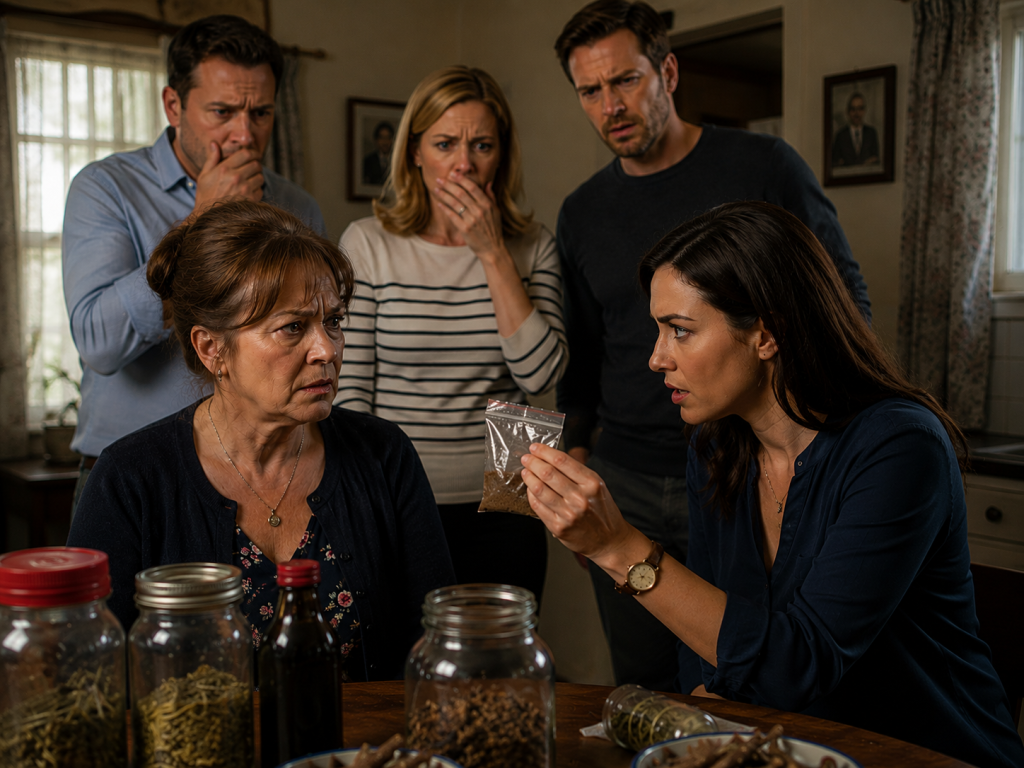
The specimen bag sat on the table between them like something radioactive, something none of them wanted to be the one to touch first.
Claire picked it up again anyway, turning it once in her fingers, keeping her voice level because level was the only thing standing between her and the tremor she could feel building in her own hands.
“The lab found foxglove fragments in the raspberry-nettle jar. Not trace contamination. A deliberate mix — enough digitalis compound per cup to explain every symptom on Mom’s chart. The dizziness. The arrhythmia. The confusion that got so bad the first ER visit, they almost sent her home with a diagnosis of anxiety instead of running a tox screen at all.”
“You’re a nurse.” David’s voice softened, found something almost tender in it, the tone he used to use when Claire was small and scared of thunderstorms. “Not a toxicologist. You’re frightened, and you’re looking for something to point at—”
“I had it tested twice. Two different labs. Same result both times.”
That silenced him, briefly, the way a closed door silences an argument without ending it.
Eleanor turned from the window at last, and when she spoke, each word came out separately, weighed before it left her mouth.
“I have never put foxglove in a tea meant for drinking. Not once. Not in sixty years.” She looked at David directly for the first time since he’d walked into her kitchen that night. “I watched my own mother bury her cousin because of that plant when I was nine years old. I have respected that fence in my garden every single day since, and I will not have that respect questioned in my own home.”
“Then who put it in her jar?”
Nobody answered right away. The kettle Eleanor had set on earlier, forgotten now, began to tick faintly on the stove as it cooled.
Grace lowered herself into a chair slowly, the way a person sits when they’re not entirely sure their legs will hold, one hand pressed flat against her own chest like she could keep her heart steady through sheer force of will.
“The insurance.” Barely above a whisper.
Claire turned toward her. “What insurance?”
Grace’s eyes stayed fixed on David, not on her daughter.
“Three months ago. You told me the company was doing a routine policy review. You had me sign an increase.” Her voice wavered and then, deliberately, steadied itself. “Two million dollars. I didn’t ask a single question. I trusted you completely.”
David’s face had gone the color of old paper.
“That’s standard practice. Every couple our age updates their coverage—”
“The same week,” Eleanor cut in, quiet and precise as a scalpel, “you started doing the groceries yourself. Every single trip. Thirty years of marriage, and you never once carried a shopping bag into that house before April.”
The accusation, once spoken aloud, seemed to expand and fill every corner of the small kitchen at once.
Claire watched her father’s composure fracture in slow motion, the careful stillness cracking into something closer to panic, his eyes flicking toward the back door like a man silently measuring the distance.
“This is insane.” His voice had risen for the first time all night. “You’re standing in your mother’s kitchen accusing me of trying to kill my own wife over a lab slip and a shed with a bad hinge.”
“Then explain the shed.” Ryan’s voice came out flat, final, nothing left in it to negotiate with. “Right now, Dad. Just explain it.”
David said nothing.
And in that silence, Claire heard the small, sharp catch of her mother’s breath behind her — the sound of a woman understanding, in real time and all at once, exactly what the man she’d shared a bed with for three decades had let her drink every night for four months rather than answer one simple question.
Chapter 3 — The Merger
Ryan found it three hours later, long after David had retreated to the study “to make some calls” and Claire had followed him at a careful distance just close enough to notice he never once picked up his phone.
The folder was tucked behind old tax returns in the bottom drawer, unmarked except for a single line of type on the tab: BRENNAN HOLDINGS — MERGER PROPOSAL. Ryan had spent the last four years as VP of Operations at Whitfield Furniture, the company his grandfather had built from a single workshop into three regional plants, and he recognized the letterhead before he’d even finished pulling the folder free.
He carried it into the kitchen and spread the pages across Eleanor’s table like a hand of cards nobody wanted dealt.
“A full buyout. Ninety percent stake. He’d stay on as a figurehead, take an eight-figure payout, and Brennan strips the company for parts inside two years. Every plant. Every job. Gone.”
Grace stared down at the pages like they were written in a language she’d only just begun to learn.
“I voted against this. Eighteen months ago.” Her voice had gone flat, distant, the voice of someone reciting facts to keep from feeling them. “I own forty percent from my father’s estate. He needed my signature to move forward, and I refused to give it.”
Claire felt something settle cold and heavy in her chest.
“And if you weren’t around to refuse anymore, your forty percent transfers to him. Automatically. Spousal inheritance.”
Nobody said anything for a long moment. Somewhere down the hall, the old grandfather clock Eleanor’s husband had built decades ago chimed the half hour, oblivious.
“He wouldn’t survive losing it slowly.” Grace, almost to herself now, working something loose in her own memory. “He kept telling me it was killing him, every time Brennan’s offer expired and he had to go back and beg for another extension. I thought he meant the stress was killing him. I never once considered he meant it literally.”
“Some men,” Eleanor said, reaching over to take her daughter’s hand, “cannot tell the difference anymore between what is killing them and what they are willing to kill for. I have seen it before. I have simply never seen it sit at my own table.”
Claire flipped to the final page of the proposal — a signature line dated six weeks earlier, David’s name already filled in above a blank space clearly meant for a second signatory.
Grace Whitfield.
The blank itself was empty. But in the margin beside it, in pencil, faint enough that someone had clearly meant to erase it, someone had practiced her signature four times.
Claire set the page down very carefully, the way she’d learned to set down evidence she didn’t want to contaminate.
“He wasn’t just planning to wait for the insurance,” she said. “He was planning to forge her signature the moment she was gone. He wanted both.”
Ryan sat back, running a hand over his face, the gesture of a man trying to physically press a headache back into his skull.
“I sat across from him in every one of those Brennan calls. He’d talk about Mom’s ‘stubbornness’ like it was a line item on a budget. A problem to be resolved by Q3.” His voice had gone hollow. “I thought he meant he’d wear her down eventually. Convince her. I never once thought—”
“None of us did.” Grace’s hand found her son’s on the table, an old instinct neither of them questioned. “That’s what he was counting on.”
Eleanor gathered the pages back into their folder with hands that had gone very steady, the particular steadiness of a woman who had decided, somewhere in the last ten minutes, exactly what she needed to do next.
“We keep this,” she said. “Every page. The police will want it, and I intend to make certain they get it whole, in the order it was found, so no one can ever stand in a courtroom and say this family invented a motive to fit a lab result.”
Chapter 4 — The Camera
It was almost midnight when Ryan sat up straight in his chair, halfway through his second cup of the coffee no one had actually wanted to drink but everyone kept refilling anyway, something to do with their hands.
“The camera.” He was already reaching for his laptop. “I put one on the shed two months ago. After the Alvarez’s lawnmower went missing next door. I told Grandma about it and she said fine, put it up, and then I forgot I’d ever installed the thing.”
“You mentioned it exactly twice.” Eleanor’s mouth found the ghost of something that wasn’t quite a smile. “Once you said fine, put it up, once you said it was a waste of money, and I never heard about it again.”
Two months of motion-triggered footage sat untouched in a cloud folder Ryan hadn’t opened since installation day, buried under a stack of work notifications he’d been too exhausted to sort through. He scrolled backward through the timestamps while Claire stood behind his shoulder, close enough to feel the cold radiating off the screen, and Grace’s hand gripped the back of his chair hard enough to whiten her knuckles.
April 14th, 11:47 p.m.
A figure crossed the dark garden, moving with the particular, deliberate caution of someone who already knew exactly where the motion light’s blind spot fell — the kind of knowledge you only get from walking a path more than once.
Ryan paused the clip. Zoomed. The porch light caught the edge of a navy windbreaker Claire recognized on sight, the one Grace had bought David for their anniversary two years ago, back when a gift like that still meant what it was supposed to mean.
Nobody said a word.
Ryan clicked forward. April 14th, 11:52 p.m. The same figure leaving the shed, something small and dark clutched in one hand, pausing once to glance back at the darkened house before disappearing around the side fence.
“Five minutes.” Claire’s voice had dropped almost to nothing. “In and out in five minutes. He wasn’t looking around. He knew exactly what he was after and exactly where to find it.”
Grace made a sound that wasn’t quite a sob and wasn’t quite anything Claire had a name for — something torn loose, finally, from four months of refusing to let herself consider this possibility, even while her own body kept failing in ways no specialist could fully explain.
Eleanor reached over and folded her hand around her daughter’s.
“I noticed the lock in April. The jars had shifted by May. In June I found a bruised leaf near the pantry door that didn’t belong to anything I’d planted that season, and I told myself it must have blown in from somewhere.” A long breath. “I need you all to understand that I was not stupid. I was afraid.”
“Afraid of what?” Claire’s hand covered her grandmother’s, steadying it.
“Of being right. If I spoke and I was wrong, this family would say, see, she really is slipping. If I spoke and I was right, it meant someone under this roof was capable of something unthinkable, and I did not want to be the one who brought that into the open.”
“It almost got Mom killed.”
“I know.” Eleanor’s eyes didn’t lift from the table. “I have known that possibility since her second hospital admission, and I said nothing, because I could not make myself believe your father would be so deliberate about it. I kept inventing other explanations. A raccoon in the shed. A confused delivery driver. Anything that was not this.”
Claire watched her grandmother’s hands, still faintly unsteady, and understood something she hadn’t fully grasped until that moment — David hadn’t chosen Eleanor’s kitchen simply because it was convenient. He had chosen it because an eighty-one-year-old woman with a shelf of dried leaves and the occasional forgotten sentence was the perfect shape for suspicion to disappear behind.
He had taken the exact thing this family loved most about her and turned it into a weapon aimed at both women at once.
Two nights before all of it broke open in Eleanor’s kitchen, Claire sat in her rental car outside her parents’ house with the lab results glowing on her phone screen and couldn’t make herself go inside.
Ryan found her there. He tapped on the passenger window with two knuckles, the same knock he’d used on her bedroom door their entire childhood, and let himself in without waiting for an answer.
“You’ve been sitting out here for twenty minutes.”
“I don’t know how to say it.” She turned the phone face-down against her thigh. “There’s no version of this sentence that doesn’t end with someone’s life falling apart.”
“Say it anyway.” He looked straight ahead through the windshield, not at her, giving her the privacy of not being watched while she found the words. “You’ve been carrying it alone since Friday. I can see it on you.”
“What if I’m wrong.”
“You had it tested twice.”
“What if I’m right, and it’s someone none of us want it to be.”
Ryan didn’t answer that right away. Outside, a neighbor’s porch light clicked on and off on its motion sensor, some animal passing through a yard two doors down, oblivious to everything happening in this car.
“You already think you know who.” Not a question.
“I don’t want to say it out loud until I’m sure.”
“Then let’s get sure.” He reached over and took the phone from her lap, thumb already scrolling to the lab report she’d read so many times she could recite it. “Together. Tonight, tomorrow, however long it takes. You’re not doing this by yourself, Claire. Whatever it turns out to be.”
She let her head fall back against the headrest, the tension in her shoulders unspooling half an inch, not gone, just shared now, distributed across two people instead of one.
“I keep thinking about Grandma,” she said. “The way she’s been lately. The forgetting.”
“You think it’s connected.”
“I think we’ve all been telling her she’s slipping for months, and I think that’s exactly the kind of thing someone would count on if they wanted an old woman to look guilty instead of themselves.”
Ryan’s jaw tightened, some private calculation working behind his eyes that Claire recognized because she’d been running the same one herself for two days straight.
“Dad’s been doing the groceries,” he said slowly, like the fact had been sitting in his memory unremarked for weeks, waiting for someone to ask the right question of it. “Since spring. I never thought anything of it.”
“Neither did I. Until today.”
They sat with that for a while, the car ticking as the engine cooled, neither of them ready yet to say the name out loud, both of them already knowing, in the particular way siblings know things without needing to speak them, exactly whose name it was going to be.
Chapter 5 — Confrontation
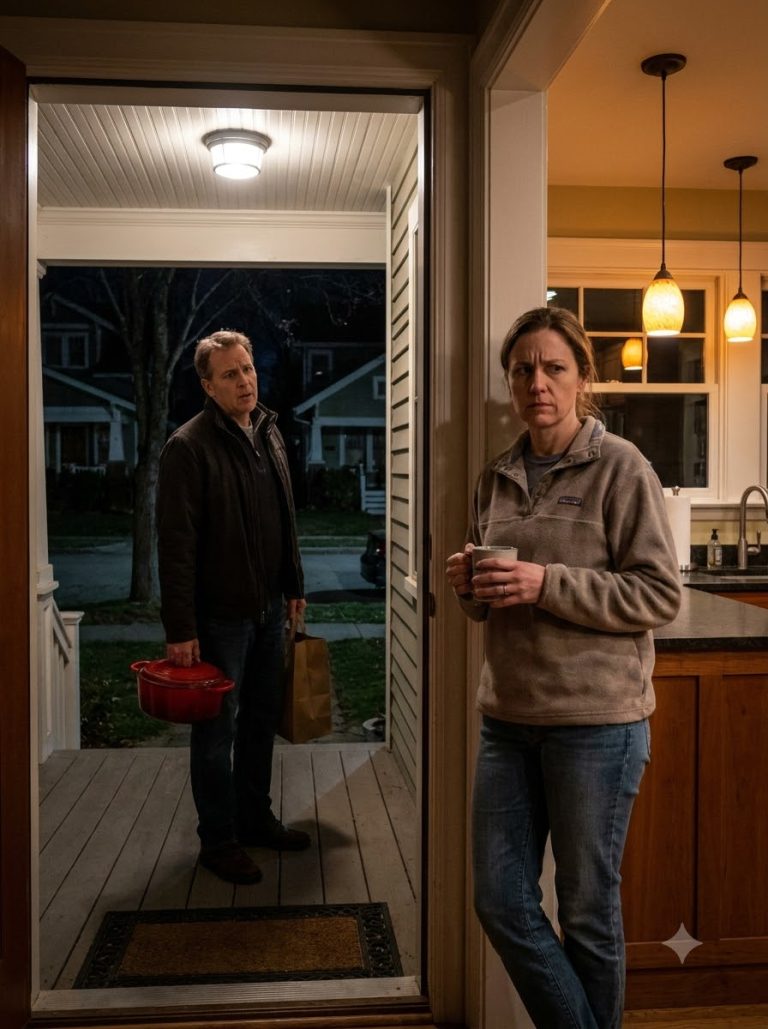
David came back into the kitchen a little after midnight and stopped hard in the doorway.
The laptop, still open. The merger folder, spread flat. Five faces turned toward him, none of them the faces he’d left twenty minutes ago.
“You don’t understand what it’s like.” His voice had lost the boardroom calm entirely now, something rawer underneath it. “Watching thirty years of work run into the ground because someone won’t sign a piece of paper.”
“So you decided to kill me.” Grace didn’t raise her voice. She didn’t need to; the words did their own work in the silence that followed them. “Slowly. In my own mother’s kitchen.”
“I never wanted it to go that far.”
“Then how far did you want it to go?”
He didn’t answer.
“Small amounts.” His jaw worked, like the words cost him something to say out loud. “Enough to wear you down. Enough that you’d finally agree, because you’d be too tired to keep fighting me on it.”
“Didn’t think a nurse in the family might notice.” Claire stepped closer, close enough that he had to look at her instead of the door. “Didn’t think it through at all. Or didn’t care, as long as it looked natural at the end of it.”
Ryan stood slowly, the paused footage still glowing pale blue on the screen behind him.
“Four years I worked beside you. Every day. I trusted every number you ever showed me.”
“Ryan—”
“Don’t say my name like you still have the right to.”
Eleanor crossed the kitchen and stopped directly in front of the man who had let her be quietly doubted for months while he filled her carefully labeled jars with poison.
“You let me believe I was losing my mind.”
“I never meant for you to—”
“You meant exactly that. That is precisely what you meant, David, and I would like you to have the decency not to insult me by pretending otherwise in the last few minutes you have to speak to me as a free man.”
David flinched at that — really flinched, for the first time all night, as though Eleanor’s stillness had cut deeper than anyone’s shouting could have.
Claire had already dialed the private lab before her father finished his sentence, not the police yet, confirming the second sample was still on file and ready for sworn documentation the moment law enforcement asked for it.
David’s eyes moved, one last time, toward the back door.
“Don’t.” Grace’s voice, for the first time all night, carried no tremor in it at all. “You don’t get to run from this the way you have been running from everything else for months. Sit down. It’s over, David.”
He sat.
Chapter 6 — What Eleanor Knew
While they waited for the police, Eleanor made tea.
Nobody stopped her. It felt, in its strange way, like the only thing that made sense to do with unsteady hands in a kitchen that had just held the worst hour of the family’s life. She chose a jar from the far end of the shelf — spearmint, harmless, ordinary — and set five cups on the table, one by one, like she was proving something to all of them without having to say it aloud.
“I want you to understand I was not stupid.” Quieter this time, as if the words had worn a little smoother with repeating. “I was afraid of being right.”
“It almost got Mom killed.” Ryan’s voice had lost its edge. Not an accusation anymore. Just the shape of something he was still turning over in his hands.
“I know.”
Grace reached across the table and closed her hand around her mother’s.
“None of this is your fault. Not the lock. Not the jars. Not any of it.”
“I let doubt about my own mind stop me from protecting my daughter.” Eleanor’s eyes stayed fixed on the cup in front of her, steam curling up between them. “That is mine to carry, whatever else turns out to be true tonight.”
Claire watched her grandmother’s hands wrap slowly around the warm cup and understood, fully now, exactly what David had used against her — not only the jars, not only the shed, but two years of small dismissals that had taught this woman her own instincts weren’t worth trusting in the first place. He hadn’t needed to plant much evidence. He’d only needed a family that had already been quietly, gently, taught to doubt her.
She thought of every time she’d told her grandmother gently, you’re probably just tired, and felt something in her chest twist tight enough to hurt.
“I should have listened to you in May,” Claire said. “When you said the jars had moved.”
“You had no reason to believe an old woman over her own son-in-law.” Eleanor’s hand found Claire’s on the table. “None of you did. That is not a failure of love. It is simply how trust works, and how it can be turned against the people who deserve it most.”
Outside, red and blue light began to flicker faintly against the kitchen window, still distant, still minutes away.
Chapter 7 — Blue and Red Light
The patrol car’s lights came through the window at 1:14 a.m., washing the kitchen blue, then red, then blue again, catching on the row of mason jars still lined along the shelf like witnesses that had finally been allowed to speak.
David didn’t resist. He stood when the officer told him to, quietly, almost gratefully, as though some part of him had been waiting months for someone else to finally stop the thing he had proven, over and over, he couldn’t stop in himself.
“I never wanted her to actually die.” To no one in particular, as the cuffs closed around his wrists. “I told myself I’d stop before it got that far.”
“You gave her poison three times.” Claire didn’t look away from him. “You don’t get to decide how the story ends just because you feel bad about the ending you were writing.”
David looked at his wife then — really looked at her, the way Claire hadn’t seen him look at her mother in longer than she could remember, not since before the merger talks started, before the late nights at the office became something else entirely.
“Grace. I’m—”
“Don’t.” Steadier every time she said the word. “Whatever you’re about to say, I don’t want it. Not tonight. Maybe not ever.”
They led him out through the kitchen, past the shelf of jars, past the window that looked out on the shed where he had once spent five careful minutes deciding exactly how much of his mother-in-law’s garden it would take to make his wife’s death look like nature instead of will.
The screen door swung shut behind him with a soft, ordinary click — the same sound it always made, unchanged by everything that had just happened underneath it.
Nobody moved for a long moment.
Then Ryan exhaled, long and shaking, and sat down hard in the chair his father had just vacated.
“I keep waiting to wake up.”
“You are not asleep.” Eleanor crossed the kitchen and refilled his cup — spearmint, harmless, ordinary. “None of us are, Ryan. That is rather the trouble with all of this.”
Chapter 8 — What the Company Learned
The story broke in the local business paper eleven days later, and then, faster than any of them expected, in two of the trade publications Whitfield Furniture had spent decades trying to get featured in for entirely different reasons.
Ryan handled the fallout because someone had to, and because handling things had always been the way he loved people — quietly, from the side, without asking anyone to notice him doing it. He met with the board. He met with Brennan’s lawyers, who dropped the merger proposal within forty-eight hours of the arrest, unwilling to attach their name to whatever headlines were coming. He met, three separate times, with employees who had worked the plant floor for twenty years and wanted to hear, from a Whitfield and not a press release, whether their jobs were safe.
“They are,” he told them, and meant it, though he wasn’t yet entirely sure how he was going to make that true.
At home, in the evenings, he was quieter than Claire had ever known him to be. He stopped by Eleanor’s most nights after work, not to talk about the case, but to sit in her kitchen while she cooked, the two of them not saying much of anything, which somehow said more than conversation would have.
“You didn’t know,” Eleanor told him once, not looking up from the pot she was stirring.
“I worked beside him every day. I should have seen something.”
“He built his whole life around making sure no one saw anything.” She set the spoon down and looked at him directly. “That is not a failure of your attention, Ryan. That is the particular skill of a man who has spent thirty years learning how to be believed.”
Ryan didn’t answer that. But he stayed another hour, and ate two bowls of soup he hadn’t asked for, and when he finally drove home, something in his shoulders had loosened that hadn’t been loose in eleven days. He left the radio on the whole drive back, for the first time since the arrest, instead of driving in silence the way he had every night before.
David’s arraignment fell on a Thursday, and Grace surprised everyone by insisting on being there.
“You don’t have to.” Claire stood beside her in the courthouse parking lot, under a sky the color of wet concrete. “No one would think less of you for staying home.”
“I know I don’t have to.” Grace straightened her coat, the small, deliberate gesture of a woman putting on armor she’d made herself. “I need to see him say it in a room where it counts. Not a kitchen at one in the morning. Somewhere it goes on the record.”
Inside, David looked smaller than Claire remembered — not physically, but in some other way, the boardroom stillness gone, replaced by the flat gray posture of a man who’d finally run out of rooms to be calm in. He didn’t look at his wife when the charges were read. Attempted murder. Elder endangerment, for what he’d done to Eleanor’s name along with everything else. Fraud, for a signature practiced four times in pencil.
Grace didn’t look away from him once.
Afterward, on the courthouse steps, she exhaled like she’d been holding her breath since the charges started.
“I thought I’d feel something bigger. Relief. Vindication. Something with a name.”
“What do you feel?”
“Tired.” A small, unexpected laugh, more air than sound. “Just tired, in a way that might actually be the start of getting better instead of the middle of getting worse.”
Eleanor said nothing, but reached over and took her daughter’s hand the way she had every hard day since this began — no dramatics in it, just a steady, practiced grip that had carried this family through worse things than either of them wanted to name today.
Chapter 9 — Sunlight on the Jars
Three weeks after the arrest, Grace’s cardiologist cleared her heart rhythm as fully stable. No more monitors. No more medication schedule taped to the refrigerator like a countdown. Just the slow, ordinary work of a body learning to trust itself again.
The investigators had come and gone by then, taking the shed’s broken lock as evidence, taking David’s laptop with its browser history full of dosage calculators and toxicity timelines Claire tried not to think about too closely, on the rare nights she managed to sleep at all.
Eleanor spent most of those three weeks doing what she had always done with grief too large to name directly — cooking far more food than five people could eat, freezing the extra in labeled containers nobody asked her to label, keeping her hands busy so the rest of her didn’t have to sit still with what had almost happened in her own kitchen.
Claire found her on a Sunday afternoon, standing at the counter with a stack of blank labels and a fresh set of empty mason jars, sunlight pouring through the window over the sink in a way that turned the dried herbs beside her faintly gold.
“What are you doing?”
“Starting over.” Eleanor didn’t look up from the jar in her hands. “New jars. New labels. I want everyone in this family to look at this shelf and know, without a single shadow of doubt, exactly what they’re looking at.”
She held out a marker.
“Your hand is steadier than mine these days. Will you help me?”
Claire took it, and for the better part of an hour they worked side by side — Eleanor measuring, Claire labeling, falling into an easy, wordless rhythm that felt, for the first time in months, like something close to ordinary. Chamomile. Ginger. Raspberry leaf and nettle, the recipe exactly unchanged, the trust in it being rebuilt one carefully printed jar at a time.
When they finished, Eleanor lined the new jars along the windowsill where the afternoon light always caught them best — the same spot they had always occupied — and stepped back to look at the row of them, catching the light.
“There.” Something in her voice had loosened, finally, after three long weeks. “Now anyone can see exactly what’s inside. No more guessing.”
She ran a thumb along the edge of one label, checking the ink had dried, an old habit from decades of canning that no longer served any real purpose except to keep her hands occupied while the rest of her caught up with everything that had happened.
Grace appeared in the doorway then, color back in her face, steadier on her feet than she’d been in longer than any of them wanted to count, and came to stand beside her mother and her daughter, looking at the jars glowing gold in the last of the afternoon sun.
“It looks like it used to.” Her voice had a small wonder in it. “Before all of this.”
“No.” Eleanor rested a hand on her daughter’s shoulder, watching the light move across the row of glass. “It looks like something we built back on purpose. That is not quite the same thing at all. I think, in the end, it is better.”
Outside, past the garden, the fenced-off foxglove still bloomed tall and purple in its corner exactly where it had always stood — beautiful, dangerous, and, for the first time in months, precisely where everyone in this family could see it.
Claire stayed a while longer after the others had gone back inside, standing at the fence with her hands in her pockets, watching the late light move slowly across the purple heads of flowers her grandmother had never once stopped tending, even now, even knowing what a single leaf of it could do in the wrong hands. There was something in that she wanted to hold onto — the idea that a dangerous thing, kept honest and out in the open, could still be beautiful, could still be tended and trusted and loved. That the real danger had never really been the plant at all, but the silence that let it hide.