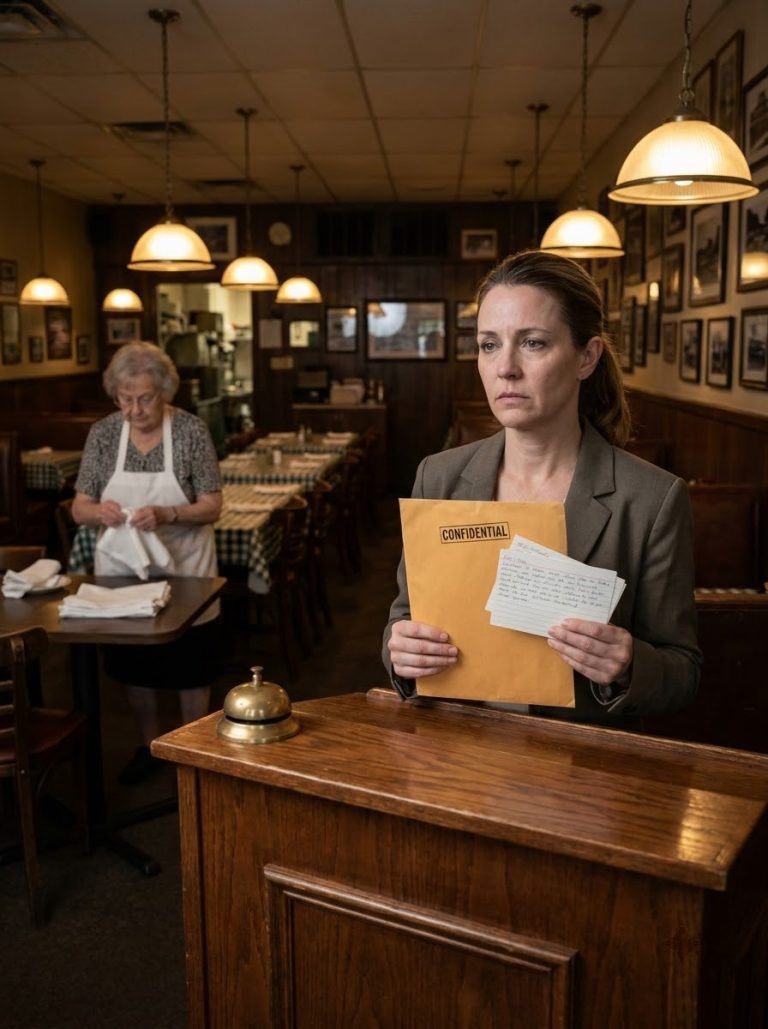
I Returned From Approved Leave to Find Someone Else in My Office—Then I Learned My Boss Had Told Everyone I Resigned

When I came back from six weeks of approved leave, my name was gone from my office door. Not covered. Not taped over. Gone—the little black letters peeled clean off the frosted glass, leaving a pale rectangle where MARA ELLISON had been. Tessa Kim was inside, sitting at my desk with my old blue mug full of pens, and when she looked up, her face did something I will never forget: relief first, then fear.
“Mara,” she said. “What are you doing here?”
“I work here.”

The silence behind me told me that was not the answer anyone expected.
It was 8:11 on a Monday morning, my first day back at Northfield Benefits Group after six weeks away helping my mother recover from a hip replacement. HR had told me not to work from another state, so I had closed the laptop and trusted the approved return date.
I had followed that instruction. I had closed my laptop. I had trusted the calendar invitation titled RETURN TO WORK — MARA ELLISON that still sat on my phone.
Now half the payroll operations team was watching me from the open area outside my office.
Tessa stood too quickly. Her chair rolled backward and bumped the low file cabinet. “I thought you were coming in Wednesday.”
“No. Today.” I looked at the desk. Most of my things were gone. The framed picture of my mother and me at Lake Superior had been moved to the credenza. My blue mug remained because apparently even an office coup had limits.
Tessa followed my eyes. “Victor said we needed the room.”
“Victor said you needed my room?”
Her mouth tightened. “He said you weren’t returning.”
Behind me somebody’s phone rang and kept ringing. No one moved to answer it.
I turned around. “Did everyone hear that?”
A payroll specialist named Joel looked down at his monitor. Priya, who had worked for me for nine years, did not. She met my eyes and said quietly, “We were told you resigned.”
For one strange second, the sentence did not land. I understood every word individually, but together they belonged to someone else’s morning.
“I did not resign.”
Priya’s expression changed. “That’s what I thought.”
Tessa whispered, “Oh, God.”
The first useful thing I did that morning was not cry. The second useful thing I did was not call Victor Hale.
I took my company badge from the lanyard around my neck, held it against the reader beside the payroll suite, and watched the green light blink. My access still worked. Then I opened my phone and found Denise Carter’s email from Friday.
Welcome back Monday. Please check in with me when you arrive so we can review any access changes made during leave.
I turned the screen toward Tessa.
“I’m going to HR,” I said. “Please don’t move anything else.”
She nodded too fast.
Denise’s office was two floors down. When the HR partner saw me in her doorway, her first expression was ordinary welcome.
Then she saw my face.
“What happened?”
“I’d like you to tell me.”
I sat across from her and put my phone on the desk. My hands were steady until I realized I was proud of them for being steady. Then they started to shake.
Denise read the email she herself had sent me, frowned, and opened the HR system.
“You are active,” she said.
“I know.”
“Leave ended yesterday. Return date today.”
“I know.”
“No resignation entered.”
“That part I did not know.”
She stopped typing. “Who told you there was?”
“Apparently Victor told payroll.”
Her chair made a small squeak as she leaned back.
Victor Hale had been my manager for fourteen months, a director who liked speed and had a talent for making caution sound like cowardice.
Before my leave, Victor and I had fought over the conversion schedule for a new payroll platform. Northfield processed payroll for more than sixty midsize clients, so a rushed change could move real bank files, deductions, approvals, and client-specific exceptions before anyone caught the damage.
My plan had three stages. Parallel testing. Limited client release. Full conversion after two clean payroll cycles.
Victor called it “a museum piece.”
I called it “Tuesday.”
That argument was six weeks old. It was not, in my mind, connected to the missing letters on my office door.
Denise closed the HR system. “Stay here.”
“I don’t want Victor coming down before I understand what has been entered in writing.”
“Nothing has been entered in HR as a resignation.”
“What about position changes?”
She looked at me for a moment, then turned the monitor slightly away. “Tessa was coded as acting supervisor four weeks ago. Temporary assignment.”
“Based on what?”
“Manager request.”
“Did the request say why?”
“It says continuity during extended absence.”
“My absence had an end date.”
“I can see that.”
I let out a breath and asked the next specific question.
“Can you email me confirmation of my current employment status and return date?” I asked.
“Yes.”
“And that you have no resignation from me?”
Denise’s eyebrows rose, not because the request was unreasonable but because she understood why I was making it.
“Yes.”
“Thank you.”
The elevator doors opened on the sixth floor just as Victor came around the corner. He saw me and stopped so hard the man walking behind him nearly hit his shoulder.
“Mara.”
“Victor.”
He recovered quickly. “I was told you were downstairs.”
“I was told I resigned.”
He gave a soft, pained laugh, as though I had made a social mistake in a restaurant. “That’s not how I would put it.”
“How would you put it?”
“We understood from your communications that your family situation had changed.”
“My mother had surgery.”
“And that you might be staying longer.”
“I had a return date.”
“I know that now.”
“You knew it before I left. You approved the handoff plan.”
His eyes moved past me toward the payroll floor. People were pretending not to look.
“Can we do this in my office?” he asked.
“After HR confirms my status in writing.”
The muscles around his mouth tightened. It was the first honest thing his face had done.
“Mara, nobody is trying to create a situation here.”
“I walked into one.”
I went back to my office. Or Tessa’s office. Or the room that had become proof that language mattered.
Tessa had moved to the small conference table in the corner and was flipping through a notebook without reading it.
“I’m sorry,” she said as soon as I entered.
“Did you tell anyone I resigned?”
“No.”
“Did Victor?”
“He said you had decided your priorities were with your mother and you were working out the details with HR.”
“Those were his words?”
“Pretty much.”
“Did you ask him why HR still had a return date for me?”
Her face went red. “I didn’t see your HR file.”
“That was unfair. Sorry.”
She looked surprised by the apology.
I sat across from her. “Did you want the job?”
She stared at me.
“I’m not asking to trap you. I’m asking because I need to know whether I’m dealing with one problem or three.”
“I wanted a chance to supervise,” she said. “I did not want your job because someone lied about you leaving.”
That answer hurt more than a defensive one would have.
“Okay.”
“I thought you recommended me.”
I looked up.
Tessa swallowed. “Victor said you did.”
Before I could answer, my laptop chimed. Denise’s confirmation had arrived. Active employee. Approved return date. No resignation on file.
A second email arrived less than a minute later from Victor.
Subject: TRANSITION DOCUMENTATION — ADMINISTRATIVE CLEANUP
Mara,
Glad you are back. To avoid confusion after several changes during your leave, please review and sign the attached transition memorandum. It simply memorializes decisions made before your departure and confirms the temporary authority structure used while you were out.
I opened the attachment.
The first page was ordinary enough: staffing, client contacts, escalation coverage.
The second page was dated the Friday before my leave.
Under a heading labeled SYSTEM MIGRATION AUTHORIZATION, it said I had approved an accelerated conversion schedule and delegated implementation authority to Victor during my absence.
I read the sentence three times.
Then I read the date.
Then I scrolled back to my own handoff email from that Friday, which said the opposite.
Phase II conversion remains contingent on parallel-test signoff. No full client migration should occur before two clean payroll cycles.
My phone buzzed.
A message from Tessa.
Please don’t sign anything until we talk. There are 317 payroll corrections from the first two cycles after you left.
I looked through the glass wall at her. She was not looking at me.
The problem was no longer that someone had taken my office.
The problem was that someone needed my name on a decision I had never made.
At noon, I carried my lunch to the picnic tables behind the building instead of eating at my desk. Tessa came out eight minutes later with a bottle of water and no food.
“I didn’t know whether you’d come,” she said.
“You asked me not to sign something. That usually earns ten minutes.”
She sat across from me. September heat still clung to the concrete, but a breeze moved through the cottonwoods along the parking lot. For a moment, neither of us spoke.
“What are the corrections?” I asked.
“Everything.”
“That is not a payroll category.”
Her mouth twitched despite herself. “Direct-deposit rejects. Deduction mapping. Two clients had PTO balances load wrong. One had overtime codes mapped to regular hours for part of a cycle. Most of it was corrected before final funding, but not all.”
“How many people were actually underpaid?”
“Forty-three that I know of. All corrected within three business days.”
That mattered. Not because forty-three was acceptable. It was not. But payroll failures had scale, and scale mattered if you wanted truth instead of theater.
“Who approved full conversion?”
“Victor.”
“On whose signoff?”
“He said yours.”
I almost laughed. “Of course he did.”
Tessa rubbed the label off her water bottle with one thumb. “He showed us a slide from the steering meeting. It said ‘Ops approval confirmed.’ I assumed you had agreed after our last team meeting.”
“I never did.”
“I know that now.”
“What changed your mind?”
Her eyes moved toward the building. “The transition memo.”
“You saw it?”
“He asked me Friday to fill in staffing dates. The migration section wasn’t in the draft I saw.”
That was useful, but I did not let it become more useful than it was.
“Did you save the draft?”
“No. It was in a shared folder. He sent a link.”
“Version history may still exist.”
“I thought of that.”
“Do not pull anything you are not authorized to access.”
“I have access. It’s the team operations folder.”
“Then don’t alter anything.”
She nodded.
I hated how natural the instructions felt. Preserve the ordinary. Don’t make a mess trying to prove someone else made one. It was the same instinct that had built my career.
Tessa looked down at the table. “Are you going to try to get me removed?”
“From what?”
“My acting role.”
“I don’t know yet.”
“That’s fair.”
“No, it isn’t. None of this is fair. But I’m not going to make you the villain because it would simplify my morning.”
Her eyes lifted to mine.
I went back inside and requested access to the payroll conversion dashboard. The system rejected me.
My normal payroll permissions had been restored, but the conversion workspace was still restricted.
I forwarded the denial to Denise and asked whether the limitation reflected my current role. Twenty minutes later she replied that IT had applied a project-specific restriction during my leave and she was checking the approval chain.
Victor appeared at my doorway before she answered.
He had taken off his suit jacket and was carrying two coffees.
“Peace offering,” he said.
“I don’t drink coffee after lunch.”
“You used to.”
“I used to be thirty-eight.”
He set both cups on the conference table anyway.
“Mara, I want to lower the temperature.”
“Then don’t ask me to sign a false memo.”
“It is not false.”
“The date is false. The authorization is false.”
“The document memorializes an evolving conversation.”
“It claims a specific approval before I left.”
“We were all under pressure.”
“I was not under pressure to approve full conversion. I opposed it.”
He exhaled through his nose. “You opposed the initial timeline. Then we discussed a conditional path.”
“We discussed what would have to be true. Those things were not true.”
“Semantics.”
“Payroll is mostly semantics with bank files attached.”
His jaw shifted.
He walked to the glass wall and lowered the shade. “Here is what I need you to understand. We had client commitments. The platform vendor had resources booked. Finance wanted the old environment retired before quarter end. You left at a difficult moment.”
“I left on an approved date with a documented return date.”
“I am not criticizing the leave.”
“You told my department I resigned.”
“I said your return was uncertain.”
“Priya used the word resigned.”
“People interpret.”
“Tessa said you told her I recommended her as my replacement.”
That caught him. Only for a second, but enough.
“I said you had confidence in her.”
“I do. That is not the same thing.”
He sat across from me. His voice softened.
“Sign the memo with edits if you need to. We are not trying to pin anything on you.”
“Then remove the migration authorization.”
“We need continuity of decision records.”
“Then record the decision that actually happened.”
For the first time, Victor looked tired rather than polished.
“You don’t know how messy this got,” he said.
“I’m beginning to.”
He stood. “Think before you turn this into an investigation.”
I looked at the two untouched coffees.
“Victor, I did not create the need for an investigation by reading the date on a document.”
When he left, he took neither coffee.
At 3:40, Denise restored my conversion-workspace access and asked me in writing to review only records normally available to my position. The request was careful. I appreciated that.
I opened the correction dashboard.
Tessa had not exaggerated. Three hundred seventeen correction tickets over two payroll cycles. Most were minor. Some were not. The pattern mattered more than the number.
The problems clustered around items my staged plan was designed to catch: special deductions, client-specific earning codes, file timing, approval inheritance.
I pulled up the migration checklist I had saved before leave.
Version 8.2, last edited by me.
Then I opened the current procedure.
Version 11.0.
My name still appeared in the document history as the original owner, but entire sections were gone.
Parallel test required before client release had become Parallel test recommended where feasible.
Two clean cycles had become One validated cycle or director exception.
The line requiring operations signoff before accelerated migration had disappeared entirely.
The change log showed edits while I was away.
Victor Hale.
An implementation manager from IT.
Victor again.
No edit from me.
I leaned back from the screen.
For years, I had told new supervisors that a clean process was not about distrusting people. It was about preserving memory when people were tired, busy, promoted, embarrassed, or gone.
Now the system was doing exactly what I had always asked it to do.
It remembered.
At 4:12, an unfamiliar name appeared in my inbox.
Ramon Alvarez — Internal Audit.
Mara,
I understand you returned today. I am reviewing the payroll platform conversion as part of the scheduled post-implementation audit. HR suggested I speak with you regarding pre-launch operating criteria. Please let me know when you are available tomorrow.
Scheduled.
Not created by me. Not triggered by my complaint.
A post-implementation audit that had been coming whether I returned angry or smiling.
I looked through the glass wall toward Victor’s office.
His door was closed.
On my phone, my mother had sent a picture of herself standing in the kitchen without the walker, one hand on the counter, chin lifted in triumph.
Under it she had typed: Physical therapist says I can make coffee if I stop trying to carry the mug and the walker at the same time. Tyranny.
I laughed so suddenly Priya looked over.
For thirty seconds, I let myself be somebody’s daughter instead of somebody’s evidence.
Then I wrote Ramon back.
Tomorrow at nine works.
I did not attach anything.
I did not accuse anyone.
I did not copy the entire executive team.
I went home at 5:07 with my badge still active, my office still not mine, and one clear rule for the next day:
I would not defend myself by guessing.
I would find out what happened.
The next morning, Ramon Alvarez arrived at my desk five minutes early carrying a laptop and a yellow legal pad. He was in his early fifties, with silver beginning at his temples and the expression of a man who had learned that silence made other people volunteer more than questions did.
“Would you rather use a conference room?” he asked.
“Yes.”
He waited while I booked one myself.
That small courtesy mattered. Victor had spent the previous day speaking as if every room, record, and version of events belonged to him. Ramon made me responsible for my own chair.
We took Conference B, the one with a window overlooking the employee parking lot and a table too large for two people. Ramon opened the meeting by telling me exactly what he was doing.
“This is the scheduled post-implementation review for the payroll platform conversion,” he said. “It is not an employment investigation. HR asked that I coordinate with them because your return created questions about decision authority. I am trying to establish the operating timeline.”
“Good.”
“You sound relieved.”
“I am relieved to hear a noun that is not ‘misunderstanding.’”
The corner of his mouth moved.
He asked me to explain the pre-leave conversion plan as if he had never seen it. I did. I described the three stages and why each existed. I told him where the risks were highest and which client groups had the most custom configurations. I did not tell him Victor had always been reckless. I did not tell him Tessa had been tricked. I did not tell him what I thought the missing letters on my office door meant.
Then Ramon slid a printout across the table.
“Is this your document?”
It was a copy of Version 8.2 of my checklist.
“Yes.”
“Is this the last version you edited?”
“As far as I know. The version history in the shared workspace shows later edits by other people while I was out.”
“Did you approve accelerated full conversion before leave?”
“No.”
“Did you authorize Victor to waive operating signoff?”
“No.”
“Did you tell him you would likely not return?”
“No.”
“Did you recommend Tessa Kim to replace you?”
“I told Victor she was capable of covering routine supervisory issues while I was gone. That is not the same statement.”
Ramon wrote something.
“Do you have a written handoff?”
“Yes.”
“Send it to the audit folder after this meeting. Not to me by regular email. Denise will send you the link.”
That was the first moment I believed the company might actually know how to handle the problem it had allowed Victor to create.
Ramon did not ask me about the transition memo until the end.
I gave him a copy of Victor’s email and the PDF exactly as I had received it. He read the migration section without changing expression.
“Did you sign?”
“No.”
“Did you edit?”
“No.”
“Has anyone asked again?”
“Victor told me I could sign with edits.”
“Did he explain why the date needs to be before your leave?”
“He called it continuity of decision records.”
Ramon looked at the paper for another few seconds.
“Okay.”
That was all.
I wanted him to look shocked. I wanted the document to do the dramatic work for me so I could stop carrying it. Instead he put it in a folder labeled CONVERSION TIMELINE and moved to the next item.
It was irritatingly professional.
Which was exactly what I needed.
By eleven, HR had sent a short note to the payroll team saying there had been incorrect information about my employment status, that I remained an active employee, and that the department’s reporting structure was under review. It did not blame Victor. It did not restore my title. It did not mention Tessa.
It did something more basic.
It corrected the record.
Priya came into my office—still Tessa’s office on paper, though Tessa had moved to an empty manager cube for the day—and closed the door.
“I owe you an apology,” she said.
“For what?”
“I believed you resigned.”
“Because your director told you I did.”
“I still believed it.”
I looked at her. “Priya, if I spend the next month collecting apologies from everyone Victor misled, I’m going to need an assistant.”
She gave a small laugh, then did not leave.
“What?”
She hesitated. “He started saying it before the first live conversion.”
My attention sharpened.
“How long before?”
“Maybe a week after you left. He said we had to plan as if you weren’t coming back.”
“That could mean anything.”
“I know. Then a few days later he said the department couldn’t wait for ‘someone who had chosen a different priority.’”
“Did he use my name?”
“Yes.”
“Where?”
“Team huddle.”
“Who else was there?”
“Everyone.”
I wrote down the date she thought it happened and stopped there.
“Thank you.”
“You don’t want me to tell HR?”
“I want you to tell the truth if they ask. I do not want to build a choir.”
Her shoulders dropped, as if I had released her from a role she had already begun rehearsing.
That afternoon, Tessa sent me the link to the transition memo in the shared operations folder. Because both of us still had authorized access, we could see version history without doing anything unusual.
The staffing section had been created three days before my return.
The migration authorization paragraph had been added Friday at 4:46 p.m.
The document date remained the Friday before my leave.
Tessa stared at the screen beside me.
“That paragraph wasn’t there when he asked me to add staffing dates,” she said.
“When was that?”
“Thursday morning.”
“You don’t have to convince me.”
“I’m trying to convince myself.”
I turned away from the screen.
“What did you think this job was?” I asked.
She looked at me as if I had changed subjects.
“The acting role?”
“Yes.”
“A chance.”
“At what?”
“To prove I could lead.”
“And what did Victor say about me?”
Her face closed a little.
“Tessa.”
“He said you were brilliant at maintenance and resistant to change.”
I almost admired the efficiency of it. Praise wrapped around an accusation.
“He said your strength was keeping old systems stable, but Northfield needed someone who wasn’t emotionally attached to how things had always been done.”
“And you believed that?”
“Some of it.”
That answer stung because it was honest.
I stood and walked to the window.
For ten years, I had been the person people called when payroll did something impossible. A deduction vanished. A tax feed stalled. A client acquired another company halfway through a cycle. I had built checklists because checklists let normal people solve abnormal problems without becoming heroes.
Victor had translated that into emotional attachment to old ways.
Maybe because it was easier to promote himself as the future if someone else could be labeled the past.
“Were you?” Tessa asked.
“Was I what?”
“Resistant to change.”
I turned around.
“Yes.”
She blinked.
“Sometimes. I fought stupid changes and smart changes with stupid timelines. I also said no too often without explaining what a safe yes would require. That doesn’t make the memo true.”
“No.”
“It does mean we do not need to turn me into a saint to make Victor wrong.”
Something changed in her expression then. Not loyalty exactly. Trust was too large a word for day three. But the room got less crowded with the versions of each other we had been handed.
On Wednesday morning, Denise asked Tessa and me to meet separately with HR. Tessa went first. She came back twenty minutes later looking pale.
“Are you okay?” I asked.
“Yes.”
“You do not have to tell me what you said.”
“I know.”
That answer was important too.
My own meeting was less dramatic than I expected. Denise sat with a second HR manager, Cynthia Brooks, and they asked about my return, my office, Victor’s statements, and the memo. Cynthia took notes while Denise mostly listened.
At the end, Cynthia said, “We are temporarily restoring your supervisor classification while the reporting structure is reviewed. Tessa’s acting assignment will continue for project-specific work so no one loses pay during the review.”
I looked at Denise. “So I have my title back?”
“Temporarily, yes.”
“And my office?”
Denise almost smiled. “Facilities has been asked to find Tessa a proper space.”
I should have felt victorious.
Instead, I felt tired.
The missing name on the door had been the most visible insult, and by Wednesday afternoon Facilities had replaced it with fresh black lettering. MARA ELLISON. Same font. Same size.
I stood in the hall and looked at it.
Priya came up beside me. “Better?”
“I thought it would be.”
She glanced at me. “What’s wrong with it?”
“Nothing.”
That was the problem.
The company had restored the sign before it knew why it had been removed.
A temporary correction could look exactly like a resolution if you wanted it badly enough.
That evening, I called my mother.
She answered on speaker while apparently rearranging cans in her pantry.
“You are supposed to be using both hands on the walker,” I said.
“I am in my kitchen. I have counters.”
“Counters are not medical devices.”
“Neither are daughters, yet here we are.”
I laughed.
She knew the basic outline of what was happening at work because I had told her on Monday. I had left out the payroll details, mostly because my mother had always treated payroll as dark magic performed by people with sensible shoes.
“So,” she said, “did they give you your room back?”
“My office, yes.”
“And your job?”
“Temporarily.”
“Are you happy?”
“No.”
“Why not?”
I sat on the edge of my bed, still in work clothes.
“Because I wanted them to say Victor was wrong and I was right.”
“And?”
“They said the reporting structure is under review.”
“Sounds like work language for ‘we are not done yet.’”
“That is exactly what it means.”
“Then you are not done yet.”
“I know.”
A pantry door closed.
“Mara, can I say something you will hate?”
“You usually do not ask permission.”
“You spend your life fixing the thing in front of you so everybody can keep going. That is useful. It is also how people learn you will carry the bucket every time the roof leaks.”
“I do not know what that means in this situation.”
“It means maybe your question is not just how to get your office back.”
I leaned back against the wall.
“I hate that.”
“I know.”
On Thursday, Ramon asked me to help reconstruct the pre-launch approval path.
Not to investigate Victor. Not to prove misconduct. To explain what each control had been designed to do and what happened when it was removed.
It was the first task all week that felt like work instead of defense.
I opened a clean spreadsheet and built a timeline.
Date.
Planned control.
Actual event.
Source.
Who had authority.
What changed.
I started with my last full week before leave. The steering committee meeting where Victor had pushed for full conversion. My follow-up email stating the conditions that still had to be met. The handoff plan. The test results.
Then the weeks I was gone.
The first director exception.
The limited client release that quietly became broader.
The first correction batch.
The team huddle where Victor said I had chosen another priority.
The second wave of conversion.
The audit sampling notice.
The transition memo.
I stopped.
The audit sampling notice had a date I had not noticed before.
It arrived in Victor’s inbox on the Tuesday of my fourth week away.
Priya believed Victor told the department I had effectively left the company during a team huddle that Thursday.
Two days later.
That did not prove anything by itself.
But it changed the question.
Until then, I had assumed Victor’s story about me existed because he wanted a clean succession while I was gone.
Now I wondered whether the story became more useful after he knew someone would review the conversion.
I sent Ramon the timeline with a note that the dates might be relevant and that Priya could confirm the team huddle if asked.
I did not write the word scapegoat.
He replied twelve minutes later.
Thank you. Please add system-access dates if available through IT. Do not request raw logs yourself; I will coordinate.
Good.
The process had guardrails.
I was beginning to trust guardrails again.
Friday morning brought the first real piece of good news. The payroll correction team reported that all identified employee underpayments connected to conversion defects had been corrected, with client notifications completed and a second verification review underway. The company was also pausing the final retirement of the old environment.
Victor sent a department-wide message thanking the team for “rapid stabilization” and acknowledging that “the accelerated implementation created avoidable strain.”
He did not mention me.
He did not mention Tessa.
He did not blame anyone.
For three hours, I let myself believe that might be enough.
At lunch, I took Tessa to a small deli two blocks from the office because I was tired of discussing betrayal beside a microwave that smelled like soup.
She ordered a turkey sandwich and spent most of the first ten minutes arranging pickle slices on the paper wrapper.
“Victor asked me if I wanted to stay acting supervisor,” she said.
“When?”
“Before HR restored your classification.”
“What did you say?”
“I said I wanted to know what job I was actually doing.”
“That was smart.”
“He said leadership is about being comfortable with ambiguity.”
“That is what people say when they want you to accept missing information as a personality test.”
She smiled.
Then she grew serious. “I found something in my notes.”
I did not reach for it.
“What?”
“Meeting from week two. I wrote, ‘Mara approval?’ because IT asked who had signed off. Victor said, ‘Handled before leave.’”
“Did anyone else hear that?”
“Six people.”
“Your notes are yours?”
“Company notebook. I use it for meetings.”
“Do not give it to me.”
“I know. I gave the page reference to Ramon.”
I felt something close to relief.
“You did?”
“Yes.”
“Thank you.”
“I did not do it for you.”
The words landed more gently than they could have.
“Good.”
“I did it because he made me repeat things to the team that were not true.”
There it was. Costly action. Not friendship. Not redemption. A woman deciding which version of herself she could live with.
We ate in silence for a minute.
Then I said, “I was angry at you Monday.”
“I know.”
“I wanted you to have known.”
“That would have made it easier.”
“Yes.”
“Sorry.”
“Do not apologize for making the story harder.”
She looked at me like she was filing the sentence away.
By the following Tuesday, the audit had expanded into what Northfield called a joint control review. HR, Internal Audit, Payroll, IT, and a finance representative were involved. Victor remained director but had been asked not to make staffing changes or approve further migration exceptions during the review.
He responded by becoming very reasonable.
He stopped appearing in my doorway.
He stopped sending me documents to sign.
He congratulated the correction team publicly.
He included me on emails.
He even asked whether I wanted to co-lead a “lessons learned” session.
I declined.
Not angrily. Not dramatically.
I wrote: I am happy to participate once the decision timeline has been established. Until then, I do not think I should facilitate a session about conclusions we have not reached.
He replied with a thumbs-up emoji.
That irritated me more than it should have.
The company’s response began to look competent. The pay errors were being corrected. HR had corrected my employment record. My title was back. The audit was functioning.
I could have stopped pushing.
In fact, for a day or two, I almost did.
Then Denise called me into her office and shut the door.
“I need to show you something,” she said.
She handed me a printed email chain. The top message was from Victor to HR operations during my third week away.
Mara’s family circumstances appear to be evolving. We should treat her return as uncertain and preserve flexibility around permanent role coverage.
An HR coordinator had replied that my approved return date remained unchanged and asked whether I had submitted any extension request.
Victor answered:
Not formally. I do not want to pressure her during a family situation. Operationally, however, we need to proceed.
I read it twice.
“He knew HR still had my return date,” I said.
“Yes.”
“He was told directly.”
“Yes.”
“Why are you showing me this?”
“Because you are part of the employment-status review. It is relevant to what you were told.”
I kept reading.
There was another message from a week later. Victor asked whether a temporary acting assignment could be extended without changing my status. HR said yes.
Nothing in the chain said I resigned.
Nothing said Victor planned to frame me for payroll errors.
It did something subtler.
It removed his favorite defense.
He had not simply misunderstood my return.
He knew what the official record said and created a different story for the department anyway.
I put the pages down.
“Does Tessa get to see this?”
“Not automatically.”
“Can I tell her?”
“I would prefer you let us handle interview evidence separately.”
“Okay.”
Denise watched me.
“You are calmer than I expected.”
“I am past wanting him to be careless.”
“What do you want?”
“I want the story to be accurate.”
She nodded.
That evening, I stayed late enough to see the cleaning crew start on the far end of the floor. I was reading old steering notes when Ramon stopped at my doorway.
“You should go home,” he said.
“So should you.”
“I am an auditor. We feed at night.”
I smiled.
He leaned against the doorframe. “Your timeline helped.”
“Did it prove anything?”
“It showed us where to ask.”
“That was not my question.”
“No. It did not prove intent.”
I appreciated the answer.
“Do we need intent?”
“For every control issue? No. For some employment conclusions? HR will decide what matters.”
I looked at the files on my screen.
“I keep wanting one document that explains the whole thing.”
“That is usually the document that does not exist.”
“I know.”
“You know professionally. Different from knowing personally.”
That was true too.
He left, and I sat alone in the office with my name freshly restored to the glass.
I thought about how often people say evidence when what they really mean is relief. A screenshot that ends doubt. A confession that makes every memory line up. A perfect witness who arrives before dinner.
Real systems were uglier.
One record showed a date.
Another showed access.
A person remembered a sentence.
A procedure changed.
A manager made one story official in a room and another story useful in a hallway.
Truth accumulated.
I closed the laptop at 7:18.
For the first time since Monday, I did not look back at the office door when I left.
Two days later, Victor invited me to a conference room on the executive floor.
Not his office. Not mine. Neutral ground with nicer chairs.
Denise was there when I arrived, which told me the conversation had already been categorized.
Victor stood when I entered.
“Mara, thanks for coming.”
I sat beside Denise instead of across from her.
Victor noticed.
He had a folder in front of him and the careful expression he used with difficult clients.
“I want to talk about a path forward,” he said.
“Okay.”
“First, I regret the confusion around your return. I should have been more precise with the team.”
I waited.
“That is not an apology for telling them I resigned.”
Denise looked at him.
Victor’s fingers tightened on the folder.
“I never issued a formal statement that you resigned.”
“You told people I had chosen a different priority. You told Tessa I recommended her for my role. HR told you my return date was unchanged.”
“I am trying to move us toward resolution.”
“So am I. Accuracy is part of resolution.”
He glanced at Denise again, as if she had failed to provide him with the right version of me.
“All right,” he said. “I should have communicated your status differently.”
It was still not the sentence I wanted.
It was close enough that I could stop spending energy on it.
“What is the path forward?” I asked.
Victor opened the folder.
Northfield was reorganizing operations. There was a systems-quality manager role in another division, reporting to a vice president I knew by reputation but had never worked for. The job would focus on controls, implementation readiness, and cross-functional process design.
It was, irritatingly, a good fit.
“The role is not a demotion,” Victor said. “Same compensation band. Potentially broader exposure.”
“Why are you offering it now?”
“We think your skill set can help stabilize future implementations.”
“Who is ‘we’?”
“Executive leadership.”
I looked at Denise.
“The role exists,” she said. “It was planned before this week. You are being considered for it because of your experience.”
I turned back to Victor. “Is the transfer contingent on me signing anything?”
“No.”
“Is the transition memo withdrawn?”
He paused.
“We still need a final record of pre-leave authority.”
“Then write one that is true.”
“We can revise the language.”
“Remove my approval of accelerated migration.”
“Mara—”
“Remove it.”
Denise spoke before he could answer. “Victor, the disputed authorization is part of the review. She should not be asked to sign a statement on that issue while the review is active.”
His face went still.
“Understood.”
The meeting ended five minutes later.
I carried the transfer description back downstairs and put it in my drawer.
For the rest of the day, I tried not to think about it.
That was impossible.
The new role appealed to the part of me that had always wanted to build systems before they broke instead of being thanked after I fixed them. It also felt like an exit ramp offered while smoke still rose behind me.
Was I choosing growth or allowing the company to move the inconvenient woman out of the room?
Was staying a statement of strength or an act of stubbornness?
I hated questions with two morally flattering answers.
At four, Tessa appeared at my doorway holding her notebook.
“Ramon wants the migration team together tomorrow,” she said.
“Everyone?”
“Victor, IT, Finance, you, me. Maybe Denise.”
“Okay.”
She looked at the transfer description on my desk.
“Is that the systems-quality job?”
I covered it with my hand.
“You heard?”
“Victor mentioned there might be a reorganization.”
“Of course he did.”
“He said it could be a good opportunity for you.”
I laughed once.
“What?” she asked.
“Nothing. Everything. I do not know.”
Tessa leaned against the frame.
“If you leave payroll, are you leaving because of me?”
“No.”
“Because of him?”
“I hope not.”
“That does not answer it.”
“I know.”
I studied her. “Do you want the supervisor job permanently?”
She thought before answering.
“I want to earn a supervisor job. I do not want this one handed to me because somebody made you disappear.”
The sentence stayed with me after she left.
The next morning, Ramon’s migration review filled Conference A. It was the first time all the relevant people had sat together since I returned.
Victor took the seat at the head of the table without asking.
Ramon sat halfway down the side.
That told me more about both men than their titles did.
The IT implementation manager, Carl Benson, looked exhausted. He had been one of the editors on the procedure after I left. Finance sent a controller named Nisha Patel. Denise sat near the door. Tessa took the chair across from me.
Ramon projected the timeline I had built, now expanded with system logs and steering records.
“We are not here to assign motives,” he said. “We are here to establish what decisions were made, when they were made, and under what authority.”
Victor nodded as if he had written the sentence.
For the first hour, the meeting was painfully technical. Parallel test results. Client cutover dates. Exception approvals. Correction tickets. IT resource windows.
Then Ramon reached the first accelerated release.
“Operations signoff?” he asked.
Carl looked at Victor.
Victor said, “Mara and I had aligned before her leave that we could accelerate if the vendor test cleared.”
I felt everyone look at me.
“That is incomplete,” I said.
Victor’s eyebrows lifted.
“I said we could accelerate from parallel test to limited release if three controls cleared: reconciliation, deduction mapping, and two clean sample files. They had not cleared before I left.”
Carl shifted in his chair. “The vendor reported green on core validation.”
“Core validation was not our client exception testing.”
“That is true,” Tessa said quietly.
Victor looked at her.
Ramon moved on.
“Who authorized director exception language in Version 10?”
Victor answered, “I did, in coordination with IT.”
Carl nodded.
“Why was operations signoff removed?”
Victor said, “Because operations leadership authority sat with me during Mara’s absence.”
I wrote that sentence down.
Ramon did too.
At 11:20, we reached the audit sampling notice.
Ramon put the email on screen.
“Post-implementation sampling scheduled for the week of September eighth,” he read. “Notice sent August nineteenth.”
Then he advanced the timeline.
August twenty-first: department huddle. Statement reported by multiple staff that Mara’s return was uncertain and that acting coverage should be treated as an ongoing structure.
Victor leaned forward.
“I reject the characterization.”
Ramon did not react. “What characterization?”
“That I changed staffing because of the audit.”
“No one said that.”
The room went quiet.
Victor looked around and realized he had answered a question no one had asked.
I felt a surge of something hot and sharp.
Not triumph.
Recognition.
Ramon continued. “The timeline shows proximity. We are documenting sequence.”
Victor’s voice hardened. “My staffing decisions were based on operational continuity. Mara had indicated family priorities were changing.”
Denise spoke. “HR records do not support an indicated change in return date.”
“I am speaking about conversations.”
“With me?” I asked.
He turned toward me.
“Yes.”
“Which conversation?”
“The week before your leave. You said you did not know how your mother’s recovery would go.”
“That is true.”
He seemed surprised.
I continued. “I also said I would follow the approved leave and extension process if anything changed. Nothing changed.”
Victor sat back.
I could have denied every ambiguity. I could have said I had been perfectly clear in every moment.
I had not.
My mother’s recovery had been uncertain. I had been worried. I had told Victor that.
But uncertainty was not resignation.
“Did you tell Victor you might relocate permanently?” Ramon asked.
“No.”
“Did you ask HR for an extension?”
“No.”
“Did you tell anyone you would not return?”
“No.”
“Okay.”
Again, no drama. Just accumulation.
After lunch, we reviewed the transition memo.
Version history appeared on screen.
Staffing draft Thursday.
Migration paragraph added Friday afternoon.
Document date set six weeks earlier.
Victor spoke first.
“The date reflects the effective period the memo documents.”
Ramon asked, “Why is it presented as a contemporaneous acknowledgment rather than a retrospective summary?”
“It says transition memorandum.”
“It also says, ‘Approved and acknowledged as of’ the pre-leave date.”
Victor looked toward Denise.
She did not rescue him.
Tessa raised her hand slightly, an old habit from training meetings.
“I filled in the staffing dates Thursday,” she said. “That approval section was not in the document I saw.”
Victor’s expression changed.
“You are sure?” Ramon asked.
“Yes.”
“Your basis?”
“My own memory and the version history. I was asked to update coverage dates. I did not see a migration authorization. If I had, I would have asked why Mara needed to sign it after she came back.”
Victor looked at her with a disappointment so personal I almost intervened.
Then I remembered she was not my employee in that moment. She was a witness to her own experience.
Ramon closed the memo.
The meeting ended without a conclusion.
That frustrated everyone except Ramon.
Victor left first.
Carl lingered and then came to my side of the table.
“I owe you something,” he said.
“What?”
“Context.”
I waited.
“The vendor was threatening to reassign their conversion team if we slipped another month. Finance was pushing hard. Victor said you had given him room to accelerate.”
“I gave him room to accelerate if the controls cleared.”
“I know that now.”
“Did you know then?”
Carl looked down at the table.
“I saw your handoff. I also saw the revised procedure.”
“And you accepted the revised procedure.”
“Yes.”
There was no point pretending Victor had worked alone.
“Why?”
“Because we wanted the cutover done.”
The answer was ugly and ordinary.
No conspiracy. No secret criminal plan. A room full of adults who had wanted the schedule to work badly enough to treat a control as optional.
Then the control failed.
Then a missing woman became useful.
“I appreciate you saying that,” I told him.
“I am not trying to blame Victor for everything.”
“Neither am I.”
Carl looked surprised.
“Then what are you trying to do?”
“Make sure I do not sign my name under something I did not decide.”
That afternoon, the company announced that the conversion project would remain paused for two additional payroll cycles while controls were rebuilt. Victor would remain director of payroll operations but would no longer serve as executive sponsor for the conversion pending completion of the review.
It was not a firing.
It was not a public shaming.
It was a loss of leverage tied to the problem he had actually created.
I read the announcement twice and felt almost nothing.
The next part happened on a Friday morning three weeks after my return.
Ramon asked for one final control-review session.
By then, the payroll errors were mostly behind us. The team had rebuilt the parallel test. Client exceptions had owners. The anger in the department had cooled into the practical fatigue that follows a mess everyone has had to clean.
I thought the story was ending.
I was wrong about what remained.
Ramon projected a set of access logs from the document-management system.
“This is the transition memo,” he said. “Creation and edit sequence as already discussed. What is new is access timing.”
The log showed Victor opened the scheduled audit notice at 8:14 a.m. on August nineteenth.
He opened my HR return-status email chain through a manager portal at 9:02 a.m. the same day.
At 10:37, he opened my original handoff plan.
At 2:18, he created a staffing-planning note titled LONG-TERM COVERAGE.
Two days later came the team huddle where multiple employees recalled being told my priorities had changed.
The accelerated second client wave launched the following Monday.
The sequence did not prove what Victor had thought.
It proved what information he had before he acted.
Ramon looked at him.
“Victor, when you described Mara’s return as uncertain to the team, you had already reviewed HR’s confirmation of her return date. Correct?”
Victor’s face had lost its practiced smoothness.
“I had concerns based on direct conversations.”
“That is not my question.”
“Yes, I had seen the HR record.”
“And when you told the team to plan for longer-term coverage, you also knew a post-implementation audit had been scheduled.”
“Yes.”
“Did the upcoming audit influence your staffing narrative?”
“No.”
No confession.
No cinematic collapse.
Just a denial sitting beside a timeline that made his version harder to carry.
Denise asked the next question.
“Why did you tell Tessa Mara had recommended her for the role?”
Victor looked at me.
“She had repeatedly said Tessa had leadership potential.”
“That is true,” I said.
He seized on it. “Exactly.”
“It is also not the same as telling her I had chosen not to return and wanted her to replace me.”
Tessa spoke without looking at him.
“That is what I understood you to say.”
Victor’s voice sharpened. “You understood what was convenient.”
Tessa flinched.
I felt the old instinct rise—to step in, to make the room safer, to take over the explanation because I was better at it.
Then I stopped.
Tessa looked at Victor.
“No,” she said. “I understood what you told me. I repeated it to other people. That is why I am telling the truth now.”
She did not need me to save her sentence.
Ramon turned to me.
“Mara, one last issue. The original steering notes show you said an accelerated path could be workable under certain conditions. Victor relies on that statement as evidence that the final decision was within the direction you approved. How do you respond?”
I knew what the easy answer was.
Say Victor distorted everything.
Say I had never supported acceleration.
Say the entire plan had been his from the beginning.
It would have been emotionally satisfying and factually wrong.
“I supported an accelerated path if the stated controls cleared,” I said. “I wanted the conversion to succeed. I was not opposed to the project. I was opposed to treating conditions as decoration. If the review concludes I was not clear enough about which conditions were mandatory, I will own that. What I will not own is an approval I did not give, a resignation I did not submit, or a memo created after the fact and dated before my leave.”
The room stayed quiet.
I did not feel brave.
I felt accurate.
For most of my career, I had thought accuracy was a small virtue. Useful, unglamorous, safe.
In that room, accuracy cost me the cleanest possible story about myself.
That was why it mattered.
Ramon nodded once.
“Thank you.”
The control-review portion ended there.
HR’s employment review continued privately for another week. I was not entitled to every detail of Victor’s consequences, and Denise did not pretend otherwise. What she told me was limited and concrete.
My personnel record would reflect that I had not resigned and had returned on the date previously approved.
The temporary staffing change would be documented as management-directed coverage, not a successor appointment based on my request.
The transition memo would be withdrawn and replaced with a retrospective project summary that identified actual decision owners.
Victor would remain out of the conversion sponsorship role. Additional management action had been taken, which HR would not discuss with me.
The payroll department would report temporarily to the vice president of operations while leadership structure was reviewed.
It was not the fantasy ending I had rehearsed during angry drives home.
No cardboard box on Victor’s desk.
No company-wide email naming what he had done.
No moment where everyone who had doubted me lined up to apologize.
Instead, the record changed.
Authority changed.
The project changed.
And I had a decision to make.
The systems-quality role was still open.
Denise slid the final description across her desk.
“You have forty-eight hours before they open it externally,” she said.
“Do they want me or do they want the problem moved?”
“Both can be true in an institution.”
I laughed.
“I cannot believe HR just said that.”
“I did not say it officially.”
I read the description again.
The role reported to Monica Reyes, vice president of enterprise systems. It included implementation readiness, control design, cross-functional testing, and post-launch review. No direct payroll staff. More influence before decisions. Less authority over daily operations.
Five years earlier I would have called it a sideways move.
Now I saw the direction differently.
“What happens if I stay?” I asked.
“Payroll leadership will be restructured. You would remain a supervisor during that process.”
“And Tessa?”
“Her acting assignment ends when the structure is finalized. She can apply for open roles.”
I stared at the paper.
My old instinct whispered that leaving meant Victor had won.
The thought embarrassed me as soon as I heard it.
A man who had treated my absence as a vacancy did not get to define staying as courage.
That night, I drove to my mother’s house.
She had graduated from the walker to a cane and was furious that the physical therapist still did not want her carrying laundry downstairs.
We ate takeout soup at her kitchen table.
“So,” she said, “are you going back to the room with your name on it?”
“I do not know.”
“What is the other job?”
I explained it.
She listened, then asked, “Which one would you choose if the bad man worked in Arizona?”
I laughed so hard I nearly spilled soup.
“That is not how careers work.”
“It is how questions work.”
I looked out the window at her backyard, where the maple tree had started turning at the top.
“If Victor did not exist, I would take the systems job.”
“Then why are we talking?”
“Because I do not want to be pushed.”
“Maybe you are not being pushed. Maybe you are walking.”
I hated that too.
The next morning, I accepted the role.
Not immediately.
I asked Monica Reyes for a conversation first.
She met me at eight in a small conference room and did not pretend she had not read the review summary.
“I want to be clear,” I said. “I am not interested in becoming the person everyone cites after ignoring me.”
“Good,” Monica said. “Neither am I.”
“I want authority to stop a launch if required controls are not met.”
“You will have authority to document readiness and escalate to the steering committee. Final business authority remains with executives.”
“That is more honest than saying I can stop anything.”
“I try not to offer powers the org chart does not contain.”
I liked her immediately and distrusted that instinct.
“What happened with payroll is not why this job exists,” she continued. “But it is evidence you understand why controls fail socially, not just technically.”
“What does that mean?”
“It means procedures do not remove pressure. They make pressure visible.”
That sounded like something I had been trying to say for ten years.
I accepted before lunch.
Then I went back to payroll and told Tessa before the department announcement went out.
She listened without interrupting.
“Are you okay?” I asked.
“Yes.”
“You look disappointed.”
“I am.”
“That is allowed.”
“I wanted to work for you when things were normal again.”
The sentence surprised me.
“Things are not going back to normal.”
“I know.”
“And that might be good.”
She nodded.
“What are you going to do?” I asked.
“Apply for the permanent supervisor opening when they post it.”
“Good.”
“Will you recommend me?”
This time we both laughed.
“Yes,” I said. “In writing. With very specific language.”
My last two weeks in payroll were not triumphant.
They were busy.
That was almost a relief.
The rebuilt conversion controls had to survive two clean cycles before the company would resume the final client wave. Tessa and I divided the work in a way we never had before my leave. I handled the control matrix and exception design. She ran the daily team huddles and client follow-up. Priya owned correction verification. Carl’s IT team rebuilt the test environment with the same seriousness they should have given it the first time.
No one called the process a museum piece.
No one called it innovative either.
It simply worked.
On the first Friday, Tessa brought me a draft of her application for the permanent supervisor role.
“You said you’d recommend me,” she said. “I am making it easy for you to remember why.”
“That is either confidence or extortion.”
“I learned from leadership.”
I laughed and read her résumé.
She had undersold herself in the exact way women are told not to and then punished for when they stop. She had written assisted with conversion response when she had coordinated two hundred correction tickets and managed client communication during the worst week.
“Change this,” I said, pointing.
“To what?”
“Led operational correction response for platform conversion defects. Put the scope. Put the result.”
“That sounds like I am taking credit for the disaster.”
“You are taking credit for your work after the disaster.”
She studied the line.
“Okay.”
Then she pointed to another bullet. “You always tell people to use verbs.”
“I contain multitudes.”
She smiled and sat across from me.
“I keep thinking about Monday,” she said.
“The first Monday?”
“Yes.”
“I try not to.”
“I was sitting at your desk.”
“I noticed.”
“I had put my pens in your mug.”
“I also noticed that.”
“I did not know it was your mug.”
“That part may be unforgivable.”
She laughed, then looked down.
“I am serious.”
“So am I, a little.”
She rolled the mug between her hands. “If you had come in yelling at me, I think I would have defended Victor.”
That was not pleasant to hear.
“Probably.”
“You apologized when you asked me why I did not check your HR file.”
“I should not have asked it that way.”
“I know. It made me think maybe I did not have to choose a side before I knew what happened.”
I leaned back.
“That is a lot of meaning to put on one apology.”
“Maybe.”
“No, I mean it is good. Just inconvenient.”
She understood.
The final clean payroll cycle closed on a Thursday night at 9:32. I knew the exact time because Priya sent the team a message containing nothing but three check marks and a photograph of a grocery-store cupcake she had bought herself.
The next morning, Ramon issued the audit report.
I received only the sections relevant to operations. The findings were written in language so dry it could have survived a flood.
Governance roles had been unclear after the departure from staged implementation criteria.
Control changes had not been documented with sufficient approval traceability.
Management communication regarding staffing continuity had created inaccurate assumptions about decision ownership.
Retrospective documentation had been presented in a manner inconsistent with its creation timing.
It was not a story about Victor.
It was a story about a system that had made it easy for one person’s urgency to become everyone else’s memory.
Corrective actions were assigned. Steering approval rules changed. The document repository would distinguish effective dates from creation dates more visibly. Project staffing statements would require HR alignment when they involved an employee’s status. Accelerated exceptions would require named approvals from more than one function.
My work was in the report without my name being used as decoration.
That felt better than praise.
Victor did not attend the department meeting where the report was summarized.
A week later, Denise told me he would be moving to a non-payroll operations role after the leadership review. She did not call it punishment. She did not tell me whether he had chosen the move or accepted it.
I surprised myself by not asking.
The last direct message I received from him arrived the afternoon before my transfer became effective.
Mara — I know this was difficult. Despite everything, I hope the new role is a good fit. You are excellent at what you do.
I stared at the screen for a long time.
There were a dozen replies available to me.
You knew that when you erased my name.
You should have remembered that before you used it.
Excellence did not protect me from you.
All of them were true in one way or another.
None of them would change what had already changed.
I wrote:
Thank you. I hope the revised controls serve the team well.
Then I closed the message.
It was not forgiveness.
It was not fear.
It was the amount of access I wanted him to have to me from then on.
My mother finished physical therapy the same week I started with Monica’s group. On Sunday, I drove over expecting to help her carry laundry and found every towel in the house folded into unnervingly precise rectangles.
“You did the stairs,” I said.
“My therapist cleared me.”
“Alone?”
“With the basket half full.”
“You could have waited for me.”
She gave me a look over the top of her glasses.
“You know, your recent professional growth has not made you less bossy.”
“I was hoping for transferable skills.”
She handed me a dish towel.
“I am grateful you came when I needed you.”
“I know.”
“I am also grateful you went back.”
The sentence caught me.
She turned to the sink before I could make it emotional.
“Now dry that.”
So I did.
My first month in systems quality was uncomfortable in ways I had not expected.
I had no direct reports. No payroll queue. No daily list of emergencies that proved I was necessary. Some mornings, I spent three hours reviewing a project before deciding the most important thing I could contribute was one question in the right meeting.
At first, that felt like laziness.
Then I began to understand the difference between being useful and being consumed.
Monica asked me to build a readiness framework for technology projects. I refused to call it a checklist until the third draft, when I admitted that was exactly what it was.
“Do you have a problem with checklists now?” she asked.
“I have a complicated brand relationship.”
She did not ask.
I built the framework around five questions: what must be true, who has authority to say it is true, what evidence supports that answer, what happens if it is not true, and who gets told when the plan changes.
Simple questions.
Annoying questions.
Questions that made pressure visible.
Tessa got the supervisor role two months later.
Not because I gave it to her. I was not on the selection panel.
I wrote a recommendation that described what I had actually seen: she had accepted a role under false assumptions, corrected her own public statements when new information emerged, protected records rather than altering them, managed a correction response under pressure, and told the truth in a room where it cost her the approval of the person who had promoted her.
I did not write loyal.
I did not write promising.
I wrote evidence.
She called me the afternoon she got the offer.
“I wanted you to hear before the announcement,” she said.
“I am glad.”
“I am scared.”
“Good.”
“That is terrible advice.”
“No. It means you understand the job can affect other people.”
She was quiet.
“Do you think I am ready?”
“I think you are ready to find out.”
“That sounds like something Monica would say.”
“Do not insult me on your first day as management.”
We both laughed.
By December, the old office door on the sixth floor belonged to someone else. Payroll had reconfigured the space during the leadership change. Tessa moved into a larger shared manager area by choice because she wanted supervisors closer to the team.
Facilities sent me an email asking whether I wanted the plastic name strip from my former door before they discarded it.
I almost said yes.
For three months, that strip had represented something I could name: being present, being recognized, being impossible to erase without leaving a mark.
Then I imagined taking it home and putting it in a drawer.
I wrote back that they could dispose of it.
The following Monday, I walked into a planning room on the fourth floor for a new benefits-platform project. Monica was already there with IT, Finance, client operations, and compliance. A whiteboard covered one wall.
At the top, someone had written PROJECT READINESS TEAM.
Under it were names and functions.
My name was there between Nisha Patel — Finance and Carl Benson — Technology.
Mara Ellison — Systems Quality.
No office.
No title strip.
No one had peeled anything away to make room for me.
Monica handed me a marker.
“We are debating whether we can move the pilot up two weeks,” she said.
Carl groaned before I even spoke.
I smiled.
“What has to be true?” I asked.
The room turned toward the board.
That was enough.