The Maid My Mother-in-Law Never Knew She Hired Owned the Company That Signed Her Paycheck

At 4:07 a.m., Tamsin Williams knelt on cold tile, scrubbing a stain that wasn’t there, while three floors up, a boardroom in Geneva waited for her signature. Her mother-in-law’s voice cracked through the hallway like a whip. Her husband was six time zones away, unreachable. In four hours she would close a nine-figure acquisition from a phone hidden inside a laundry basket. No one in this house knew her real name. No one knew what she was capable of taking away. And in eleven days, a black convoy would arrive at this address — and nothing here would ever look the same again.

Chapter 1 — The Call at Midnight
The phone rang at 11:52 p.m., and Tamsin knew before she answered that it was the kind of call that rearranged a life.
“Ma’am.” Her father’s driver, Emeka — steady, but not steady enough. “Mr. Williams collapsed at the house. They’re taking him to St. Augustine’s now.”
She was already moving, already pulling the spare bag from under the bed — the small one, the one she kept packed for exactly this — before her mind caught up to her hands.
Down the hall, a door creaked.
Bissi stood in the frame of her own bedroom, hair wrapped, eyes sharp despite the hour.
“Where are you going at this time?”
“My father’s in the hospital.” Tamsin didn’t stop moving. “I have to go.”
“Your father.” Bissi’s mouth did something that wasn’t quite a smile. “The one who’s never called this house. The one none of us have met.”
“He’s sick, Bissi. I don’t have time—”
“You never have time.” A step closer. “For a wedding photo. For a phone call where I can hear his voice. For anything that would prove any of this is real.”
Tamsin stopped at the top of the stairs, bag over her shoulder, and turned.
For one unguarded second, something raw crossed her face — not defensiveness. Grief, arriving early.
“My father is dying, and you want proof of a family photo.”
She didn’t wait for a response. She went down the stairs two at a time, out into a night thick with humidity and car horns, and didn’t look back at the house until the taxi had already turned the corner.
Behind her, at the window, Bissi watched the taillights shrink to nothing.
She didn’t go back to bed.
The hospital corridor smelled of antiseptic and something under it — fear, maybe, the kind that lived permanently in places like this. Tamsin found her father’s cardiologist first, a small, precise man named Dr. Adeyemi who had known Richard Williams for eleven years and had never once, in all that time, called him by his first name.
“His heart is stable for now. But this is the second episode in four months, Ms. Williams. We need to discuss options that are more than temporary.”
“I understand.”
“Does the board know?”
Her jaw tightened.
“Not yet.”
“You’ll need to tell them soon. If something happens to him without a clear line of succession being publicly confirmed, the stock —”
“I know what happens to the stock, Dr. Adeyemi.” Softer than she meant it. “I’ve read the same worst-case memo you have.”
He studied her — the exhaustion under her eyes, the plain cardigan, hands that looked, for a woman who ran board meetings, unusually raw.
“You look like you haven’t slept in weeks.”
“I haven’t.”
Through the glass, her father lay small against white sheets, an IV taped to the back of one hand that had signed treaties, built hospitals, buried her mother. He looked, for the first time in Tamsin’s life, breakable.
She sat beside the bed until dawn came up gray through the blinds, holding a hand that used to feel enormous and now felt like paper.
“You didn’t have to hide, you know,” he said once, eyes still closed, voice thin. “Not from him. Not from me.”
“I had to know it was real, Dad.”
A long breath.
“And is it?”
She thought of Sam’s voice on the phone the week before — tired, warm, asking if she’d eaten, if she was sleeping, never once asking what her bank balance was.
“Yes,” she said. “It’s real.”
Her father’s fingers tightened, faint but sure, around hers.
“Then don’t lose it,” he murmured, “protecting a name that was never the point.”
She didn’t know, sitting there in the fluorescent quiet of Room 412, that four miles away, in a house she’d left with its lights still burning, her mother-in-law had already opened the closet where she kept her suitcase.
Chapter 2 — What the Suitcase Knew
Bissi waited until the sound of the taxi had fully disappeared before she moved.
She told herself it was concern. A mother’s right to know who had married into her family. She told Kembe the same thing when she knocked on her door at 1 a.m., voice pitched low, urgent.
“Get up. Now.”
“Mom, it’s the middle of the—”
“Now, Kembe.”
Kembe followed her down the hall in a t-shirt and bare feet, still blinking sleep away, and stopped short in the doorway of the guest room where Tamsin’s things lived in careful, guarded order.
“We can’t go through her stuff.”
“She went through our lives.” Bissi was already crouched at the closet, pulling out the small leather suitcase Tamsin never let out of arm’s reach. “Six weeks in my house, and I know less about this girl than the mailman.”
“That doesn’t mean—”
“Hold the light.”
The zipper opened easier than Bissi expected, as if the bag itself had been waiting, tired of keeping secrets no one had asked it to keep.
On top: a folded cardigan. A phone charger. Nothing.
Bissi’s hand went deeper, impatient, and caught on something stiffer than fabric — a seam that didn’t sit flat.
“Mom.” Kembe’s voice had changed. “What are you doing?”
“There’s something sewn in here.”
She worked her fingers along the lining until it gave, a soft tearing sound in the quiet room, and pulled free a slim leather folder and a passport, navy blue, gold lettering catching the flashlight beam.
Kembe leaned in.
The passport photo was Tamsin. Younger, hair different, eyes the same.
The name beneath it was not Tam Adebayo.
TAMSIN R. WILLIAMS
Bissi opened the folder next. A laminated badge slid into her palm — a photo ID, a corporate seal, a title in bold black type that neither of them said out loud for a full three seconds because neither of them, in that moment, quite believed it.
WILLIAMS HOLDINGS — OFFICE OF THE CHAIRWOMAN
“Mom.”
Kembe sat back on her heels, the flashlight beam trembling slightly against the wall.
“That’s not—” She stopped. Swallowed. “Williams Holdings. That’s not a small company. That’s the Williams Holdings.”
Bissi didn’t answer right away. She was turning the badge over in her hands the way a person turns over a stone they’ve just realized was never a stone at all.
Six weeks of 4 a.m. floors. Six weeks of lazy girls sleep past dawn, of handed-down clothes, of a laundry basket shoved into tired arms like a punishment.
Six weeks of humiliating a woman who could, with one phone call, have bought the house they were kneeling in and everything on the street around it.
For the first time since she’d opened that closet, Madame Bissi felt something that wasn’t triumph.
It was closer to the floor dropping out from under her.
“She’s been laughing at us,” Bissi said finally, and her voice, when it came, was not soft with shame. It was hard. Defensive. Already reaching for anger because anger was easier to hold than humiliation. “This whole time. Living here. Letting me treat her like—”
“Or she just wanted to be loved without it,” Kembe said quietly, still staring at the badge. “Without this.”
Bissi looked at her daughter like she’d suggested something absurd.
“Don’t be naive. People like this don’t hide for love. They hide to test us. To catch us out.” She was already standing, badge clenched in her fist, voice rising with each word like a wave gathering height before it broke. “And I will not be made a fool of in my own house.”
Kembe didn’t move from the floor.
She was still looking at the photograph — a face she’d washed floors beside for six weeks, a face that had never once, not a single time, looked at either of them the way they’d looked at her.
“Mom,” she said, very quietly, to a room that was no longer listening. “I don’t think we’re the ones who got fooled.”
Chapter 3 — The Door Closes
Tamsin came back at noon, hollowed out from a night of hospital light and bad coffee, and knew the second she stepped through the front door that something had shifted.
The suitcase sat in the middle of the living room. Open. Empty.
Bissi stood behind it, arms crossed, the corporate badge held up between two fingers like evidence at a trial.
“Care to explain this?”
The room went very still.
Tamsin’s eyes moved from the badge to her mother-in-law’s face, and something in her chest — the thing she’d held tight for six weeks, for three years, since a hotel bathroom and a wedding dress she never wore — went cold and quiet.
“You went through my things.”
“I asked you a question.”
“That badge is confidential. Corporate security clearance. You had no right—”
“I had no right?” Bissi’s laugh had no humor in it. “You lived in my house under a false name for six weeks. You let me believe—” She stopped, jaw working. “You let my son marry a stranger.”
“I let your son marry someone who loved him before she knew what he had.” Tamsin’s voice stayed level, but her hands, at her sides, were not. “That was the point, Bissi. That was always the point.”
“The point.” Bissi stepped closer, and Kembe, hovering in the doorway, took an instinctive half-step forward, unsure whether she meant to intervene or just to watch. “The point is you made me look like an idiot. Working a girl I thought had nothing, when she could have bought this entire street—”
“I never asked to be treated like nothing. You decided that on your own.” Something finally cracked in Tamsin’s composure — not tears, something sharper. “Four a.m. floors. A laundry basket at dawn. You fired Grace the week I moved in so I’d have no choice but to do her job. I did it. I never once complained. Not because I had to — because I wanted your family to see me as me.”
“Don’t stand there and act wounded.” Bissi’s voice cracked upward, defensive now, cornered. “You had a choice this whole family didn’t get. You could have told us. Instead you let us humiliate ourselves.”
“I let you show me who you are.” Tamsin’s voice dropped, and that was worse than shouting. “That’s different.”
The silence that followed had weight to it, the kind that presses on a room until someone breaks it.
Bissi broke it.
“Get your things.” She set the badge down on the console table like it burned her fingers. “I want you out of my house within the hour.”
“Mom—” Kembe started.
“Out. Before my son gets back and finds out his mother has been staff to a woman who could have told the truth and chose not to.”
Tamsin didn’t argue. She picked up her suitcase — the torn lining hanging loose now, a small wound she’d have to mend later, if there was a later worth mending it for — and walked past both of them to the door.
At the threshold, she stopped. Didn’t turn around.
“For what it’s worth,” she said, “I never once lied about who I loved him for.”
The door closed behind her, quiet, final, and Bissi stood alone in her living room with an empty suitcase and a badge she suddenly wasn’t sure she’d been right to open.
Chapter 4 — Nine Days Earlier, and Nine Days From Now
To understand Madame Bissi, you had to go back further than six weeks. Further than the wedding she hadn’t been invited to help plan, further than the daughter-in-law who’d arrived with a bad car and a quiet voice and no family to speak of.
You had to go back thirty years, to a woman named Bissi Okafor who had married into money she didn’t have and spent three decades being reminded of it — by in-laws who called her the girl from Ajegunle, by a husband’s family who never once let her forget which side of the marriage had needed the other more.
She had sworn, somewhere in those thirty years, that no one would ever again walk into her house and be the one with the power in the room. Not while she had breath to prevent it.
She hadn’t understood, until the badge was in her hand, that she’d spent six weeks recreating the exact humiliation she’d once sworn to burn to the ground.
She didn’t examine that thought for long. It was easier not to.
Tamsin didn’t go to a hotel. She went to the one place in the city that had never asked her to be anyone but herself — a small serviced apartment near the hospital, paid for in cash under a name that wasn’t Williams, so the machinery of her father’s company wouldn’t notice its chairwoman had nowhere to sleep.
She called Sam that night. Six rings before he picked up, static thick on the line.
“Hey — sorry, bad signal out here, what’s—”
“Sam.” Her voice, careful, cracked at the edges despite every effort not to let it. “I need to tell you something. About me. About all of it.”
A pause on his end, the kind that comes when someone hears the shape of trouble before the words arrive.
“Tam, you’re scaring me. What’s going on?”
She told him. All of it — the hotel bathroom, the wedding dress folded on a bed she never slept in, the decision made in the dark that no one would ever love her for anything but herself again. The name she’d buried. The company she ran at midnight from behind a locked laundry room door.
He didn’t say anything for a long time.
“Sam?”
“I’m here.” His voice, when it came, wasn’t angry. It was quieter than she expected, and rawer. “I’m just trying to understand why you didn’t trust me enough to tell me.”
“It was never about you.”
“It became about me the day I married you.”
She closed her eyes.
“I know.”
“I have to finish this contract,” he said finally. “Another eight weeks, maybe less if I push it. But Tam—” A breath, unsteady. “Don’t disappear on me. Whatever else this is. Don’t do that.”
“I won’t.”
“And my mother?”
Tamsin looked out the window at a city she’d built half her life inside of, invisible to almost all of it.
“Your mother put me out of her house four hours ago.”
The silence that followed had an entirely different weight than the one before it.
“She what—”
“Sam. It’s fine. I’ll handle it.”
“It is not fine.” Something had hardened in him, fast, the way steel does under sudden pressure. “I’ll call her right now.”
“Don’t. Not yet.” Tamsin pressed two fingers to her temple, exhaustion finally catching up with the last of her composure. “There’s something I need to do first. Something bigger than an apology.”
Chapter 5 — The Board Learns What the House Never Knew
Nine days after her father collapsed, the Williams Holdings board convened an emergency session — not in Geneva this time, but in the city, in a glass tower Tamsin hadn’t set foot in for six weeks, since the last time she’d worn a suit that wasn’t stitched with someone else’s laundry.
Fourteen directors. Her father’s chief counsel. The single largest shareholder outside the family, a soft-spoken man named Otieno who had never once, in ten years, raised his voice in that room — and did now.
“Richard is not fit to resume active leadership for at least six months, possibly longer. The market will react the moment word of his condition leaks, and it will leak. We need clarity on succession today.”
Tamsin stood at the head of the table in a room built of glass and old money, and for the first time in three years, she didn’t have to lower her voice, didn’t have to check a door, didn’t have to pretend to be smaller than what she was.
“I’ve been acting chair for fourteen months,” she said. “Every deal this company has closed in that time, I closed. The Lindqvist acquisition. The Osaka expansion. The board has seen my work — you simply didn’t always know whose hands were doing it.”
“With respect, Ms. Williams,” said a director near the far end, older, skeptical, “there’s a difference between quiet oversight and full public leadership. The market wants a face. A confirmed successor. Not a well-kept secret.”
“Then let’s stop keeping it.”
She said it simply, without performance, and something in the room shifted — the particular quiet that falls when the person speaking has stopped asking for permission.
“My father built this company on the belief that value should never be assumed from appearance,” she continued. “I’ve spent the last six weeks living that principle in a way none of you would recognize me from. I was underestimated by people who had no idea what I was capable of. I let them believe it. And I ran a company through it anyway.”
Otieno studied her for a long moment — the calm in her voice, the steadiness she hadn’t had, he realized, the last time he’d seen her fully in the light.
“Then I move,” he said slowly, “that the board confirm Tamsin Williams as permanent Chairwoman and CEO of Williams Holdings, effective immediately, pending her father’s full recovery.”
The vote took four minutes. It was unanimous.
Tamsin didn’t smile when the counsel read the final tally aloud. She thought, instead, of a kitchen floor at 4 a.m., of a laundry basket handed to her like a punishment, of a woman standing in a doorway asking her to look less tired because exhaustion was unattractive.
She thought: let her see now what tired hands were capable of.
Within the hour, the story broke — not through a leak, but through a deliberate, controlled statement from Williams Holdings’ communications office, confirming what the financial world had quietly suspected and never proven: the reclusive daughter of Richard Williams, long absent from public life, had been running one of the country’s largest private conglomerates from the shadows, and would now step fully into the light.
By evening, it was the lead story on every business channel in the country.
By evening, it had reached a modest house on a quiet street, where Madame Bissi sat frozen in front of a television, staring at a photograph of a face she had last seen carrying a laundry basket up her stairs.
Chapter 6 — The Convoy
The photo on the news wasn’t recent — a corporate headshot, hair sleeker, jaw set in the particular stillness reserved for annual reports — but it was unmistakably her. Bissi’s tea cup sat forgotten on the armrest, cooling, as the anchor’s voice moved through numbers so large they’d stopped sounding like money and started sounding like weather patterns.
“…confirmed as permanent Chairwoman and CEO, following her father Richard Williams’ ongoing medical recovery. Ms. Williams, notably private in recent years, released a brief statement thanking the board for its confidence—”
Kembe stood in the doorway, phone already in her hand, thumb frozen over a headline she’d read four times without absorbing it.
“Mom.”
Bissi didn’t answer.
“Mom, look at this. It’s everywhere. Every channel.”
“I can see it, Kembe.” Bissi’s voice had gone strange — flat, stripped of its usual certainty. “I’m not blind.”
Neither of them heard the cars until they were already on the street — the low, unhurried rumble of engines built for weight, not speed, followed by the particular authority of a police escort clearing a residential road that had never once needed clearing.
Kembe reached the window first.
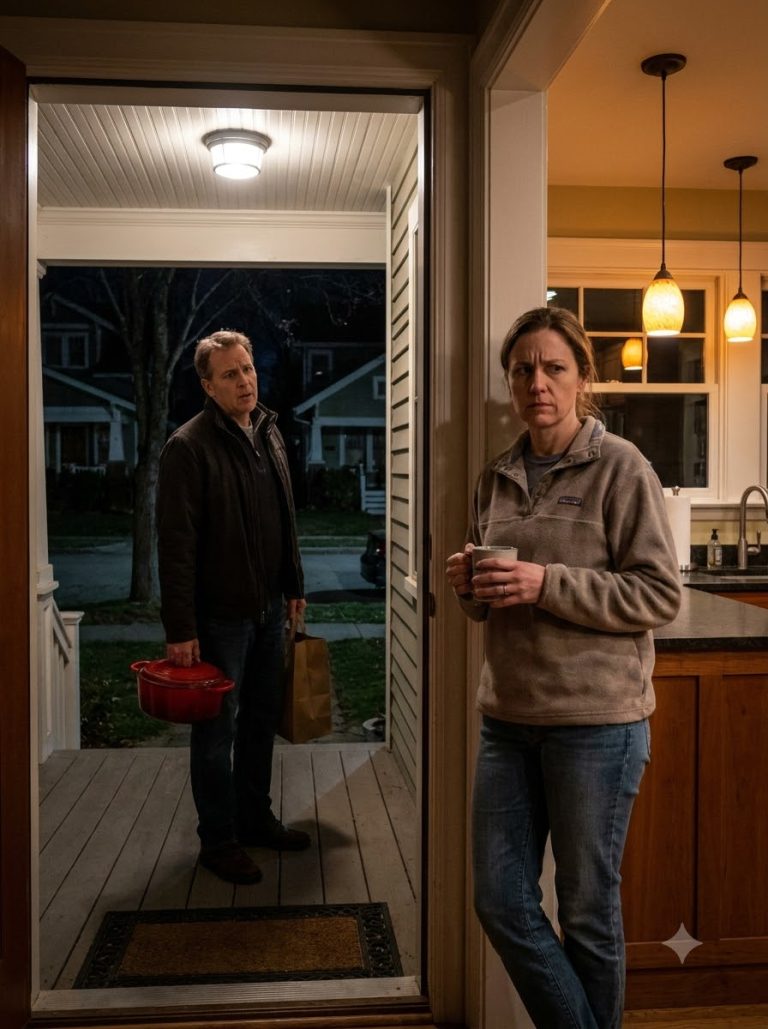
Three black SUVs, glass tinted, moving in formation behind a single squad car with its lights turning slow and silent. They came to a stop directly outside the house, engines idling, and for a full ten seconds nothing happened at all — just the low hum of expensive machinery and the neighbors, one by one, stepping onto porches they’d never used for anything but sweeping.
Then a door opened.
Richard Williams stepped out first — thinner than his photographs, one hand steadying briefly on the car door, but upright, dressed, unmistakably himself. Behind him, a small procession of aides and one visibly nervous member of hospital staff, and behind them, stepping out of the second vehicle with the particular stillness of a woman arriving somewhere she’d once left carrying nothing but a torn suitcase —
Tamsin.
Not in a cardigan. Not with tired hands. A woman the street didn’t recognize, and a woman it did, standing in the same body.
Bissi’s front door was already open. She hadn’t remembered opening it.
Richard Williams crossed the small distance between the car and the porch with the unhurried authority of a man who had never, in sixty-one years, had to explain himself to anyone twice.
“Mrs. Okafor.” His voice was courteous. It was also, unmistakably, not warm. “I understand my daughter spent some time under your roof.”
Bissi’s mouth opened. Nothing came out for a moment that stretched far longer than it should have.
“Mr. — Mr. Williams. I didn’t — we didn’t know—”
“No,” he said simply. “I understand you didn’t.”
He turned, and the look he gave his daughter was entirely different — soft in a way the street had never seen a billionaire’s face be soft, worry and pride tangled together as he took her hand.
“You look tired,” he said quietly, and it wasn’t an insult when he said it.
“I’m alright, Dad.”
“You’re not.” He said it gently. “But you will be.”
Behind them, the neighbors had gathered fully now, some filming, some simply staring, and in the middle of it all, Kembe stood frozen on the porch step, watching a woman she’d once handed a laundry list step out of a car with her father’s arm looped protectively through hers, understanding — fully, finally — exactly what her mother had spent six weeks failing to see.
Chapter 7 — What Sam Came Home To
Sam’s flight had landed four hours earlier than planned. He’d left the site in Abuja the moment the story broke on a colleague’s phone — a headline, a photograph, a name that didn’t match the one on his marriage certificate but a face that matched his wife’s exactly — and hadn’t stopped moving since.
He came around the corner on foot, having paid the taxi driver before the car had fully stopped, and took in the scene on his mother’s street in pieces that didn’t fit together at first: police lights turning slow and silent, three black SUVs, a small crowd of neighbors with their phones raised, and in the middle of it, his wife, standing beside a man he recognized only from magazine covers he’d never once connected to her.
“Tam—”
She turned at the sound of his voice, and something in her face broke open — not composure failing, but a woman finally allowed to stop holding a room together.
He crossed the distance between them fast, and for a moment neither of them said anything at all. He just held her, one hand at the back of her head, the way he used to when she’d had a bad day at a job that, he now understood, had never actually existed.
“You’re shaking,” he murmured.
“I’m fine.”
“You’re not.” He pulled back just enough to look at her. “Tam. Tamsin. Whoever you are — are you alright?”
“I’m alright now.”
Richard Williams watched the exchange with the careful attention of a man deciding, in real time, whether he approved of it. Whatever he saw in his daughter’s face when she looked at Sam — the loosening in her shoulders, the way she leaned into him without being asked — seemed to answer the question before he’d finished asking it of himself.
“You must be Samuel,” Richard said.
Sam straightened, some old instinct toward respect kicking in even through the fog of the last four hours.
“Sir. Yes. I — I didn’t know. Any of this. Until today.”
“I’m aware.” A pause, something almost like approval settling into the old man’s face. “My daughter chose to marry a man who loved her without knowing what she was worth on paper. That was the entire point of the exercise, as I understand it.” He glanced toward the house behind them, where Bissi still stood frozen in her own doorway. “It seems the exercise revealed more than she intended.”
Sam’s jaw tightened. He looked past Richard, toward his mother, and something in his expression — gentle by nature, but not now, not with this — hardened into something Tamsin had never seen on him before.
“Mom.” His voice carried across the small yard, flat and cold in a way that silenced the murmuring crowd. “Tell me it isn’t true. Tell me you didn’t have her doing housework at four in the morning.”
Bissi’s mouth worked without producing words.
“Sam, I didn’t know who she—”
“That’s not what I asked.” He took a step toward the porch. “I asked if it happened.”
Kembe, still frozen at her mother’s side, answered before Bissi could find her voice.
“It happened,” she said quietly. “All of it. I watched it happen and I didn’t stop it either.”
Sam closed his eyes for a second, absorbing it, and when he opened them again there was something exhausted and furious tangled together behind them.
“Eight months,” he said. “I left my wife with you for eight months because I thought you’d finally give her a chance. And you made her—” His voice cracked, the anger giving way underneath to something rawer. “You made her scrub your floors, Mom.”
“I didn’t know she was—”
“Would it have mattered if she wasn’t?” His voice rose now, the first time in the entire scene that it had. “If she really had been just some girl with no money, no name — would it have been alright then? To treat a person like that?”
The silence that followed had no comfortable place for Bissi to stand in.
She looked, for the first time since the SUVs had pulled up, entirely, visibly small.
“No,” she said finally, so quietly it barely carried. “It wouldn’t have.”
Chapter 8 — The Woman From Ajegunle
The crowd had begun to thin by the time Bissi found the strength to cross her own porch and step down into the yard — police lights switched off now, the SUVs idling at a respectful distance, Richard Williams having withdrawn to a nearby car to give the moment a privacy he seemed to understand it needed.
She stopped in front of Tamsin. Didn’t reach for her hand. Didn’t try to explain herself again, because every explanation she’d tried in the last hour had curdled in her own mouth before it finished leaving it.
“I owe you an apology,” she said instead. “Not because of who your father is. Because of what I did.”
Tamsin said nothing. Waited.
“Thirty years ago,” Bissi continued, and her voice had lost every trace of the authority it usually carried, “I married into a family that never let me forget where I came from. They called me the girl from Ajegunle behind my back for a decade before they said it to my face. I swore I would never again be the one without power in a room.” Her hands twisted together, the gold rings on her fingers catching the last of the evening light. “I told myself I was protecting my son. Making sure the woman he married wasn’t after something. But I think—” She stopped. Made herself finish it. “I think I just wanted, once, to be the one holding the whip instead of feeling it.”
“You didn’t just hold it,” Tamsin said quietly. “You used it.”
“I know.” Bissi’s composure finally broke, not loudly, but completely — the practiced stillness of thirty years cracking in a single, unguarded moment. “I know what I did, and knowing it doesn’t undo a single morning I made you kneel on that floor.”
She lowered herself, slowly, deliberately, onto her knees in the middle of the yard — a woman who had spent three decades refusing to be small, choosing now, publicly, in front of neighbors and police lights and her own daughter, to be exactly that.
“I’m not asking for your money or your forgiveness because of who you are,” Bissi said, looking up at her. “I’m asking because of what I did to a person I believed had nothing. That should never have mattered. It shouldn’t have needed to be this —” a small, broken gesture toward the cars, the crowd, the whole enormous unraveling of the evening “— for me to see what I’d already done.”
Sam moved to help his mother up. She waved him off, staying where she was, waiting.
Tamsin looked down at her for a long moment. She thought of a wedding dress folded on a hotel bed. Of a laundry room floor at 5:22 in the morning. Of her father’s hand, thin and papery, telling her don’t lose it protecting a name that was never the point.
She knelt too — not in submission, but level, so that when she spoke, it wasn’t from above.
“Get up,” she said. “Not because you’ve earned it yet. Because this isn’t where it gets fixed.”
Bissi’s eyes searched her face, uncertain.
“I’m not going to pretend the last six weeks didn’t happen,” Tamsin continued. “But I’m also not going to spend the rest of my life being the person who watched a woman kneel in her own front yard and called it justice.” She stood, offering a hand down. “You have a lot to prove. Start by getting up and looking Kembe in the eye. She tried to say something to you, back in that hallway, and you didn’t listen.”
Bissi took the offered hand. Let herself be pulled up.
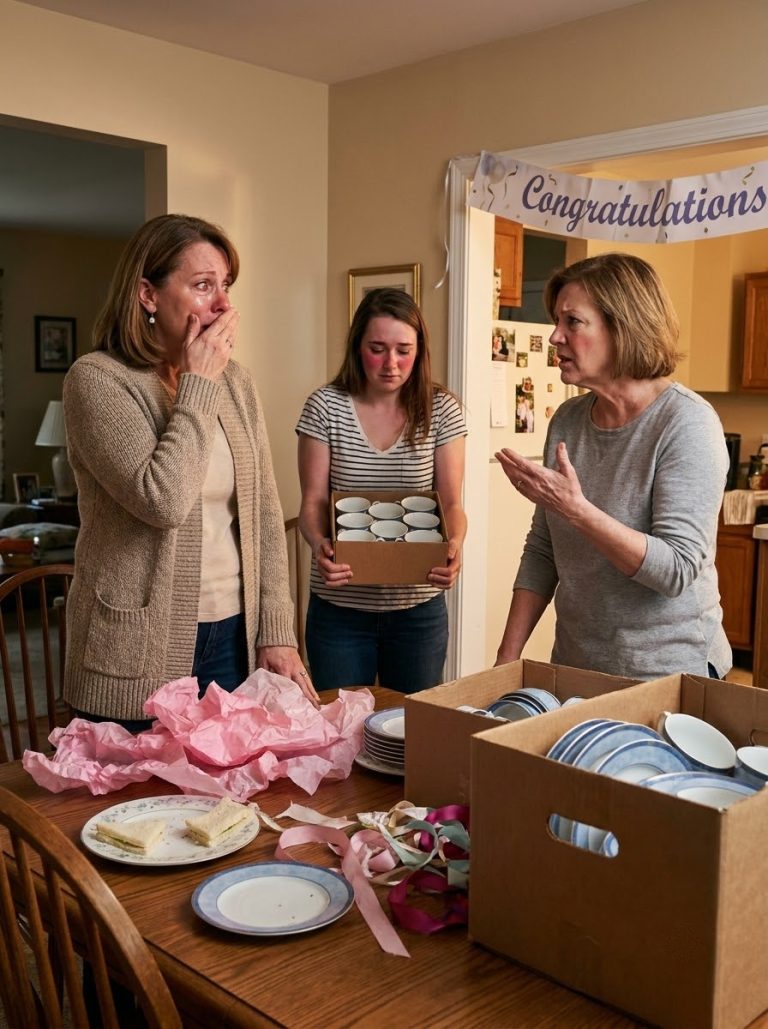
Kembe was already crying, quietly, on the porch step, and when her mother reached her, she didn’t pull away.
“I should have said something sooner,” Kembe whispered.
“You did say something,” Bissi answered, voice raw. “I just wasn’t ready to hear it.”
Chapter 9 — What Was Never About the Name
Three weeks later, Tamsin stood in an apartment that belonged to no one but her and Sam — small, by Williams standards, two bedrooms and a kitchen window that looked out over rooftops instead of a corporate skyline, chosen deliberately, the way everything in her life now was chosen deliberately instead of inherited.
Sam was in the doorway, unpacking the last box, when he found it — a folded wedding dress at the bottom, tissue paper gone soft with age, the one she’d never worn the first time around.
“What’s this?”
“A reminder.” She crossed the room, took it from his hands, held it a moment. “Of the last time I let someone else decide what my worth was.”
“You want to get rid of it?”
She considered the dress — not with grief anymore, she realized. With something closer to distance. A closed door, finally, instead of a locked one.
“No,” she said. “I want to keep it. So I remember what almost happened, and what didn’t.”
They’d moved out of Bissi’s house the same week the story broke — not out of anger, not entirely, but because Sam had said something in the car on the drive back from the hospital that stuck with her: We can’t build something honest standing in the middle of what almost broke it. Bissi hadn’t fought them on it. She’d shown up instead, the following Sunday, with a pot of stew and an offer to help paint the second bedroom, and Tamsin had let her stay for dinner, though not, not yet, for anything longer than that.
Trust, she’d learned, didn’t rebuild itself on an apology alone. It rebuilt itself in small, repeated, unglamorous proof — the way love had, the first time, in a hardware store parking lot with a man who’d never once asked what her last name was worth.
Richard Williams had recovered enough, by then, to attend the small housewarming Tamsin insisted on keeping quiet — no press, no cameras, just family, in the loosest and truest sense of the word. He’d stood at the kitchen window with a glass of something non-alcoholic his doctor had approved, watching his daughter laugh at something Sam said, watching Kembe help Bissi carry dishes to the table without being asked.
“You did the hard part right,” he told Tamsin quietly, when she came to stand beside him.
“Which part was that?”
“You let people show you who they were.” He looked at her, something proud and worn in his face at once. “And when some of them turned out to be more than their worst moment, you let them prove it. That’s harder than hiding. It always was.”
Outside, evening had settled soft and gold over the rooftops, the kind of light that made even ordinary things — a folded dress in a closet, a pot of stew cooling on a counter, a family gathered imperfectly around a table too small for all of them — look like something worth staying for.
Tamsin stood at the window a moment longer after her father moved back toward the table, watching the last of the light catch the edge of a laundry basket she’d kept, half as a joke, sitting empty now by the door — a small, deliberate reminder of every version of herself it had taken to get here.
She didn’t need it anymore. She kept it anyway.
Some things were worth remembering exactly as they were.